
The use of artificial intelligence (AI) presents opportunities for local governments to accelerate digital transformation and improve the quality of public services. However, its implementation also poses challenges, ranging from infrastructure readiness to data integration and governance.
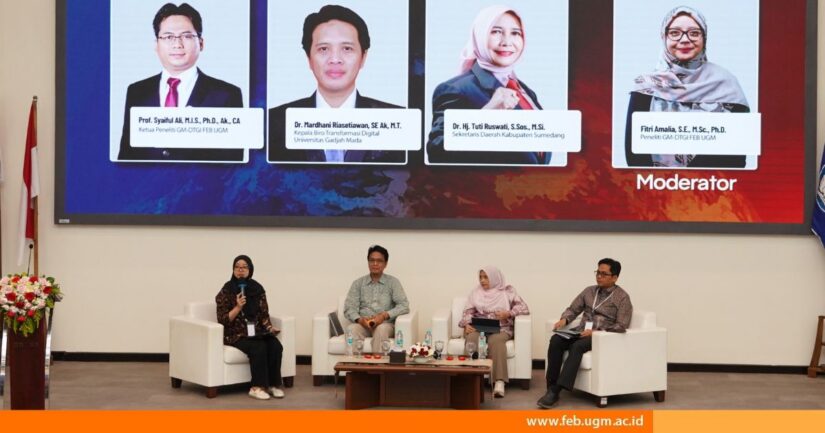
Head of the Digital Transformation Bureau at Universitas Gadjah Mada (UGM), Dr. Mardhani Riasetiawan, M.T., emphasized that governments need to improve their business processes before adopting AI technology. According to him, digital transformation is not merely about replacing conventional systems with new technologies but also about ensuring that work processes and governance are well structured.
Mardhani highlighted several challenges that governments continue to face, including fragmented information systems, limited data integration, regulatory changes, and the sustainability of digital projects. These issues may hinder the effective use of technology if they are not addressed from the early stages of digital transformation.
“Do not rush into implementing technology. There is a transition period in digital transformation that must be undertaken,” Mardhani emphasized during Panel Discussion 1 of GM-DTGI 2026, titled “Artificial Intelligence for Local Governments: Accelerating Digital Transformation and Improvement Amid Opportunities and Challenges.” The event was organized by the Information Systems Research Group of the Faculty of Economics and Business, Universitas Gadjah Mada (FEB UGM), at the Sukadji Ranuwihardjo Auditorium of the Master of Management Program, FEB UGM, on November 5, 2026.
These challenges are also reflected in the experience of the Sumedang Regency Government in developing data-driven and technology-based public services. Regional Secretary of Sumedang Regency, Dr. Hj. Tuti Ruswati, S.Sos., M.Si., explained that digital innovations developed in the region have attracted interest from 280 regencies and cities across Indonesia. However, the success of an innovation does not necessarily mean that it can be easily replicated in other regions.
According to Tuti, replicating innovations requires commitment and consistency from local governments, including the ability to integrate data down to the village level. Coordination and mobilization among stakeholders are essential to ensuring the long-term sustainability of these innovations.
“There are other aspects that require extraordinary consistency, commitment, mobilization, and orchestration to make this happen,” Tuti stated.
Head of the Gadjah Mada Digital Transformation Governance Index (GM-DTGI) Research Team at FEB UGM, Prof. Syaiful Ali, S.E., M.I.S., Ph.D., Ak., CA., highlighted AI’s potential to enhance the effectiveness of public services and support government decision-making. Its applications range from administrative automation to data analysis that informs policymaking.
He cited an example of AI being used at UGM to assess the economic circumstances of prospective students’ families, providing input to determine their Single Tuition Fee (Uang Kuliah Tunggal/UKT) rates. This application demonstrates the potential of AI to support data analysis and enable more targeted decision-making.
Nevertheless, Syaiful Ali cautioned that the quality of AI-generated analysis depends heavily on the quality of the underlying data. Inaccurate or incomplete data may lead to misleading recommendations. Therefore, decisions that directly affect the public must remain subject to human oversight and judgment.
“If the data is problematic, inaccurate, or incomplete, AI will only amplify the problems,” he remarked.
Reporter: Najwa Anggi Namira
Editor: Kurnia Ekaptiningrum
Sustainable Development Goals