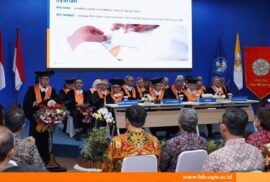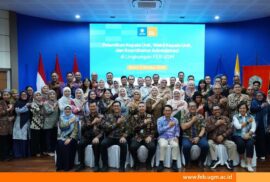
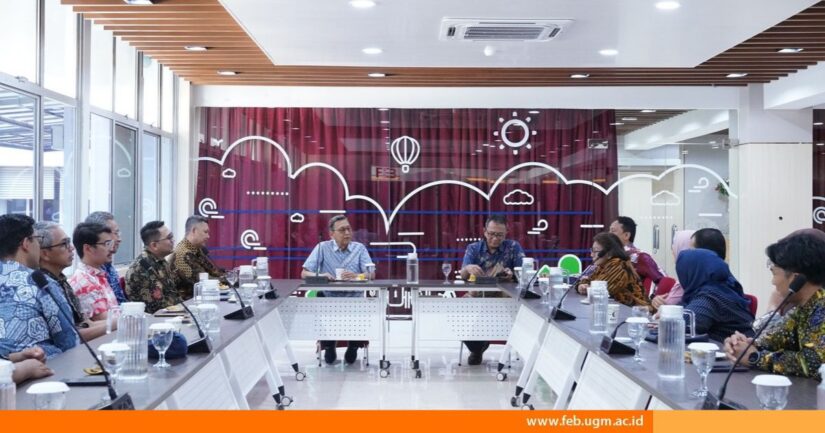
Former Vice President of the Republic of Indonesia for the 2009–2014 period and Professor Emeritus at the Faculty of Economics and Business, Universitas Gadjah Mada (FEB UGM), Prof. Dr. Boediono, has encouraged FEB UGM to develop leaders who not only possess strong academic knowledge but also demonstrate integrity, the courage to make decisions, particularly during times of crisis, and wisdom. He conveyed this message during his visit to FEB UGM on Tuesday (October 6) to discuss with lecturers from the Department of Economics and the faculty leadership.
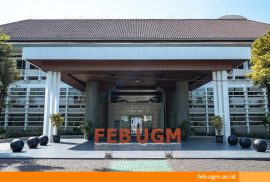
During the visit, Prof. Boediono expressed his admiration for the significant progress FEB UGM has made in developing its facilities and infrastructure. He emphasized that physical development should be accompanied by substantive improvements in education, particularly in the curriculum.
In this regard, and amid current economic dynamics, Prof. Boediono reiterated a message from his book, Indonesian Economy: Through the Lens of History (Ekonomi Indonesia: Dalam Lintasan Sejarah), which he also shared upon receiving the Lifetime Achievement Award from CNBC in 2025: “History offers lessons to those willing to learn from it, and from those lessons, wisdom grows.”
Prof. Boediono further explained how Indonesia achieved remarkable economic progress and earned international recognition for nearly three decades during President Soeharto’s administration. The key, he noted, lay in political leaders who listened to the advice of economic technocrats and ensured coordination across sectors.
Drawing lessons from past economic crises, Prof. Boediono reminded the audience that crises can originate from both domestic and international sources. While Indonesia has limited control over crises originating abroad, it can strengthen its domestic economic resilience to withstand external shocks better.
During a crisis, such as the 2008 global financial crisis, leaders must make decisions in Indonesia to prevent the situation from escalating. Such decisions often need to be made despite incomplete information. However, failing to act can have costly consequences for the economy.
Unlike normal circumstances, every passing hour during a crisis can significantly affect the nation’s economic future. Yet once decisions have been made and the economy has weathered the crisis, people sometimes forget the severity of the situation, as though it had never occurred.
Dean of FEB UGM, Bayu Sutikno, S.E., M.S.M., Ph.D., warmly welcomed Prof. Boediono’s presence on campus. His visit held special significance, as FEB UGM has played an important role in his academic journey and public service. For Prof. Boediono, UGM is also a place he considers home for the rest of his life.
Bayu noted that Prof. Boediono’s visit provided a valuable opportunity for FEB UGM to gain insights from his extensive experience in government, including his service as Minister of National Development Planning and Head of the National Development Planning Agency (Bappenas), Minister of Finance, Coordinating Minister for Economic Affairs, Governor of Bank Indonesia, and Vice President of the Republic of Indonesia.
“His insights, grounded in a distinguished career and profound wisdom, are a great source of inspiration for us to continue advancing and creating a positive impact on society,” Bayu explained.
The discussion unfolded in a relaxed and cordial atmosphere. During the conversation, Prof. Boediono also reminisced about his experiences with fellow FEB UGM lecturers and recalled how Prof. Sukadji had invited him to teach at UGM. He was later recruited by the Minister of Finance, Prof. J.B. Sumarlin, through Adrianus Mooy, following a recommendation from Prof. Widjojo Nitisastro, who had been impressed by Prof. Boediono’s article published in the daily newspaper Kompas.
“With his composed and unassuming manner, Prof. Boediono listened attentively and shared his experiences with lecturers from different generations, creating a warm and meaningful space for dialogue,” he said.
Report: Kurnia Ekaptiningrum
Sustainable Development Goals