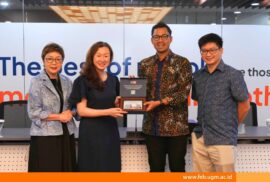

The Faculty of Economics and Business, Universitas Gadjah Mada (FEB UGM), shared its experience in developing a framework to assess the implementation of sustainability principles in higher education institutions, particularly business schools, during the 14th Congress of the Association of Indonesian Faculties of Economics and Business (AFEBI). The best practices were presented by Ahmad Zaki, S.E., M.Acc., Ph.D., Head of the Sustainability and Strategic Initiatives Unit (SSIU) at FEB UGM, during the AFEBI XIV Academic Enrichment Forum held at Le Polonia Hotel & Convention in Medan on Thursday (November 5).
During the forum, Ahmad Zaki introduced the Sustainable Business School Framework (SBSF), developed by FEB UGM to assess and promote the integration of sustainability principles in business schools, particularly in education, research, and community service.
“The SBSF is designed to help business schools integrate sustainability principles into their institutional strategies and activities,” he explained on Thursday (November 5).
The framework maps sustainability practices across the institution’s value chain based on Environmental, Social, and institutional ESG aspects. Its development also refers to the Global Reporting Initiative (GRI) standards and the Sustainable Development Goals (SDGs).
Ahmad Zaki explained that implementing sustainability principles requires performance measurement and the integration of indicators into the core activities of higher education institutions. The SBSF adopts a value chain approach that considers the three pillars of higher education: education, research, and community service.
The development of the SBSF at FEB UGM has undergone several stages, including internal conceptualization, framework and indicator development, expert reviews, pilot implementation, and the development of artificial intelligence (AI)-based tools to support assessment and reporting processes.
Ahmad Zaki also revealed that FEB UGM has prepared a Sustainability Report documenting the faculty’s journey in integrating sustainability principles into various aspects of its institutional operations. The 2025 Sustainability Report highlights several indicators, including the integration of sustainability-related courses and learning materials, SDG-related research publications, community service programs, and campus resource and environmental management.
“FEB UGM has integrated more than 20 sustainability-related courses, produced 124 research publications addressing SDG-related topics, and implemented 482 sustainability-related community service programs involving students,” he elaborated.
Ahmad Zaki added that FEB UGM has developed more than 80 Massive Open Online Course (MOOC) learning materials aligned with the Sustainable Development Goals (SDGs). In research, 93.62 percent of research funding has been allocated to sustainability-related studies. FEB UGM has also produced 124 research outputs addressing SDG-related issues and 32 multidisciplinary outputs through cross-faculty and cross-departmental collaborations.
This commitment is further reflected in student involvement in various initiatives. Student organizations have organized 28 sustainability-related activities. Meanwhile, FEB UGM’s community service programs have reached 34 provinces across Indonesia.
The 14th AFEBI Congress was organized by the Association of Indonesian Faculties of Economics and Business, with Universitas Islam Negeri Sumatera Utara serving as the host institution. Under the theme “Reconstructing National Strategic Policy Directions to Accelerate Sustainable Regional Economic Growth,” the event brought together academics and stakeholders from various institutions through a series of academic forums and strategic discussions.
Reported by: Kurnia Ekaptiningrum
Sustainable Development Goals