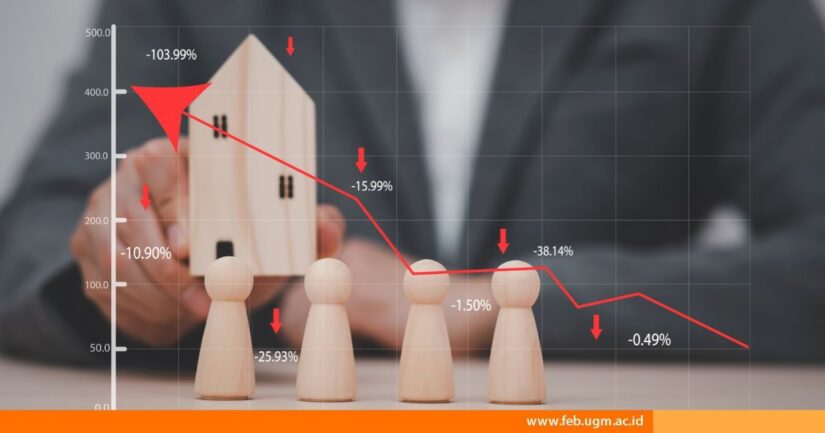
Indonesia’s Gross Domestic Product (GDP) grew by 5.47 percent year-on-year (YoY) in the third quarter of 2026. Economist at the Faculty of Economics and Business, Universitas Gadjah Mada (FEB UGM), Denni Puspa Purbasari, Ph.D., described the figure as unexpectedly high, particularly as several economic indicators suggest mounting pressure on purchasing power and household consumption.
“In the third quarter, household consumption expenditure grew by 5.04 percent, while consumer credit growth in September 2026 reached only 4.86 percent year-on-year, compared to 7.3 percent in the previous year,” she explained on Thursday (October 12).
Denni also pointed to anomalies in the relationship between household consumption growth, consumer confidence, and retail sales. Household consumption accounted for 51.97 percent of Indonesia’s GDP in the third quarter of 2026.
Pressure on purchasing power was also reflected in wage growth and inflation. In August 2026, nominal wages for workers and employees increased by 2.7 percent year-on-year. Meanwhile, inflation reached 3.2 percent, with food inflation climbing to 5 percent.

“This means that real wages have declined, which should put pressure on consumption, particularly among lower- and middle-income households,” explained the lecturer from FEB UGM’s Department of Economics.
Denni added that household consumption could also face pressure from the 29 percent decline in the Jakarta Composite Index (JCI) between January and September 2026. For upper-middle-income households investing in the capital market, the decline in portfolio values could trigger a negative wealth effect, prompting households to reduce their spending.
Furthermore, rising interest rates may encourage individuals with surplus funds to postpone consumption and shift their money into savings accounts, time deposits, or bonds offering higher returns. Economic uncertainty may also increase households’ tendency to save as a precautionary measure.
“The increase in Pertamax fuel prices in mid-June 2026 was another factor that should have put pressure on consumption among upper-middle-income households in the third quarter,” she explained.
On the other hand, Denni noted that the Free Nutritious Meals (MBG) program and the Red and White Village/Subdistrict Cooperatives (KDMP) program have contributed to investment growth and government expenditure. From a sectoral perspective, both programs have also supported strong growth in the accommodation and food service activities sector and the construction sector, which expanded by 11.22 percent and 6.42 percent, respectively, in the third quarter of 2026.
Reported by: Kurnia Ekaptiningrum
Sustainable Development Goals