The increasing vulnerability among the non-poor has emerged as a new challenge for Indonesian society today. At the same time, the middle class continues to shrink, and demographic pressures from an aging population are intensifying. These conditions underscore the urgency of transforming Indonesia’s social protection system from merely functioning as a safety net into a driver of long-term growth.
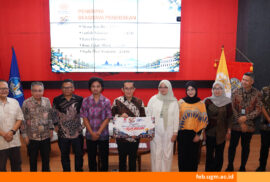
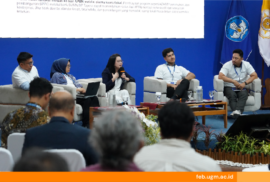
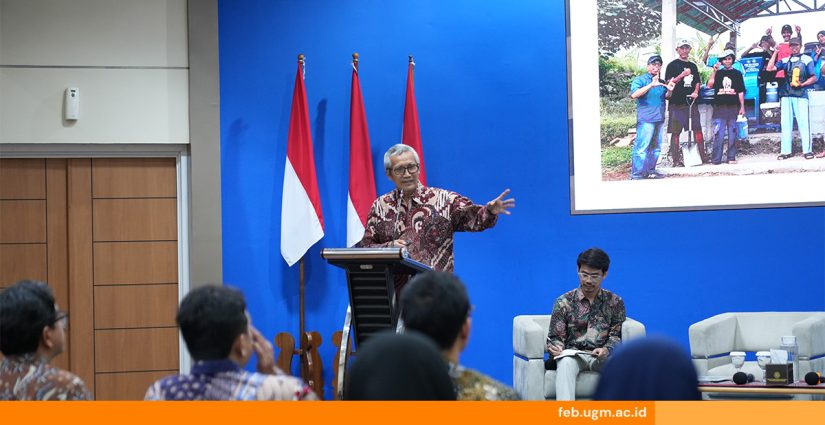
This issue was highlighted at the Mubyarto Public Policy Forum 2025, organized by FEB UGM and the Australian National University (ANU), carrying the theme “Poverty and Welfare Reform in Indonesia” on October 24, 2025, at FEB UGM. The forum featured Dr. Sudarno Sumarto (The SMERU Research Institute), Dr. Elan Satriawan (FEB UGM), and Dr. Putu Geniki Lavinia Natih (FEB UI) as speakers.
In his presentation titled “From Safety Net to Springboard for Growth: Transforming Social Protection for Indonesia’s Future,” Sudarno Sumarto emphasized that actual development does not solely rely on economic growth but also on the state’s ability to lift people out of poverty and invest in human potential. He recalled Prof. Mubyarto’s philosophy in designing the Inpres Desa Tertinggal (IDT) program, which directly targeted poor households and stimulated local economic activity.
Sudarno also highlighted a range of current challenges—from declining poverty rates that mask persistent vulnerability, the risk of unsustainable social insurance, complex cross-agency coordination, to demographic and structural pressures. According to him, Indonesia’s social protection system must evolve into an instrument that boosts labor productivity, economic resilience, and social cohesion—not merely a tool for poverty alleviation.
“It is time for social protection to function not only as a safety net but also as a springboard for growth. To achieve Vision 2045, Indonesia must transform its social protection system into a universal, sustainable, and adaptive platform that supports citizens at every stage of life while ensuring financial sustainability and broader coverage,” he explained.
Elan Satriawan expressed a similar view. According to him, Indonesia’s primary challenge is no longer simply poverty but the growing vulnerability of the non-poor, including the middle class. Therefore, social protection must become a strategic tool to address these emerging issues.
He outlined that Indonesia needs to establish a life-cycle–based social protection mission built upon four pillars: non-contributory social assistance, contributory social insurance, access to livelihoods and decent work, and adaptive social protection for disaster response.
“These four pillars position social protection as both a protective and a promotive instrument,” he noted.
To achieve these goals, Elan emphasized the importance of addressing fundamental national issues, including mistargeting, limited coverage of vulnerable groups, unsustainable financing, stunting, low educational levels, and weak linkages between livelihood programs and employment opportunities.
Putu Geniki Lavinia Natih underlined the importance of a people-centered Indonesian economy that is responsive to real societal needs.
“We need to recognize the economy of real life. Economics can help us understand real-life conditions, people’s struggles, and the urgent need for evidence-based policies,” she stated.
Putu also highlighted a key finding that Indonesia ranks as the second most vulnerable country in the world, after the Philippines, according to the World Risk Index 2023. This finding further reinforces the urgency of adaptive, inclusive, and evidence-based social protection.
“Adaptive social protection helps build the resilience of poor and vulnerable households by strengthening their capacity to anticipate, withstand, and adapt to shocks,” she explained.
Reporter: Shofi Hawa Anjani
Editor: Kurnia Ekaptiningrum
Sustainable Development Goals