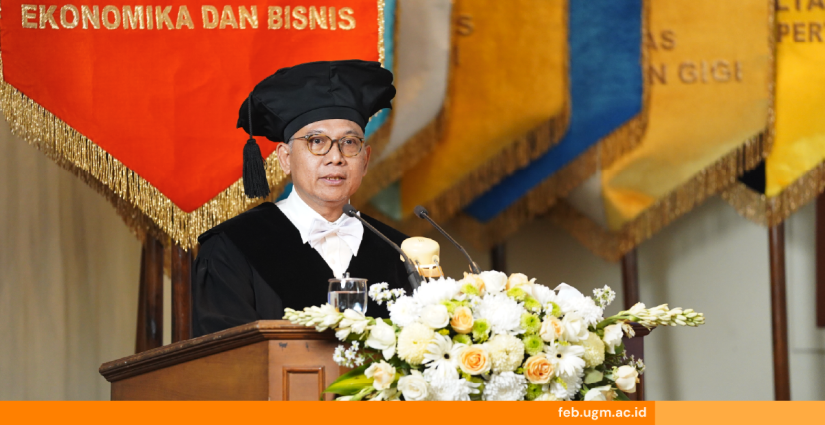
Prof. Amin Wibowo, S.E., MBA., Ph.D., Lecturer at the Department of Management, Faculty of Economics and Business, Universitas Gadjah Mada (FEB UGM), was officially inaugurated as a professor in the field of Management Science. Delivering his inauguration speech on Thursday (11/12/2025) at the UGM Senate Hall, entitled ‘The Challenge of Building Sustainable Leadership for Millennials and Generation Z’, he emphasized the importance of sustainability-oriented leadership as a strategic necessity amid the younger generation’s dominance of Indonesia’s workforce.
“Sustainability is no longer merely a moral choice, but a strategic necessity in modern leadership,” he asserted on Thursday (11/12) at the UGM Senate Hall.
Amin stated that Millennials and Generation Z now comprise the largest portion of the workforce. By 2025, Indonesia is expected to have approximately 149 million workers, with the largest demographic composition comprising Millennials (52.06 million) and Generation Z (33.92 million).
“Millennials and Generation Z bring new values in the form of environmental awareness, inclusiveness, and collective welfare,” he said.
Millennials and Generation Z have different characteristics shaped by their unique experiences and cultural contexts. They are highly skilled in digital matters from a young age. They also possess distinctive characteristics that distinguish them from previous generations. Their main characteristics are that they are more socially conscious, prioritize work-life balance, place greater emphasis on social justice, representation, and inclusivity, are very concerned about sustainability, and demand accountability from brands, companies, and governments.
“As a result, they expect modern leaders to have a style that accommodates their characteristics. For them, modern leaders who prioritize sustainable strategies act as resource managers, adopting a leadership style that focuses on team member and community engagement and empowerment to create positive change,” he explained.
Amin mentioned that leaders in the current era must integrate environmental, social, and governance (ESG) principles into organizational strategies. Sustainability encompasses a balance between economic viability, social justice, and ecological preservation, all of which must be part of the vision and practice of future leadership.
Sustainable leadership also requires transformation at the individual and institutional levels. Leaders need to develop empathetic, visionary, and systemic thinking characteristics to inspire and drive organizations towards positive change.
“Therefore, the academic world plays a major role through its curriculum, learning, and strategic networks in shaping future leaders who have an awareness of sustainability, especially in business schools where there is still minimal intervention in the sustainability curriculum,” he explained.
According to him, strengthening sustainable leadership in Indonesia requires cross-sector collaboration between the government, the business world, academics, and civil society. Public-private partnerships, green technology, team member education, transparency, and support for sustainable SMEs are concrete steps towards a resilient future.
“Modern leaders must be able to balance profit with social and environmental responsibility, as well as foster an adaptive, inclusive, and future-oriented organizational culture. Thus, millennials and Generation Z are not only part of the change, but also the main drivers of sustainable leadership in Indonesia,” he concluded.
Report: Kurnia Ekaptiningrum
Sustainable Development Goals (SDGs)