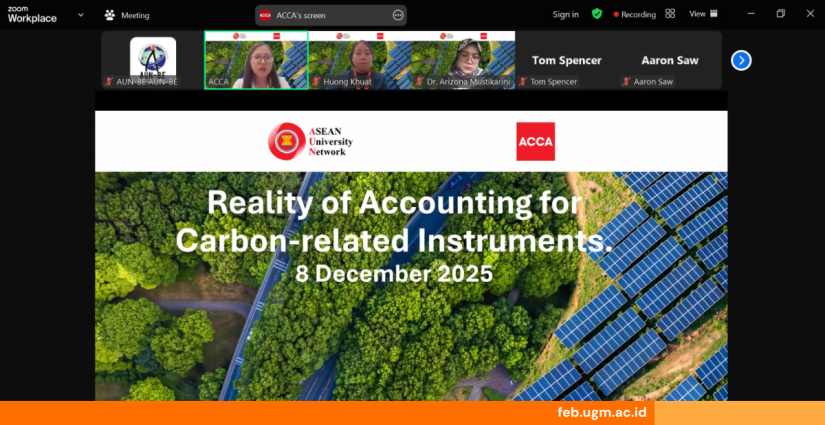
In a strategic collaboration to bridge the gap between environmental theory and financial practice, the Association of Chartered Certified Accountants (ACCA) and the ASEAN University Network on Business and Economics (AUN-BE) successfully hosted a high-level webinar titled “Reality of Accounting for Carbon-Related Instruments” in early December 2025. The webinar session addressed the urgent need for organizations to master the financial treatment of carbon assets amidst rapidly expanding global sustainability reporting mandates.
The event was officially opened by Dr. Arizona Mustikarini, Executive Secretary of AUN-BE, who emphasized the transformative role of accounting in addressing modern sustainability challenges. In her opening remarks, Dr. Arizona Mustikarini highlighted the critical importance of carbon-related instruments and the need for the accounting profession to evolve to ensure transparency and strategic compliance in an increasingly green economy.
The keynote presentation was delivered by Aaron Saw, Subject Manager (Corporate Reporting), Sustainable Business, ACCA, who shared groundbreaking research conducted in collaboration with Adam Smith Business School, University of Glasgow. The webinar attracted 71 participants from across the ASEAN region, including representatives from Vietnam, Indonesia, Thailand, Myanmar, and the Philippines.
During the session, Aaron Saw elucidated why carbon-related instruments have become a vital concern for modern business leaders. Aaron Saw mentioned that, as government-allocated free credits dwindle over time, companies are increasingly forced to source these instruments from the open market. This shift not only adds to the immediate cost of doing business but also introduces long-term financial risks as market prices are projected to rise.
The webinar concluded with a strong call to action: companies must engage deeply with key stakeholders and employees before integrating carbon instruments into their broader emission-reduction strategies. Furthermore, the urgent need for upskilling—urging accountants, finance professionals, and those in governance to sharpen their expertise. This specialized knowledge is essential for navigating complex carbon markets, selecting credible instruments, and facilitating effective, data-driven decision-making.
Reportage by: Global Relations and Mobility Office (GREAT)
Sustainable Development Goals