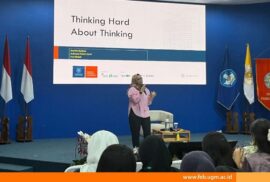
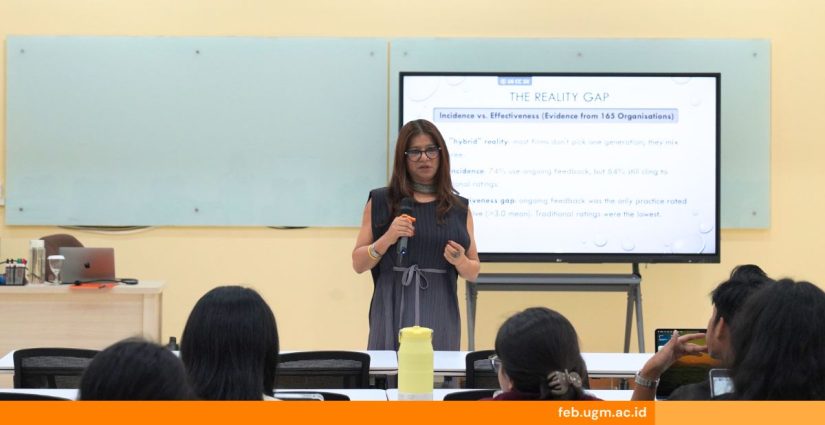
The Faculty of Economics and Business (FEB) UGM once again held a guest lecture as part of its efforts to strengthen students’ global perspectives. FEB UGM presented Dr. Anjali Chettri, Research Officer, University of Sydney, who delivered a presentation entitled Organizational Behavior: Performance Management System in Practice on Wednesday, April 1, 2026. This agenda also continued the series of guest lectures, which previously featured Prem Chettri, Professor of logistics and supply chain management at RMIT University in Australia, on Tuesday, March 31, 2026.
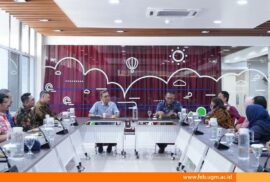
This activity was not only filled with material presentations, but also complemented by group discussion sessions. Students were divided into groups to discuss performance management practices in organizations.
In her presentation, Anjali Chettri highlighted the gap between commonly used performance management practices and their effectiveness in the field. She explained that many organizations do not fully adopt a particular approach, but instead combine various existing methods. This phenomenon is known as the reality gap, in which the most frequently used practices are not necessarily the most effective at improving team member performance.
She further explained that although the ongoing feedback approach is considered more effective at driving performance improvement, many organizations still use traditional methods, such as annual ratings, because they are more practical and easier to implement. She also outlined the evolution of performance management practices, divided into three phases: the traditional top-down approach, the transitional phase marked by the implementation of 360-degree feedback, and the modern approach emphasizing continuous feedback and coaching.
Anjali also discussed the impact of the COVID-19 pandemic on changes in performance management practices in organizations. The shift to remote work has driven greater use of technology in performance monitoring and evaluation processes. This situation has given rise to the tracking paradox, in which increased technology use not only strengthens the coaching process but also expands digital supervision practices.
On the other hand, reduced face-to-face interactions have also created challenges in building trust (a trust gap) between managers and employees. Discussions between students and lecturers were interactive, with students actively participating in question-and-answer sessions and expressing critical views. Through this activity, students should not only understand the theoretical concept of performance management but also be able to relate it to real-world practices.
Reporting by: Dwi Zhafirah Meiliani
Editor: Kurnia Ekaptiningrum
Sustainable Development Goals