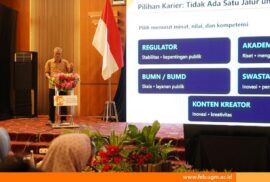

Plagiarism is a serious issue that frequently occurs in academic settings, even unintentionally, and is often committed by writers. Recognizing the importance of students’ understanding of this issue, the Career and Student Development Unit (CSDU) of the Faculty of Economics and Business, Universitas Gadjah Mada (FEB UGM), organized a Mandatory Soft Skills session on Antiplagiarism on Friday, April 24, 2026, at FEB UGM.
A lecturer from the Management Study Program, Naya Hapsari, S.E., M.Sc., Ph.D., outlined several factors that commonly contribute to plagiarism. These include limited writing skills, difficulty in evaluating online sources, and confusion in citation and referencing practices. In addition, time pressure and a lack of awareness of plagiarism in academic environments also play a role and must be carefully addressed.
Naya emphasized the importance of viewing writing as a process rather than a one-step task. This process consists of three stages: planning, which involves organizing ideas; drafting, where ideas are gradually developed into writing; and revising, which focuses on continuously improving the work. The expected outcome of following these stages is better-quality writing and fewer instances of plagiarism.
Regarding the use of artificial intelligence (AI), Naya does not prohibit students from utilizing it, but with an important caveat.
“AI is a tool, not a writer. Use it for brainstorming and organizing ideas, not for directly copying its output,” she stressed.
To avoid plagiarism, Naya introduced three main strategies: direct quotation, paraphrasing, and synthesis. Mastery of these strategies is essential not only to prevent plagiarism but also to help students produce academic writing that reflects their own understanding and critical thinking.
“The better you are at paraphrasing and synthesizing, the more it shows that you truly understand the topic and can transform others’ ideas into your own intellectual contribution,” she explained.
Naya also reminded students that the consequences of plagiarism are severe and long-lasting. In academic contexts, sanctions may range from failing a course and grade cancellation to dismissal. Academic degrees may even be revoked if plagiarism is discovered in previously published work, regardless of how much time has passed.
“Integrity is the foundation. Do not let mistakes, even unintentional ones, compromise it,” Naya concluded.
This initiative aligns with FEB UGM’s core values, which uphold integrity and professionalism in all academic activities. Naya hopes that FEB UGM students will become more aware and consistently apply principles of academic integrity in their daily assignments, as well as in their final theses and other scholarly works in the future.
Report: Dwi Zhafirah Meiliani
Editor: Kurnia Ekaptiningrum
Sustainable Development Goals