The Faculty of Economics and Business at Gadjah Mada University (FEB UGM) will host the 11th National Seminar and Annual Meeting of the Association of Economics Program Directors throughout Indonesia (APSEPI), to be held on July 9–11, 2026. Under the theme “Developing Economics Programs to Produce Independent and Globally Competitive Graduates,” this event will bring together program directors from various levels, undergraduate (S1), master’s (S2), and doctoral (S3), as well as faculty members and economics scholars from public and private universities across Indonesia.
The holding of this annual seminar and meeting serves as a strategic opportunity to strengthen collaboration among Economics Program administrators in addressing various challenges in higher education, ranging from changes in accreditation policies and the strengthening of Outcome-Based Education (OBE)-based curricula to enhancing the competitiveness of graduates at both the national and global levels. In addition, this forum serves as a platform for sharing best practices, presenting research findings, and expanding collaborative networks in implementing the three pillars of higher education.
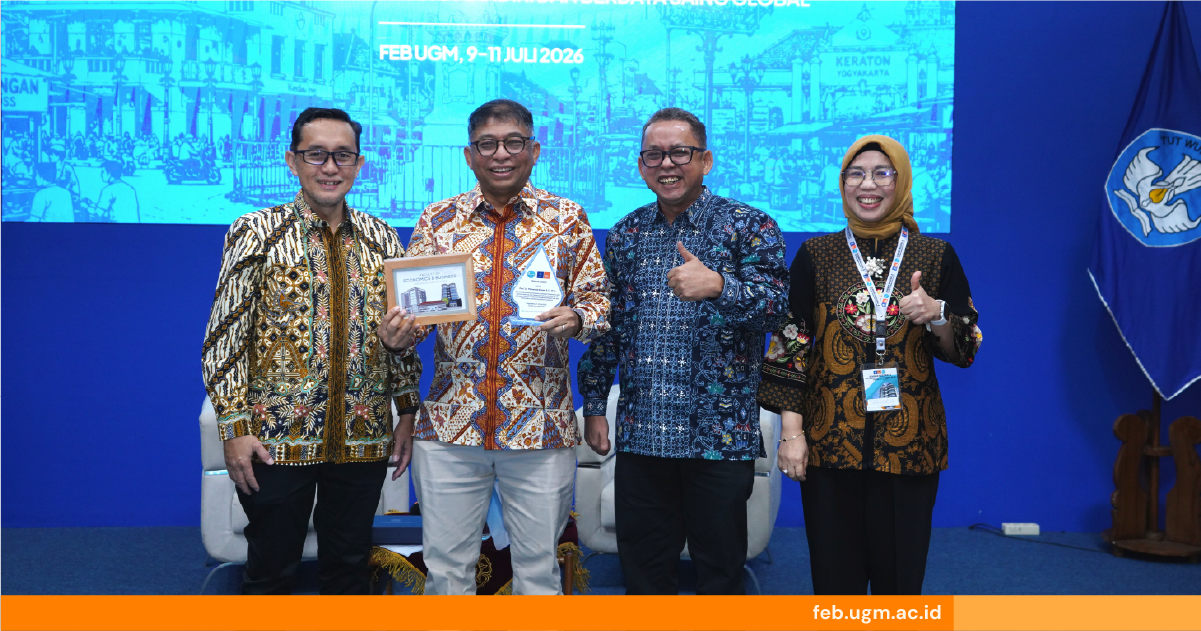
The Dean of the Faculty of Economics and Business at UGM, Prof. Dr. Didi Achjari, M.Com., Ak., CA., stated that the world of higher education is undergoing rapid change. The need to implement Outcome-Based Education (OBE), digitalization, artificial intelligence, the demands of an increasingly dynamic job market, global geopolitical shifts, and the need for sustainable development require us to adapt continually. Amid these changes, the Economics Program must not only produce graduates who understand theory but also cultivate individuals who are critical thinkers, adaptable, innovative, of high integrity, and capable of devising solutions to various economic and social challenges.
“Through APSEPI, I hope to see the emergence of various collaborative initiatives, whether in the development of an Outcome-Based Education curriculum, improving accreditation, exchanging academic resources, conducting joint research, or developing the competencies of faculty and students,” he said.
Didi added that since its inception, UGM has been driven by a spirit of service to the nation. In line with this value, the Faculty of Economics and Business (FEB) at UGM is committed to continuing its role in collective efforts to advance the quality of economics education in Indonesia. Therefore, he hopes this meeting will serve as an open forum for discussion, a mutually enriching learning environment, and a space for collaboration that yields concrete steps toward advancing economics programs in Indonesia.
Meanwhile, APSEPI Chair Dr. Fajri Muhraja, S.E., M.Si., said that APSEPI serves as a forum for fostering communication among economics-based study programs in Indonesia. APSEPI aims to ensure quality parity among economics-based study programs, particularly in terms of curriculum, faculty, research, community service, and collaboration.
“APSEPI serves as the driving force in curriculum development. Therefore, our focus is on addressing various academic issues that need to be standardized,” he said.
One of the initiatives promoted by APSEPI is the development of minimum competency standards for core courses, such as microeconomics, macroeconomics, and quantitative methods. These standards are expected to serve as a common reference for the 107 study programs that are members of APSEPI.
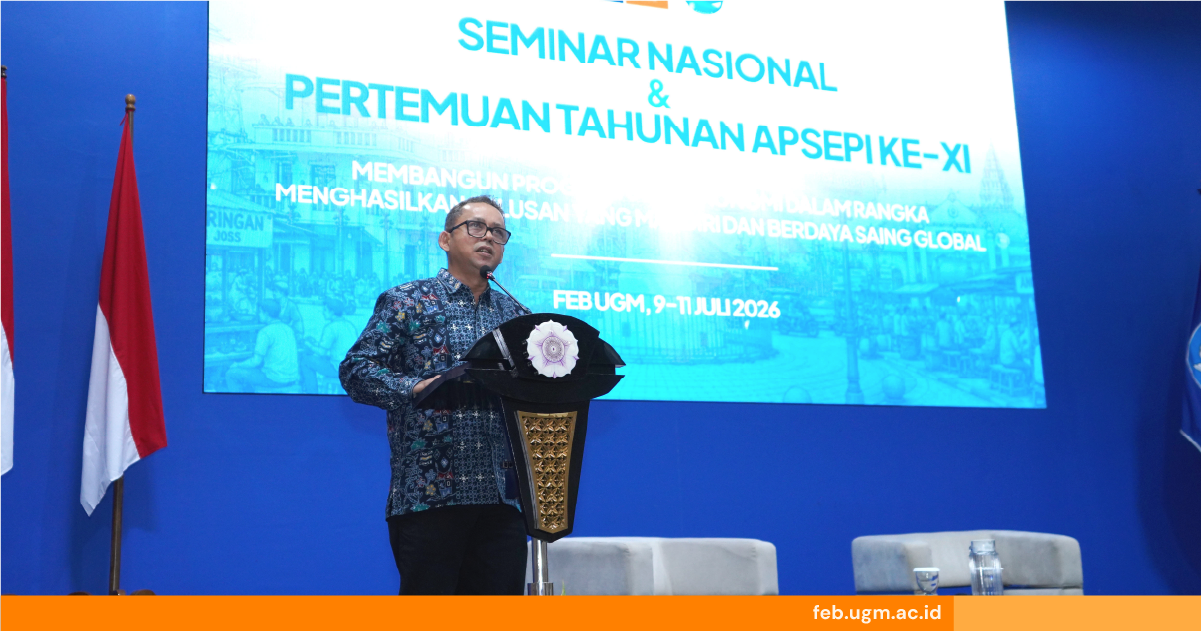
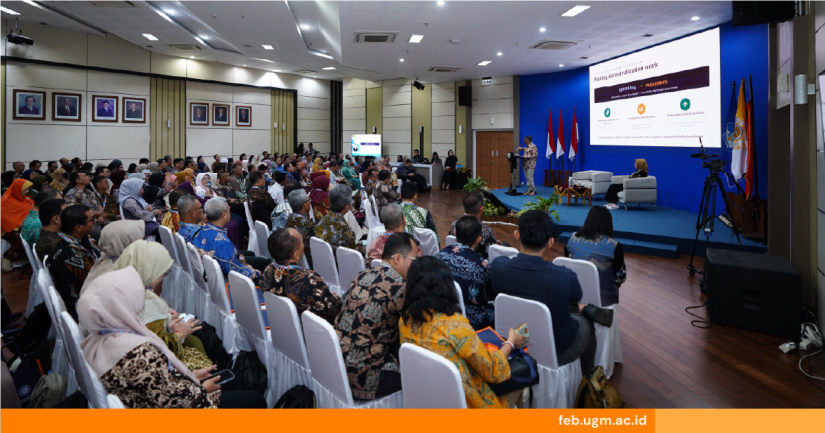
The national seminar featured a keynote speech by Prof. Dr. Mohamad Ikhsan, S.E., M.A., from the Faculty of Economics and Business, University of Indonesia (UI), who shared his views on the importance of strengthening the governance of Economics Study Programs to produce independent, globally competitive graduates. The series of sessions also included a presentation on Outcome-Based Education (OBE)-based curriculum development by Prof. BM. Purwanto, Ph.D., from the Faculty of Economics and Business, Gadjah Mada University (UGM).
Over the course of the three-day event, participants took part in various parallel discussions addressing strategic issues in the management of Economics Study Programs, including the strategic orientation of study programs, governance and management, student management in the digital age, faculty competency development, the implementation of an OBE-based curriculum, improving the quality of research and community service, strengthening accreditation, and fostering collaboration among study programs in Indonesia. Each session featured contributors from various universities and was facilitated by academics from several leading Indonesian universities.
The second day of the event focused on strengthening the capacity of Economics Study Programs by discussing the programs’ readiness for LAMEMBA accreditation. In this session, the Head of the MEP Program at FEB UGM, Amirullah Setya Hardi, S.E., Cand.Oecon., Ph.D., will share the MEP Program’s experiences and best practices. Next, there will be a session on core courses, including microeconomics, macroeconomics, quantitative methods, and econometrics. The material was presented by experts from Gadjah Mada University, the University of Indonesia, IPB, the University of Papua, and Pattimura University as part of efforts to improve the quality of Economics education across Indonesia.
In addition to the academic seminar, this event included committee meetings and an APSEPI plenary session, which produced several strategic recommendations for the development of economics education in Indonesia. The targeted outcomes include the publication of the Proceedings of the 2026 APSEPI National Seminar, the development of minimum standards for Economics Study Programs, including graduate profiles, graduate learning outcomes (GLOs), GLO rubrics, and curriculum maps, as well as the signing of a memorandum of understanding (MoU) and a memorandum of agreement (MoA) among study program administrators to support the implementation of the three pillars of higher education.
As the host, FEB UGM facilitated seminars, academic discussions, and a family gathering to strengthen bonds among APSEPI members from across Indonesia. This collaboration reflects FEB UGM’s commitment to strengthening the higher education ecosystem in economics through academic forums that promote innovation, curriculum harmonization, and the development of sustainable national networks.
Reportage by: Kurnia Ekaptiningrum
Sustainable Development Goals