Leadership is not a quality that develops overnight. It is shaped through experience, learning, and the courage to face real-world challenges. A leader is not only expected to set a direction but also to create an impact on the people and environment around them.
This was highlighted during the “Future Leaders for Impact: Leadership, Purpose, and Real-World Problems” event, organized by the Career and Student Development Unit (CSDU) of FEB UGM, on Tuesday, September 1, 2026, at the 8th-Floor Auditorium of the Learning Center, FEB UGM. Featuring practitioners and alums, the event equipped new FEB UGM students with insights into leadership, character development, and the ability to address real-world problems through innovation and entrepreneurship.
Founder and CEO of Environesia Group, Ir. Saprian, S.T., M.Sc., M.T., IPM, ASEAN.Eng. emphasized that leadership is a long game and an accumulative process, rather than an ability that can be acquired overnight. To develop leadership skills, he highlighted the importance of having the courage to take responsibility, starting with small things and doing so consistently.
“Take the opportunities that come your way. Through these opportunities, your sense of leadership will grow over time,” he said.
Saprian explained that there are three foundations of leadership. First, values and character, which serve as the key differentiators between one leader and another. Second, interest and concern, which involve building movements based on current social or environmental issues. Finally, flexibility in leadership style according to the circumstances in the field. He has applied these three foundations through Environesia Group, a business he built by addressing real problems faced by communities.
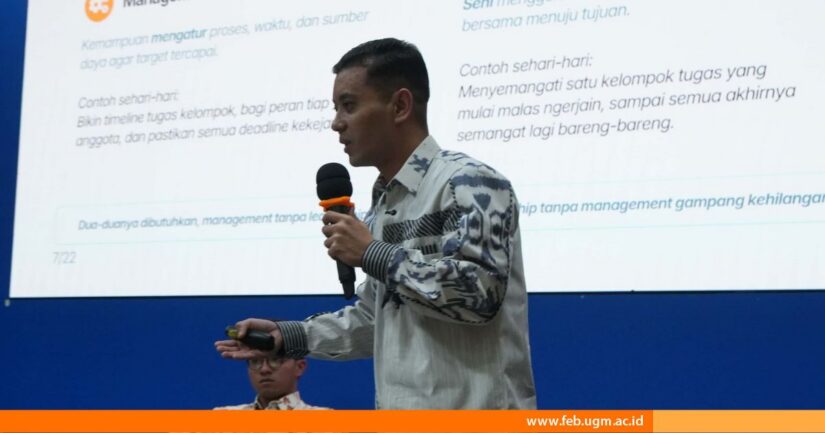
Meanwhile, Alan Putra Wijaya, a 2022 Management student and CEO of Renou, shared how his campus experiences became the starting point of his leadership journey. He later carried these experiences into his journey to start and develop a business.
Since the beginning of his studies, Alan took the opportunity to join the faculty’s student organization, BEM FEB UGM. Through this experience, he learned that leadership does not always begin at the forefront but by being a good follower, listening to others, and building networks. His leadership experience was further tested when he was entrusted with the role of CEO of The Management’s Event, an annual event organized by Management students that involved more than 170 committee members.
Alan gained a similar experience when he started his business. In his third semester, he founded Kedai Bubur Tikum, which grew to six branches and employed 35 people. However, the business had to cease operations two years later. This failure became an important experience for Alan, teaching him that a leader needs resilience and consistency to rise again and keep moving forward.
This experience later became a stepping stone for Alan to develop Renou, an environmentally focused business that transforms plastic waste into functional furniture and accessories. To date, Renou has recycled more than one ton of plastic waste and partnered with dozens of communities.
Alan highlighted three important points that he continues to use when reflecting on his leadership: whether he is willing to accept criticism, what strong reasons drive him to lead, and whether he is committed to continuous improvement.
“And the key takeaway is, leaders are lifelong learners, and I do believe that they are built and not born,” he concluded.
Report: Najwa Anggi Namira
Editor: Kurnia Ekaptiningrum
Sustainable Development Goals