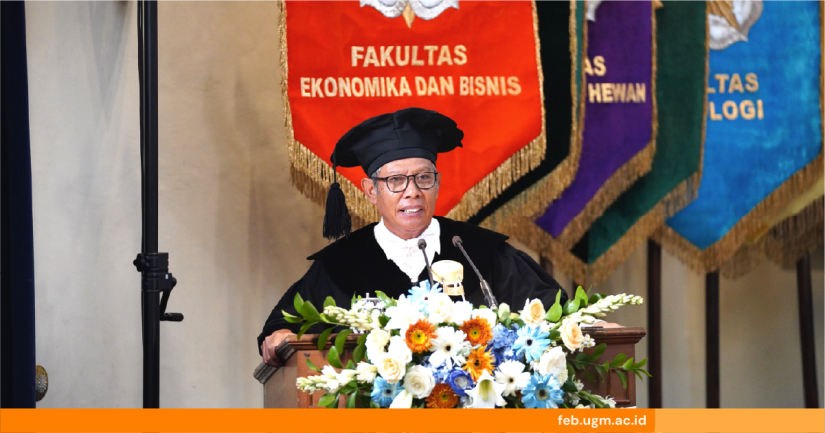
Prof. Eko Suwardi, M.Sc., Ph.D., was officially inaugurated as Professor of Accounting at the Faculty of Economics and Business (FEB), Universitas Gadjah Mada (UGM), on Thursday, 16 July 2026, at the UGM Senate Hall. During the inauguration ceremony, he delivered a professorial address titled “The Role of Accounting in the Governance of Taxpayers, Tax Authorities, and Public Expenditure.”
“Accounting plays a crucial role in strengthening governance, which is essential for both the revenue and public expenditure pillars of a modern state such as Indonesia,” he said during the inauguration ceremony held at the UGM Senate Hall on Thursday (16/07).
Prof. Eko explained that taxation is the primary source of state revenue, contributing more than 80 percent of Indonesia’s State Budget (APBN). Therefore, the quality of tax governance is a key determinant of the government’s ability to achieve national development goals and improve public welfare.
He emphasized that taxation is a constitutional mandate that connects citizens’ obligations with the government’s responsibility to manage public revenue fairly and accountably.
“Taxation is not merely a fiscal instrument but a fundamental means of achieving the nation’s objectives. Every rupiah collected in taxes represents a public trust that must be used to improve people’s welfare. Therefore, taxation is not simply about meeting revenue targets—it is fundamentally a matter of governance,” said the Dean of FEB UGM for the 2016–2021 period.
Prof. Eko further explained that accounting serves as an information infrastructure that enables economic activities to be recorded, measured, and held accountable. According to him, accounting plays a central role by providing the information infrastructure that supports transparency, accountability, compliance, and public trust.
He noted that accounting has traditionally been viewed as a technical mechanism for recording and reporting financial transactions. However, contemporary governance literature recognizes that accounting performs a much broader institutional function. As an institutional mechanism, accounting information reduces information asymmetry, supports oversight functions, facilitates accountability, and enables evidence-based decision-making. Within the taxation system, accounting determines how taxable income is measured, how tax liabilities are calculated, and how tax compliance is evaluated. In the public sector, accounting enables governments to demonstrate how public resources are collected, allocated, and spent.
“This conceptual framework demonstrates that accounting functions as a governance mechanism linking three interrelated domains: taxpayers, tax authorities, and public expenditure,” he explained.
On the occasion, Prof. Eko also highlighted the importance of taxpayer governance amid the increasing complexity of global business transactions. He stated that reliable financial statements, fiscal reconciliations, transfer pricing documentation, and adequate tax disclosures are essential prerequisites for establishing credible tax compliance.
Meanwhile, he noted that the digitalization of tax administration through the implementation of the Coretax system creates opportunities for tax authorities to adopt risk-based supervision. However, the system’s effectiveness depends heavily on the quality of accounting data generated by taxpayers.
In addition to discussing state revenue, Prof. Eko emphasized that accounting also plays a strategic role in the governance of public expenditure. Public sector accounting enables the monitoring, evaluation, and accounting for tax revenues through transparent reporting systems and strong internal controls.
He added that the digital transformation of public financial management, including the implementation of the Sistem Aplikasi Keuangan Tingkat Instansi (SAKTI), must be supported by high-quality human resources, sound data governance, and effective oversight systems to improve the efficiency of government spending while minimizing the risk of irregularities.
Concluding his speech, Prof. Eko reaffirmed that accounting plays a fundamental role as an institutional infrastructure connecting transparency, accountability, integrity, and trust throughout the fiscal system.
“Therefore, the future of tax governance and public financial management depends, among other things, on accounting systems that are transparent, integrated, technology-driven, and grounded in integrity,” he concluded.
Reportage by: Kurnia Ekaptiningrum
Sustainable Development Goals