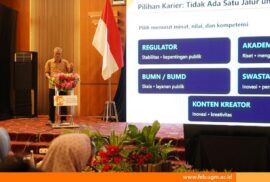
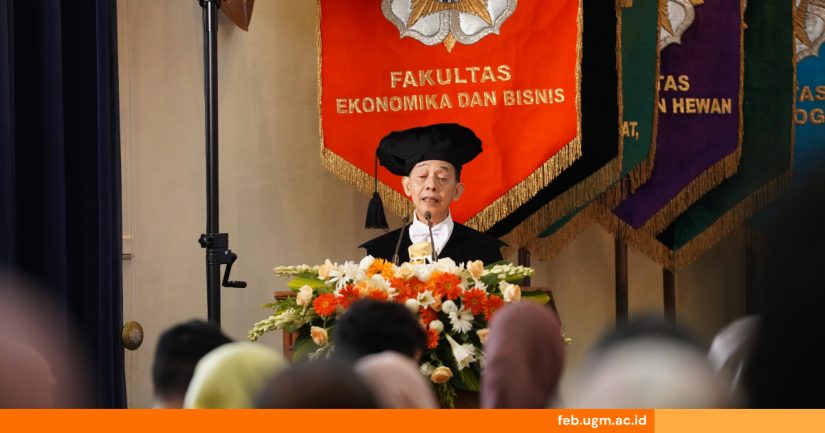
Accounting can no longer be understood merely as a financial recording system or simply as a social science discipline. In the digital era, accounting is a financial information technology that continues to evolve in response to emerging challenges while supporting smarter, more transparent, and sustainable decision-making.
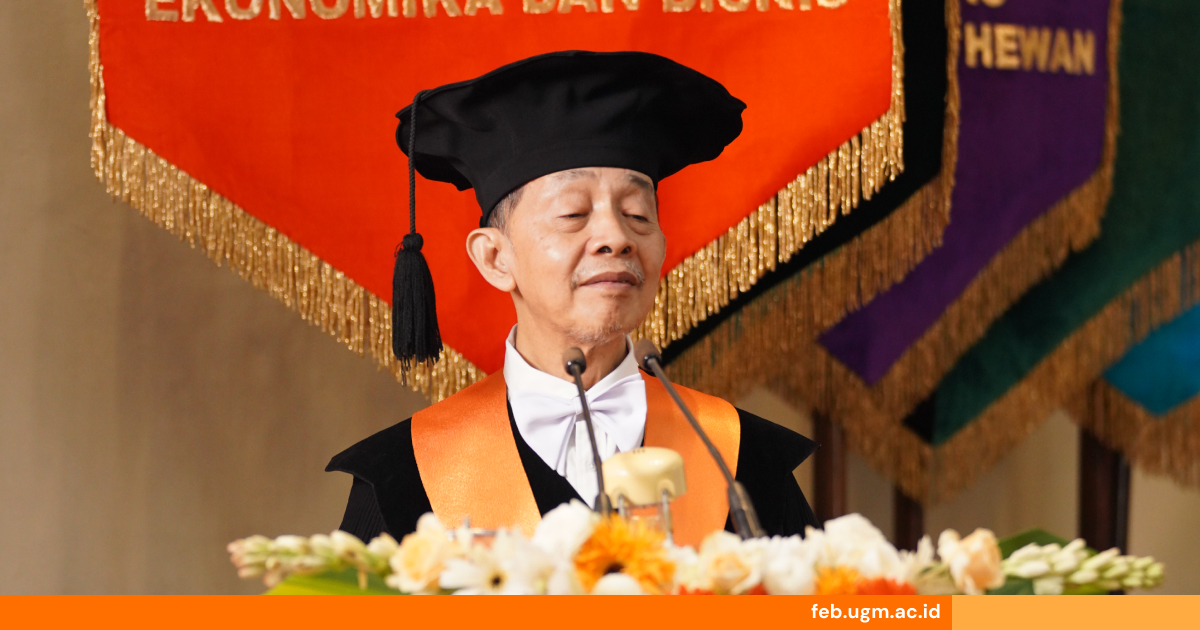
This idea was presented by Prof. Sony Warsono, MAFIS, Ph.D., CA., Ak., during his inaugural speech as Professor of Accounting Education at the Faculty of Economics and Business, Universitas Gadjah Mada (FEB UGM), held at the UGM Senate Hall on Thursday (August 6, 2026). In his inaugural address, titled Developing Accounting as a Transdisciplinary Science in the Digital Era: The Principle of Duality, Prof. Sony explained that the long history of accounting since the Renaissance demonstrates that accounting is an intellectual technology that has continuously evolved while remaining rooted in the same fundamental principles.
“Through an interdisciplinary approach, we realize that mastering the concepts of debit and credit is not a rigid technical burden but rather a core competency that enables the principle of duality to function systematically in maintaining the balance of financial information,” he said.
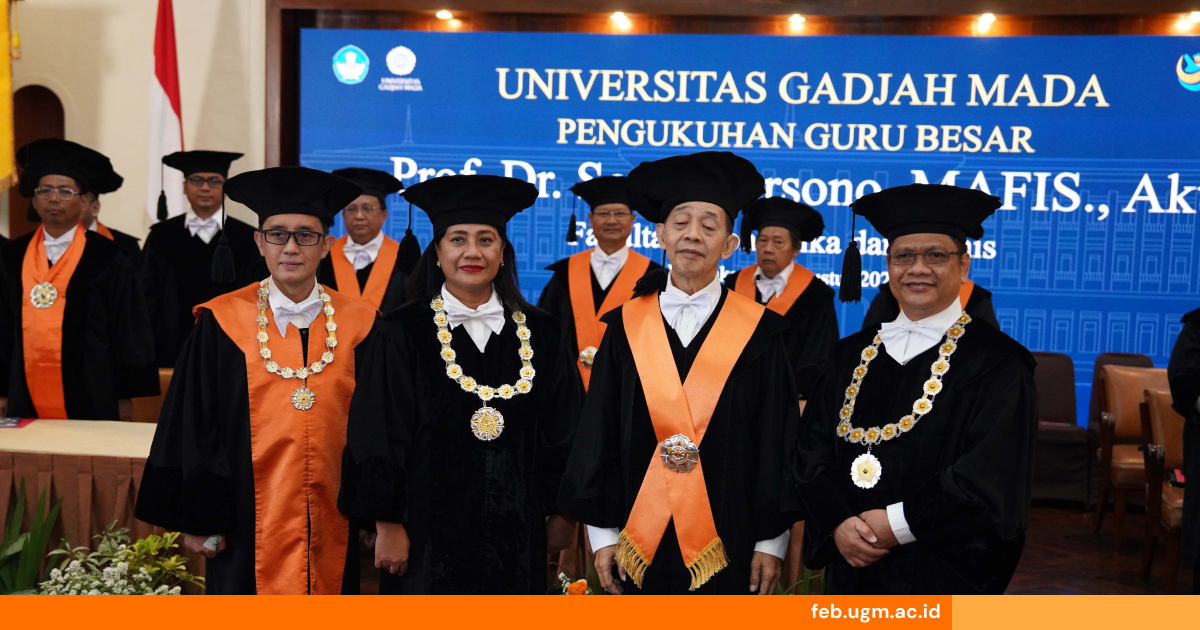
He further noted that the growing recognition of accounting as part of the fields of Science, Technology, Engineering, and Mathematics (STEM) reinforces the idea that behind every figure in financial statements lies mathematical logic, data structures, and precise analytical thinking. Therefore, accounting education must move beyond conventional approaches by integrating perspectives from technology, social sciences, and the humanities.
“This integration leads us to a new perspective the need to view accounting itself as a financial information technology,” he explained.
Prof. Sony highlighted that the history of accounting demonstrates its continuous adaptation to change. Single-entry bookkeeping evolved into double-entry bookkeeping, which became the foundation of modern accounting. Today, digital technologies have given rise to the concept of triple-entry accounting, a recording system that utilizes blockchain technology. In this system, transactions are recorded not only by the two parties involved but also permanently stored within a secure, transparent, and tamper-resistant digital network.
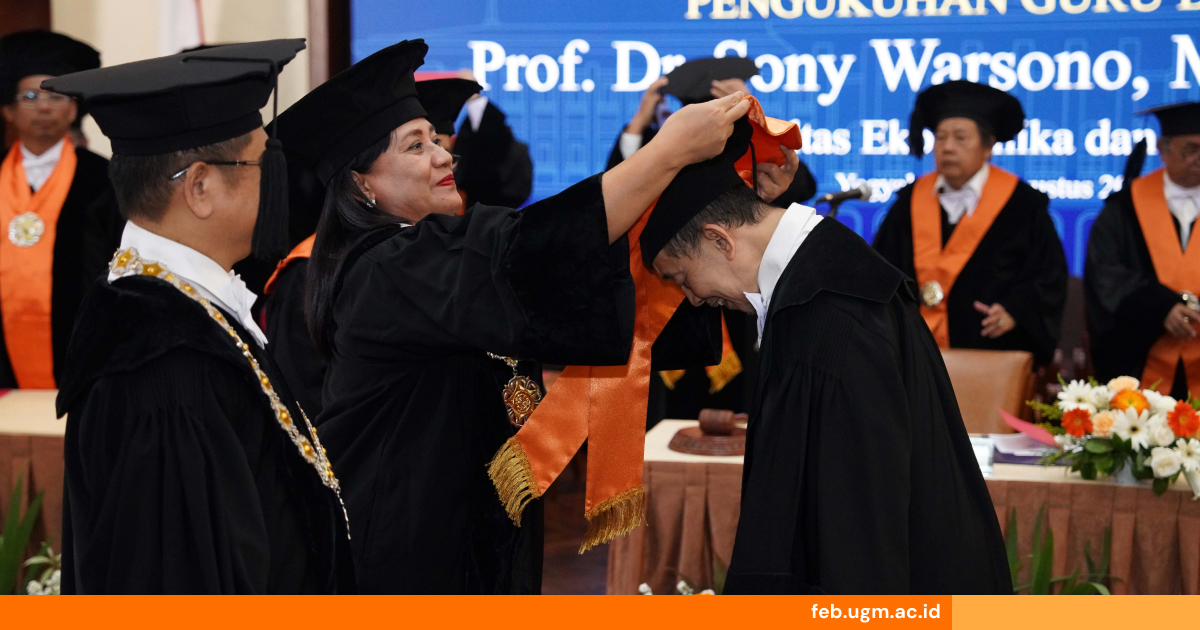
According to him, this transformation offers a new perspective in which accounting is no longer confined to debates over whether it belongs to the social sciences or the natural sciences. Instead, accounting should be positioned as a financial information technology that integrates scientific precision with social responsibility. Such an approach enables accounting to support business decisions that are not only scientifically sound but also beneficial to society.
“By treating accounting as a technology, accounting learners will no longer be trapped in the polarized debate of ‘social science versus natural science.’ Instead, they can focus on advancing accounting to produce business decisions that are intelligent, scientifically rigorous, and socially transparent,” he stated.
Prof. Sony also emphasized that recognizing accounting as a social science should not diminish its essence as a precise measurement system. On the contrary, humanistic and social perspectives should be strengthened through a solid understanding of fundamental accounting concepts, particularly debit and credit.
He explained that, just as digital technology is built on binary systems and later enriched by the arts and social sciences to drive innovation, accounting should develop in a similar way. Technical precision must be integrated with interdisciplinary perspectives to create financial information systems that are not only mathematically accurate but also relevant to the advancement of human civilization.
Concluding his address, Prof. Sony warned that the future of accounting education will face significant challenges if it continues to rely on conventional paradigms. He argued that academics must reposition technical competence as the driving force of innovation while developing the concepts of debit and credit not merely as intellectual heritage, but as dynamic algorithms that will serve as the foundation of future financial information technology through progressive research and education.
Reporter: Kurnia Ekaptiningrum
Sustainable Development Goals