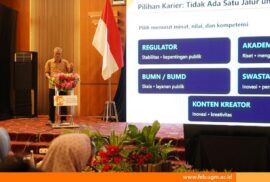
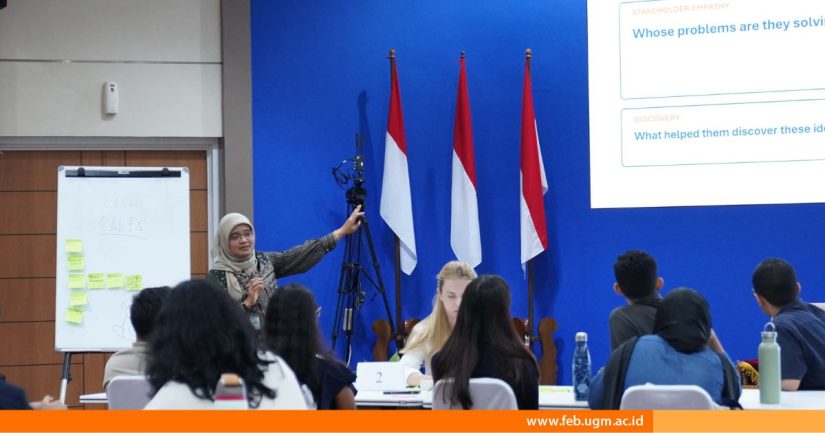
Understanding the needs and lived experiences of communities is the first step toward creating meaningful innovation. Professor of Innovation and Entrepreneurship at the Faculty of Economics and Business, Universitas Gadjah Mada (FEB UGM), Prof. Nurul Indarti, Sivilokonom., Cand.Merc., Ph.D., encouraged participants of Global Summer Week 2026 to develop impactful solutions by placing empathy at the heart of the innovation process during the workshop “Empathy and Inclusive Design Thinking.”
Nurul explained that the design thinking approach places people at the center of every innovation process.
“The fundamental principle of design thinking is human-centered design. Therefore, it is essential for us to use empathy to understand people’s needs,” she said on Monday (13/07/2026).
She introduced the five non-linear stages of design thinking empathize, define, ideate, prototype, and test as a framework for creating inclusive innovation. The process begins with understanding the experiences of target users, defining the core problem, generating multiple solution ideas, developing prototypes, and testing them with users to ensure that the proposed solutions genuinely address their needs.
Nurul emphasized that a business idea should not begin with a product to be sold, but rather with a problem to be solved.
“The first question we should ask when developing a business idea is: Who needs this, and why? Who needs the idea, and why do they need it?” she explained.
To demonstrate how empathy can be translated into innovation, participants explored several examples of companies that have successfully combined business growth with social impact. SukhaCitta empowers cotton farmers through sustainable fashion, and Fairphone produces modular smartphones in response to the lack of transparency in global electronics supply chains. At the same time, Too Good To Go reduces food waste by connecting consumers with food businesses.
During the following session on Wednesday (15/07/2026), participants shared ideas inspired by real-world challenges, including farmer empowerment, access to clean water, educational inequality, food waste management, and improving workplace inclusivity for people with disabilities. One group also proposed a solution to expand access to learning opportunities for students from low-income families.
In the subsequent session, each group presented its ideas and received feedback to refine its proposed solutions further. These ideas were then developed into business models and mapped using the Business Model Canvas (BMC) as the initial step toward building prototypes.
Through this workshop, participants learned not only to understand societal challenges better but also to transform them into structured, actionable solutions. The wide range of ideas inspired by social and environmental issues demonstrated that innovation begins with empathy and a genuine concern for people’s needs. Equipped with this foundation, participants are expected to continue developing their ideas into solutions that create meaningful and lasting impact.
Reporter: Najwa Anggi Namira
Editor: Kurnia Ekaptiningrum
Sustainable Development Goals (SDGs)