Success in building a career is determined not only by academic ability but also by communication, teamwork, adaptability, and problem-solving skills. Chairman of the Board of Commissioners of the Indonesia Deposit Insurance Corporation (LPS), Prof. Dr. Anggito Abimanyu, M.Sc., emphasized the importance of developing these competencies as students prepare to enter the workforce.
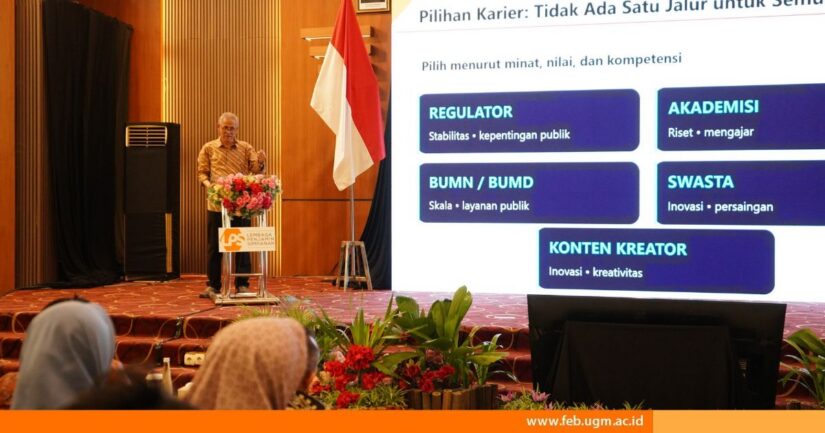
Anggito delivered the message, sharing his experiences and perspectives on professional life, during a public lecture titled “Why Pursue a Career in the Financial Sector?” held at the Gadjah Mada University Club Hotel on Friday (October 2, 2026).
Anggito explained that career journeys do not always go smoothly. Obstacles and challenges are part of the process and can help individuals develop and grow. Support, opportunities, and experiences gained from learning from others also play an important role in building a career.
Learn from Challenges and Dare to Seize Opportunities
Anggito encouraged students to set ambitious goals and remain open to various opportunities. According to him, failure and discomfort should not become reasons to stop trying. Instead, they can provide opportunities for self-evaluation and improvement.
“Do not expect the path to success always to be smooth. A comfortable life may feel pleasant, but we also need to learn from discomfort. When we face problems, we have an opportunity to improve ourselves. Turn problems into strengths that help you achieve success,” he said.
Anggito also noted that, in addition to focusing on academics, students should develop soft skills such as communication, teamwork, adaptability, and problem-solving. These skills are essential for navigating the dynamics of the workplace.
He further emphasized that everyone has different career aspirations. Some may seek high earnings, aspire to leadership positions, or prefer operational roles. According to him, students are free to determine their career goals based on their individual aspirations, as long as they pursue them in the right way.
“When choosing a job, do not only consider the job you can get today. Think about the scale of responsibility, the opportunities to learn, and the value you can create,” he said.
Create Value
Technological developments are also transforming the competencies required by industries, including the financial sector. Anggito reminded students to continuously update their skills to keep pace with change, including the use of automation, artificial intelligence (AI), and machine learning to improve work efficiency.
He highlighted data analytics, AI and big data literacy, financial modeling, and an understanding of cybersecurity as several competencies that can help students prepare for the future needs of the financial industry.
“Mastery of data analytics, AI and big data literacy, financial modeling, and cybersecurity awareness can serve as valuable assets in meeting the future needs of the financial industry,” he explained.
He added that working at financial institutions and large organizations that manage assets worth hundreds or even thousands of trillions of rupiah, such as Bank Indonesia, BCA, the Financial Services Authority (OJK), and LPS, provides opportunities to learn to handle responsibilities in large-scale organizations. However, gaining experience at prestigious institutions should not be the sole objective when building a career.
“The most important thing is how you create value. It would be even better if you could create value through your own ideas, innovations, or ventures, for example by developing innovative digital solutions,” he concluded.
Reported by: Shofi Hawa Anjani
Sustainable Development Goals