Through a series of policies, the Indonesian Government has positioned the establishment of 80,000 Merah Putih Village/Subdistrict Cooperatives (KDMP) as a means of fulfilling the mandate of Article 33 Paragraph (1) of the 1945 Constitution while promoting a more inclusive national economy. However, challenges remain in improving and developing the institutional quality of cooperatives alongside the rapid increase in their number.
Amirullah Setya Hardi, Ph.D., a lecturer at the Department of Economics, Faculty of Economics and Business, Universitas Gadjah Mada (FEB UGM), emphasized that this gap needs to be addressed in the development of KDMP. According to him, the growth in the number of cooperatives must be accompanied by stronger capacity, governance, and the ability to meet members’ needs.
Amirullah noted that the Government has attached numerous objectives to KDMP, ranging from improving rural welfare and creating jobs to controlling inflation. However, cooperatives should have a single primary objective.
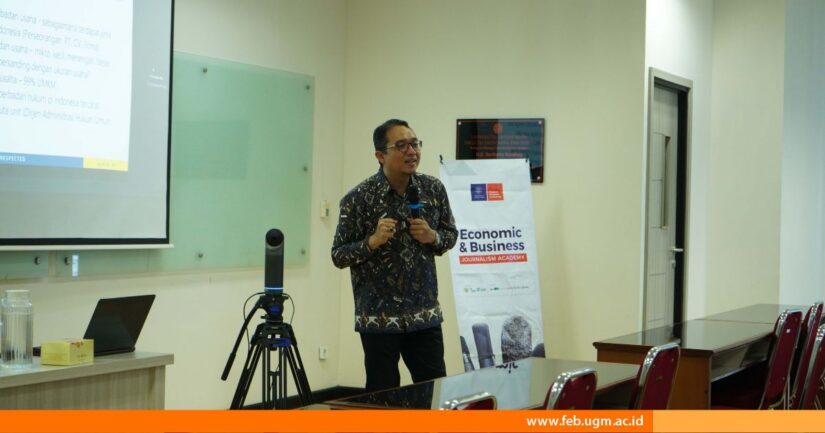
“The objectives of the Merah Putih Village Cooperatives are too numerous. That should not be the case because the objective of a cooperative is singular: to fulfill the needs of its members. That is all. If members’ needs are fulfilled, they will prosper as a consequence,” he said during the Economic and Business Journalism Academy (EBJA) titled “Indonesian Cooperatives,” recently held at FEB UGM.
Amirullah pointed to national cooperative performance data, which reveal an anomaly between quantity and quality. Data from the Ministry of Cooperatives show that the cooperatives’ own capital increased from IDR 105 trillion in 2024 to IDR 113.46 trillion in 2025, while total assets rose from IDR 293.14 trillion to IDR 325.87 trillion.
However, this increase was not accompanied by a proportional rise in the remaining proceeds of cooperative operations (SHU). SHU increased only from IDR 8.1 trillion to IDR 8.8 trillion over the same period.
“Our SHU only increased from IDR 8.1 trillion to IDR 8.8 trillion. Compare that with the amount of funding disbursed—the increase is very small. What has changed significantly instead is the number of workers and Business Identification Numbers (NIB),” he explained.
The disparity is also evident in the growth in the number of cooperatives and their members. The number of cooperatives increased from 131,617 units in 2024 to 222,462 units in 2025. However, the number of members rose only from 29,819,216 to 31,850,469. Meanwhile, the number of workers surged from 669,164 to 1,189,176, while the number of managers and employees changed relatively little.
Ambitious Target, Extremely Rapid Process
Amirullah also highlighted the relatively short timeframe in which KDMP was established. The program was initiated during a retreat for regional heads at the Military Academy in Magelang from February 21–28, 2025, followed by the announcement of the launch of 80,000 village cooperatives at a Limited Cabinet Meeting at the State Palace on March 3, 2025.
The formal legal process for establishing KDMP proceeded within a relatively short period. It began with the issuance of Presidential Instruction No. 9 of 2025 on the Acceleration of the Establishment of Merah Putih Village/Subdistrict Cooperatives (KDMP) on March 27, 2025, followed by Presidential Decree No. 9 of 2025 on the Task Force for the Acceleration of the Establishment of Merah Putih Village/Subdistrict Cooperatives on May 2, 2025, and culminated in the inauguration held on National Cooperative Day on July 12, 2025. During this period, 20,000 new cooperatives were reportedly established. On average, this translates to approximately 666 new cooperatives being established every day.
According to Amirullah, the speed of the process has not been matched by adequate academic studies. He linked this concern to the need for large-scale infrastructure development. Of the 38,064 applications for land for cooperative outlets, the average construction cost reached IDR 3.8 billion per unit.
“As far as I know, based on statements by relevant officials reported in various media outlets, there was limited research underlying the establishment of the 80,000 village cooperatives. The question is, what was the basis for setting such a target when each unit requires up to IDR 3.8 billion to construct a physical outlet?” he said.
Strengthening Institutional Activities
Data from the simkopdes.go.id dashboard as of July 2026 show that, of the 83,382 registered cooperatives, 79,707 had accounts, 80,978 had Taxpayer Identification Numbers (NPWP), and 60,792 had Business Identification Numbers (NIB). Of the 38,064 applications for land for physical outlets, 35,861 had been verified, with 17,462 units fully completed and another 17,933 still under construction.
Nevertheless, Amirullah noted that on-the-ground institutional activities have not fully matched these administrative achievements. Of the 83,382 registered cooperatives, only 50,255 had held their Annual Members’ Meetings, while another 18,750 had yet to do so.
Amirullah also raised concerns about the determination of cooperative locations, arguing that it should be based more heavily on assessments of community needs. He observed that cooperative locations tended to be determined by business-competition logic, resembling the placement patterns of modern retail outlets. He cited an example of a village that had rejected establishing a cooperative because it was considered economically inefficient for its residents.
“If we look at the location patterns, the logic is similar to that of minimarkets competing by opening outlets close to one another, rather than being based on an assessment of community needs. Some villages have rejected them because they realized that it would not be economically efficient for them,” he said.
Promoting Pentahelix-Based Governance
Despite these concerns, Amirullah acknowledged that the KDMP program still has the potential to contribute to the economy at the aggregate level. Referring to Keynesian theory, he explained that national income is formed through consumption, investment, government spending, and net exports. An increase in government spending on the village cooperative program, he said, could stimulate economic growth. However, consumption and investment may not necessarily increase given the current instability of the domestic economy.
To strengthen governance, he proposed a pentahelix model involving five stakeholders: Government, the business sector, academia, society, and the media. According to him, these five elements should ideally play equal roles, although in practice their interactions may be hierarchical depending on the implementation context.
Amirullah emphasized that integrity and professionalism in carrying out each stakeholder’s respective role are key to the sustainability of cooperatives—far more important than simply pursuing numerical targets.
“Achieving the welfare of cooperative members is the means to achieving the welfare of society,” he concluded.
Report: Dwi Zhafirah Meiliani
Editor: Kurnia Ekaptiningrum
Sustainable Development Goals