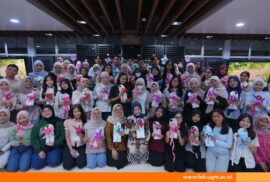
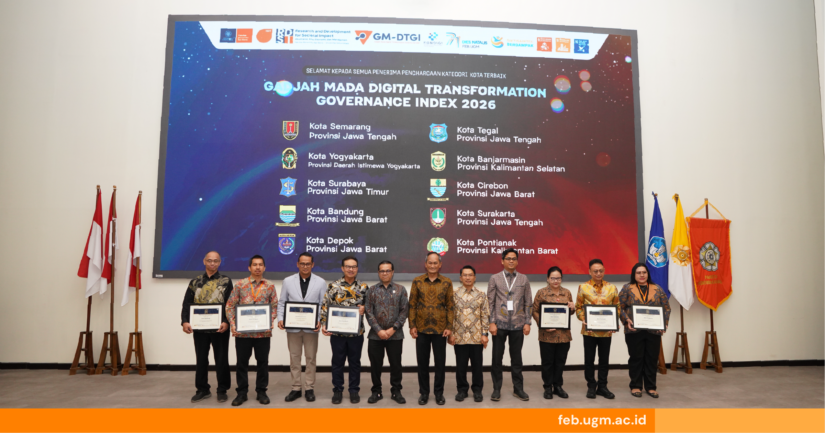
The Faculty of Economics and Business, Universitas Gadjah Mada (FEB UGM), through its Information System and Digital Transformation (ISDT) Research Group, presented the 2026 Gadjah Mada Digital Transformation Governance Index (GM-DTGI) Awards to regency and municipal governments across Indonesia for their achievements in implementing digital transformation governance.
The awards were presented during a National Seminar titled “Artificial Intelligence for Local Governments: Accelerating Digital Transformation and Improving Performance Amid Opportunities and Challenges,” held at the MM FEB UGM Auditorium on Thursday (November 5, 2026).
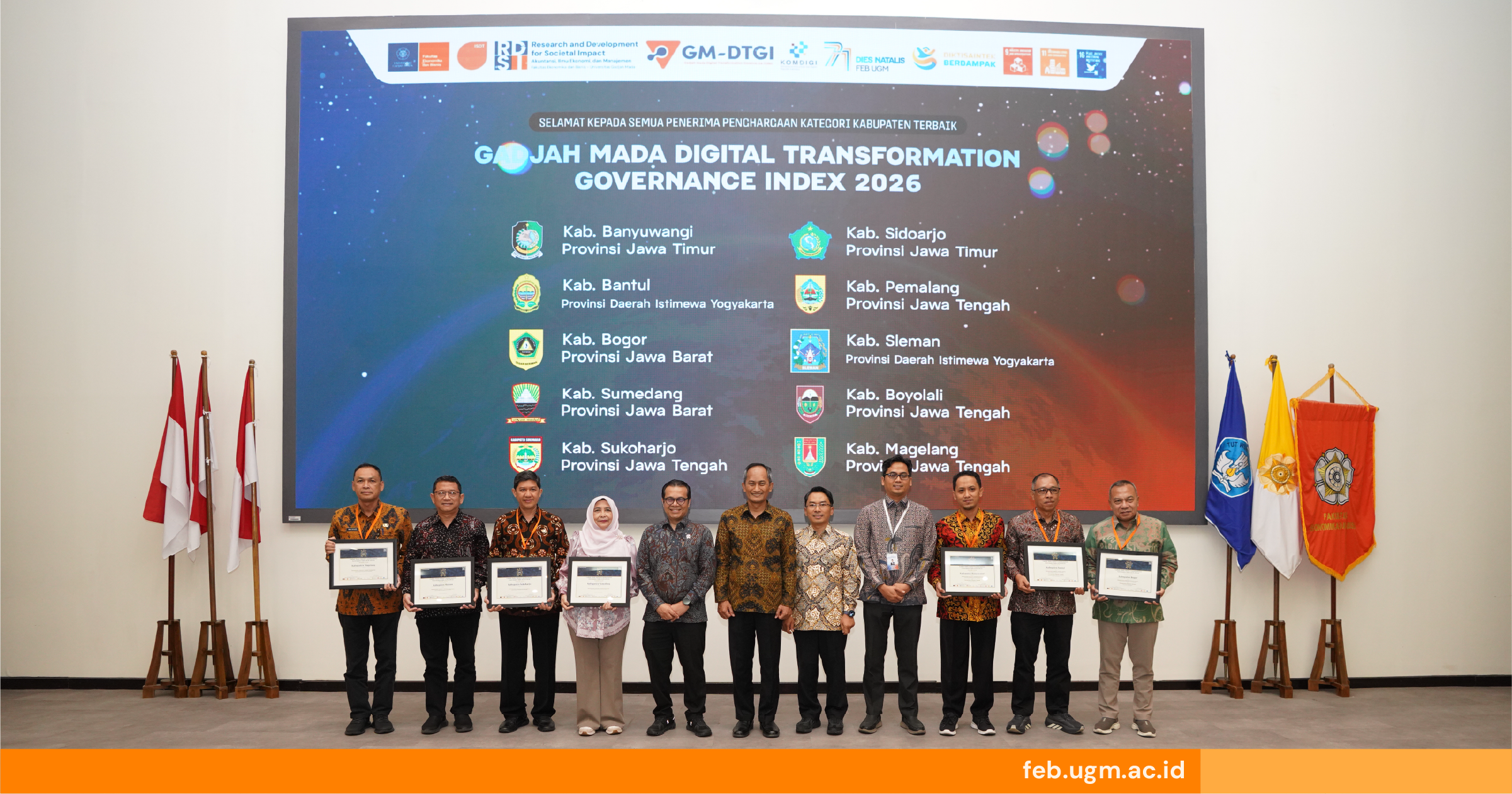
Based on the 2026 GM-DTGI assessment results, Banyuwangi Regency ranked first in the Best Regency Government category, followed by Bantul, Bogor, Sumedang, and Sukoharjo Regencies. Sidoarjo, Pemalang, Sleman, Boyolali, and Magelang Regencies completed the top ten.
Meanwhile, in the Best Municipal Government category, Semarang City secured first place, followed by Yogyakarta, Surabaya, Bandung, and Depok. Tegal, Banjarmasin, Cirebon, Surakarta, and Pontianak occupied the remaining positions in the top ten.
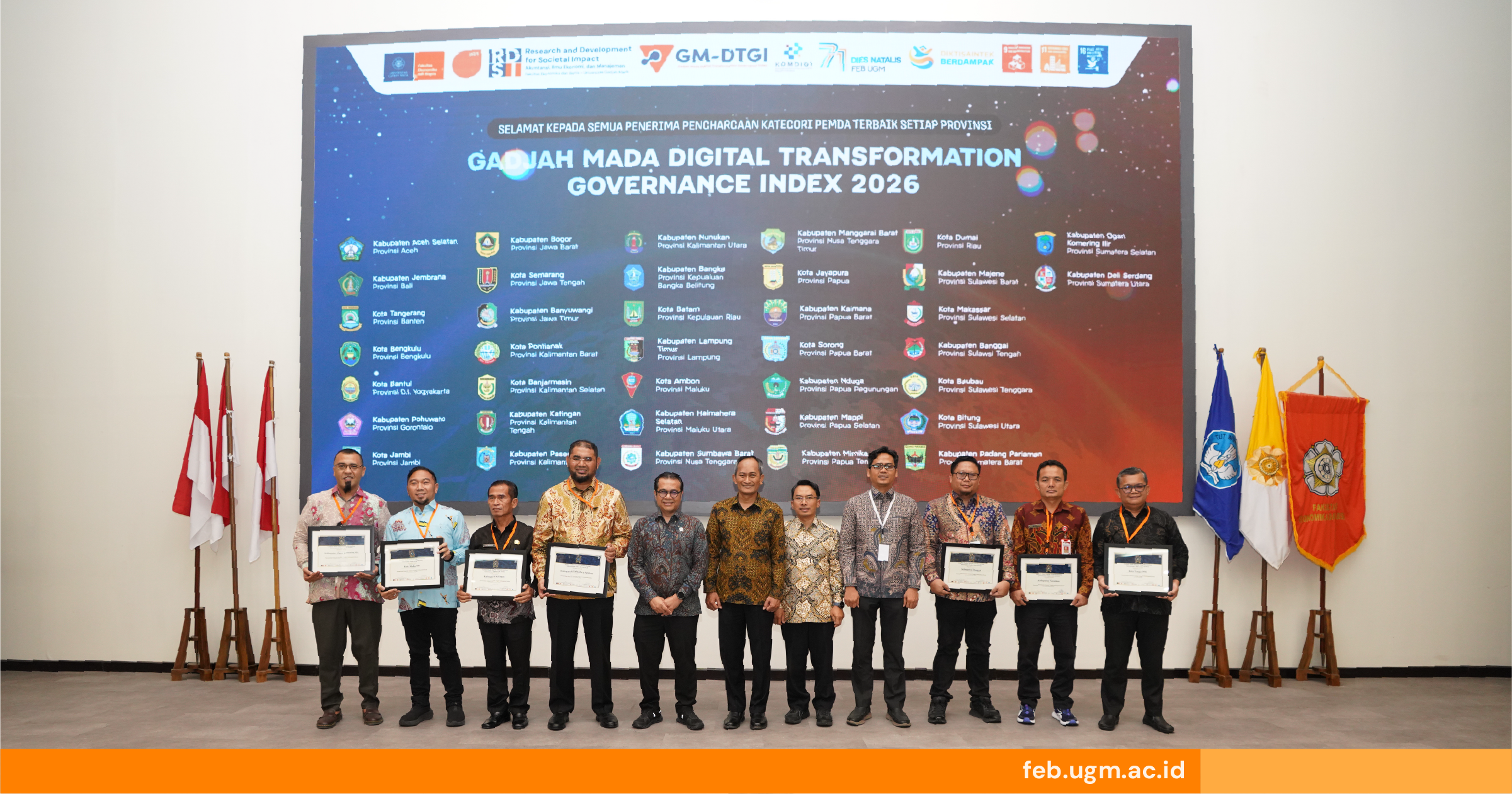
The 2026 GM-DTGI also recognized the best-performing regency and municipal governments in each province.
In the Best Digital Transformation Governance category at the provincial level, awards were presented to 37 local governments: South Aceh Regency (Aceh), Jembrana Regency (Bali), Tangerang City (Banten), Bengkulu City (Bengkulu), Bantul Regency (Special Region of Yogyakarta), Pohuwato Regency (Gorontalo), Jambi City (Jambi), Bogor Regency (West Java), Semarang City (Central Java), Banyuwangi Regency (East Java), Pontianak City (West Kalimantan), Banjarmasin City (South Kalimantan), Katingan Regency (Central Kalimantan), Paser Regency (East Kalimantan), Nunukan Regency (North Kalimantan), Bangka Regency (Bangka Belitung Islands), Batam City (Riau Islands), East Lampung Regency (Lampung), Ambon City (Maluku), South Halmahera Regency (North Maluku), West Sumbawa Regency (West Nusa Tenggara), West Manggarai Regency (East Nusa Tenggara), Jayapura City (Papua), Kaimana Regency (West Papua), Sorong City (Southwest Papua), Nduga Regency (Highland Papua), Mappi Regency (South Papua), Mimika Regency (Central Papua), Dumai City (Riau), Majene Regency (West Sulawesi), Makassar City (South Sulawesi), Banggai Regency (Central Sulawesi), Baubau City (Southeast Sulawesi), Bitung City (North Sulawesi), Padang Pariaman Regency (West Sumatra), Ogan Komering Ilir Regency (South Sumatra), and Deli Serdang Regency (North Sumatra).
Head of the GM-DTGI Research Team, Prof. Syaiful Ali, MIS., Ph.D., Ak., CA., explained that GM-DTGI was developed as an instrument to assess digital transformation governance in local governments. The initiative emerged in response to challenges in implementing Indonesia’s Electronic-Based Government System (SPBE) policy, which has yet to be fully optimized at the regional level. Several challenges remain, including policy synchronization, limited capacity among government personnel, and disparities in the implementation of digital transformation across regions.
He noted that digital transformation assessments have largely focused at the national level, highlighting the need for an instrument that provides a more measurable picture of achievements at the regency and municipal levels.
GM-DTGI was initiated in 2023 and officially launched nationwide in 2024. The assessment is conducted using seven pillars and 50 indicators, covering governance and leadership; regulations and policies; public administration reform and change management; data governance; digital ecosystems; user-centered platform design; and cybersecurity and system resilience.
“The assessment of readiness and implementation of digital transformation governance covers 508 regency and municipal governments across Indonesia,” he explained on Thursday (November 5).
Syaiful Ali expressed hope that GM-DTGI would serve as a tool for local governments to evaluate their achievements and identify areas requiring improvement. The index is intended not only to improve rankings but also to provide a foundation for local governments to formulate strategies to strengthen digital transformation.
Indonesia’s Vice Minister of Communication and Digital Affairs, Nezar Patria, also congratulated the local governments receiving the GM-DTGI awards. He expressed his appreciation to FEB UGM and the GM-DTGI research team for their initiative in developing an assessment of digital transformation governance at the local government level.
According to Nezar, GM-DTGI provides a more detailed picture of digital technology adoption at the regency and municipal levels. The assessment complements existing digital indices, which have primarily reflected conditions at the national and provincial levels.
Meanwhile, UGM Vice Rector for Planning, Assets, and Information Systems, Arief Setiawan Budi Nugroho, S.T., M.Eng., Ph.D., commended the development of GM-DTGI by the ISDT Research Group at FEB UGM. He emphasized that digital transformation is not merely about technological advancement but also an essential part of strengthening government governance and improving the quality of public services.
“People need public services that are fast, accessible, and accountable. Local governments are also expected to operate more effectively and efficiently while utilizing accurate data in their decision-making processes,” he stated.
He further explained that digital transformation continues to face challenges, including infrastructure gaps, limited human resources, and varying levels of readiness across regions. Therefore, digitalization should not simply focus on converting conventional services into electronic services but should also drive fundamental changes in how governments operate, make decisions, and deliver services to the public.
Arief emphasized that GM-DTGI serves as a relevant evaluation instrument that provides an objective overview of the progress of digital transformation governance across 508 local governments. The assessment results can be used to identify areas for improvement while enabling local governments to learn from best practices implemented in other regions.
Reporter: Kurnia Ekaptiningrum
Sustainable Development Goals