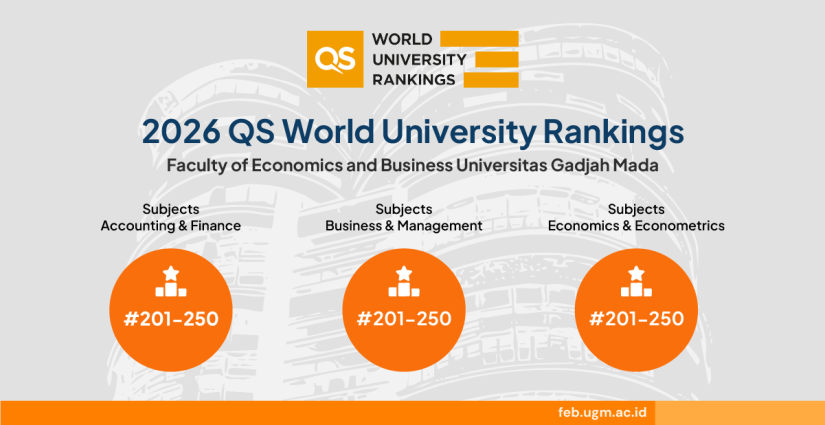
The Faculty of Economics and Business, Gadjah Mada University (FEB UGM) has once again achieved global recognition. FEB UGM has been included in the Quacquarelli Symonds World University Rankings (QS WUR) by Subject 2026, ranking 201–250 worldwide in Accounting & Finance, Business & Management Studies, and Economics & Econometrics.
The Dean of FEB UGM, Prof. Dr. Didi Achjari, M.Com., Ak., C.A., stated that this achievement demonstrates the consistent quality of education and research within FEB UGM. The achievement is the result of a sustained commitment to maintaining and enhancing the quality of education.
“This achievement is a form of global recognition of the quality of education at FEB, which is the result of the hard work of the entire FEB UGM academic community in maintaining educational quality on an ongoing basis,” he explained on Thursday, 9 April 2026, at FEB UGM.
The QS WUR by Subject ranking is based on 10 key indicators, including academic reputation, citations per faculty member, employer reputation, employment outcomes, international faculty ratio, international research network, international student ratio, international student diversity, faculty-student ratio, and sustainability.
“FEB’s success in maintaining quality standards across these ten indicators has significantly contributed to this ranking achievement,” he said.
Didi emphasized that this success is inseparable from the various strategic initiatives undertaken by the Faculty of Economics and Business at UGM over the past few years. FEB UGM consistently pursues continuous improvement across education, research, and international cooperation. One manifestation of this is global collaboration through academic and research networks. To date, FEB UGM has established partnerships with over 75 global partners across Asia, the Americas, Australia, and Europe.
Another strategic initiative is the strengthening of research activities and international publications. In its efforts to establish thought leadership in its field, FEB UGM continues to encourage lecturers to enhance research productivity and scientific publications, both individually and collaboratively with other researchers and students, through research grant schemes. Consequently, research productivity and publication output at FEB UGM continue to show a positive trend. FEB UGM lecturers published 86 scientific articles in reputable international journals in 2023 and 115 in 2024. This positive trend continued into 2025 with 130 articles already published, 32% of which appeared in reputable international journals ranked in the highest quartile (Q1).
In addition, adaptive hybrid learning facilities or Massive Open Online Courses (MOOCs) are accessible free of charge to both students and the wider public. By 2025, through the Learning and Academic Multimedia Production (LAMP) unit, the Faculty of Economics and Business, UGM, has successfully produced 66 digital learning materials designed to expand access to and the equitable distribution of knowledge.
In addition, adaptive hybrid learning facilities or Massive Open Online Courses (MOOCs) are accessible free of charge to both students and the wider public. By 2025, through the Learning and Academic Multimedia Production (LAMP) unit, the Faculty of Economics and Business, UGM, will have successfully produced 66 digital learning materials designed to expand access to and the equitable distribution of knowledge.
Another strategic step is improving learning quality and developing curricula aligned with industry needs. Didi stated that FEB UGM continues to innovate by developing new courses and programs aligned with its sustainability mission. At the undergraduate level, FEB UGM has introduced courses on Planetary Health and Sustainability and Sustainability Accounting, tangible manifestations of integrating sustainability issues into the curriculum. Furthermore, at the postgraduate level, program development is carried out through strategic collaborations with partners, including the Circular Economy course with the Cortese Notoboyo Foundation, the Mini MBA program with Kuncie on the topic of Human Capital, and the FEB UGM MM Executive Development Program with Pertamina in the field of Accounting and Finance for Human Capital. The MM Program has also established the Infrastructure and Project Finance concentration in collaboration with Hutama Karya, as well as the Infrastructure Management & Project Finance and Railway Management concentrations in collaboration with PT Kereta Api Indonesia. In 2024, the UGM MM Program, in collaboration with the Department of Management, introduced a new concentration in Sustainability Management as part of the MASUDEM consortium (Master Studies in Sustainable Development and Management (CBHE Erasmus+ European Union)). This concentration also represents a commitment to sustainability stemming from the ASEAN Master’s in Sustainability Management program, a collaboration with the Government of Norway and the University of Agder, Norway, from the previous year.
Meanwhile, the Master of Science in Accounting program has introduced Social and Environmental Accounting as a compulsory module and has launched new specializations in Accounting & Sustainability and Data Science & Artificial Intelligence. The Master’s Program in Development Economics has also launched new specializations in Sustainable Economic Development and Digital Innovation & Economic Development.
“Currently, the Faculty of Economics and Business (FEB) at UGM is supported by 150 lecturers, 32 of whom hold the title of professor,” he explained.
Furthermore, Didi stated that, moving forward, FEB UGM is committed to further improving these achievements through various strengthening strategies. He emphasized that quality improvement does not stop at ranking achievements.
“We will continue to strengthen the quality of research, enhance international collaboration, and ensure the curriculum remains relevant to global dynamics and industry needs,” he explained.
Didi emphasized that these achievements are expected to have a tangible impact (societal impact) on society.
“The hope is that FEB UGM will not only excel in rankings but also be able to make a tangible contribution through research, innovation, and graduates who are globally competitive and have an impact on development,” he concluded.
Reportage by: Kurnia Ekaptiningrum
Sustainable Development Goals