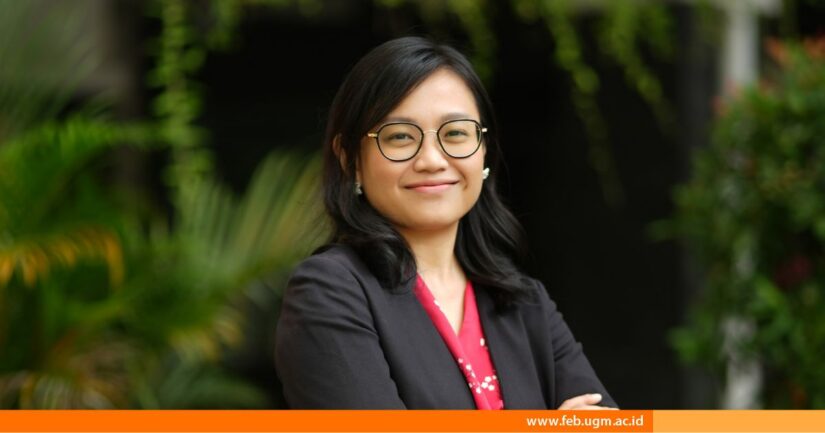
Widya Paramita, S.E., M.Sc., Ph.D., a lecturer at the Faculty of Economics and Business, Gadjah Mada University (FEB UGM), has been selected as an Editorial Board Member for the Journal of Business Venturing Insights (JBV Insights), a reputable international journal focused on entrepreneurship and business venturing published by Elsevier. This appointment makes Widya the only academic from Indonesia to be entrusted with a seat on the journal’s editorial board.
This recognition is largely due to Mita’s, Widya Paramita’s nickname, publication track record in JBV Insights. To date, she has published three articles in the journal and received recognition from the Editor-in-Chief of JBV Insights. This achievement also creates opportunities for FEB UGM academics to become more actively involved in international academic discourse and networking in entrepreneurship.
This achievement is all the more special because Mita is the only academic from Indonesia entrusted with this strategic position. JBVI comprises academics from various countries and regions in its editorial board. In addition to Mita, 10 other academics from universities around the world were selected to serve on the JBV Insights editorial board.
“It is an honor for me to serve as a liaison between FEB UGM and this highly reputable journal. I also see that research on entrepreneurship at FEB UGM has already made significant progress,” she explained.
Mita noted that entrepreneurship practices in Southeast Asia, including Indonesia, have developed significantly. The involvement of academics from Indonesia and Southeast Asia in international academic forums is crucial because entrepreneurship practices in this region possess distinctive characteristics. Differences in policy contexts, regulations, and the social and economic conditions of societies mean that entrepreneurial experiences in Southeast Asia offer a wealth of perspectives that can enrich global discourse.
“I believe that representation from Indonesia and other Southeast Asian countries is also quite important. We have unique aspects in entrepreneurship practices that stem from our national contexts, whether in terms of policies, applicable regulations, or the socioeconomic conditions of our societies, which set us apart from other countries,” she explained.
As a member of the editorial board, Mita will be involved not only in the article review process. She will also play a role in determining the direction of research in collaboration with other editorial board members. This includes attending annual meetings to discuss issues in entrepreneurship studies that are relevant to current developments.
As a member of the editorial board, Mita will be involved not only in the article review process. She will also have the opportunity to contribute to discussions and help determine the direction of research in entrepreneurship alongside other editorial board members.
For Mita, involvement in international academic networks can serve as a platform to expand interdisciplinary and cross-national research collaborations. This aligns with FEB UGM’s efforts to strengthen internationalization and continuously expand its academic networks.
“Here, we can open opportunities for academics to learn from one another, build collaborations, and jointly develop research grant opportunities,” she added.
Mita noted that her involvement on the JBV Insights editorial board is expected to help strengthen the scientific publication ecosystem at FEB UGM, including the development of the Journal of Indonesian Economy and Business (JIEB) to enhance its reputation and visibility on the international stage.
“When participating in international forums, I am inseparable from FEB UGM and JIEB. Hopefully, all of this will create collaboration, including attracting more international researchers to submit their work and contribute to JIEB,” she said.
Mita advised young researchers who want to start building a track record of international publications not to hesitate to try and to keep learning. She also encouraged faculty members to take advantage of the various forms of support provided by the Faculty of Economics and Business, UGM, including grants and publication incentives.
“Once we’ve committed to becoming faculty members, we really shouldn’t set research aside because that’s what distinguishes faculty members from other educators, such as teachers or trainers, in accordance with the Tridarma of Higher Education and the Dikti regulations regarding the definition of a faculty member,” she concluded.
Reportage by: Shofi Hawa Anjani
Editor: Kurnia Ekaptiningrum
Sustainable Development Goals