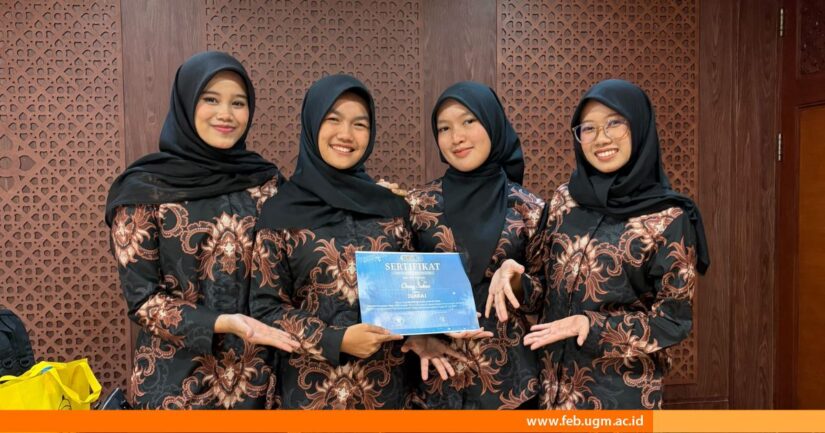
Another remarkable achievement has been made by students of the Faculty of Economics and Business, Universitas Gadjah Mada (FEB UGM). The Orang Sukses team, consisting of four Management students from the 2024 cohort—Almayla Taorayudha, Abhithah Luita Janna, Ananda Revallina Adrienne Nambella, and Ersha Diandara Madani—won first place in the Business Plan Competition of the Faculty of Agriculture, Universitas Udayana 2026 on Thursday, July 23, 2026, in Badung Regency, Bali.
This annual national-level competition was organized by the Student Executive Board (BEM) of the Faculty of Agriculture, Universitas Udayana, as part of the Forum Komunikasi Perguruan Tinggi Pertanian Indonesia (FKPTPI) Eastern Region series of events. This year’s competition carried the theme “Optimizing Innovation through Adaptive and Sustainable Business Model Design.” The team defeated finalists from several leading universities in Indonesia, including Universitas Brawijaya, Universitas Hasanuddin, and Universitas Cenderawasih.
For the competition, the Orang Sukses team presented an agro-based business idea titled “Suburin.” The business concept introduces an integrated platform that processes organic waste from communities into fertilizer and high-protein animal feed using black soldier fly larvae, commonly known as maggots.
Through its integrated platform, Suburin creates a digital ecosystem that connects three key stakeholders: communities as suppliers of organic waste, processors who convert it into fertilizer, and farmers and livestock breeders as consumers of the fertilizer. In addition, Suburin has designed a strategic collaboration with Koperasi Desa Merah Putih (KDMP) to strengthen local economic empowerment.
Interestingly, the business idea that earned them first place in the competition originated from an assignment for the Business ModelingX course. From there, they were encouraged to take the business model to the next level by participating in the competition.
Initially, we only created a Business Model Canvas (BMC) for a course assignment. However, because the feedback from our lecturer was very supportive, we decided to develop it into a full business proposal and register for this national competition,” said Ananda, one of the members of the Orang Sukses team.
Ananda explained that the journey to the final round was not without challenges. The challenges began when the team qualified for the proposal stage, which required them to submit a BMC. As students more accustomed to studying business, Ananda and her teammates had to deepen their knowledge of agribusiness, particularly fertilizer produced from black soldier fly larvae. Their journey began with conducting journal research, studying the life cycle of black soldier fly larvae, and conducting direct interviews with practitioners to better understand the core of their proposed business idea.
The Orang Sukses team’s achievement demonstrates that disciplinary limitations are not barriers to cross-disciplinary innovation. Almayla shared that developing a business idea outside their field of study encouraged her and her teammates to learn and gain new knowledge.
“Do not let limited knowledge become a reason to stop learning. When business is applied in the real world, there are many new things beyond our expectations that we need to learn and explore,” Almayla concluded.
Reportage: Najwa Anggi Namira
Editor: Kurnia Ekaptiningrum
Sustainable Development Goals