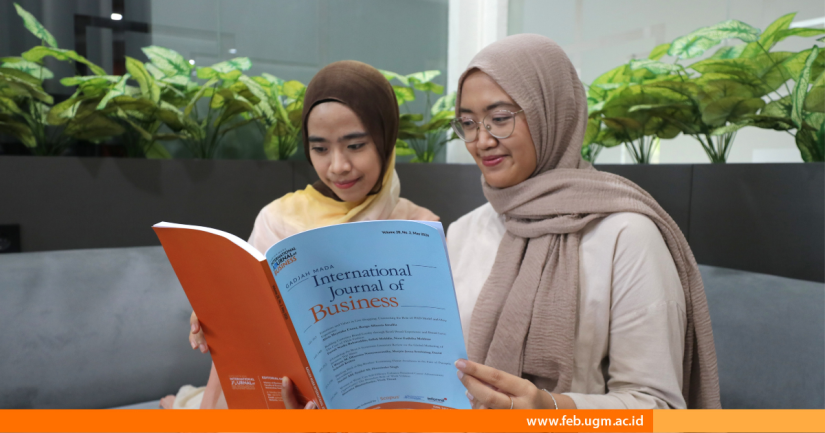
The Faculty of Economics and Business, Universitas Gadjah Mada (FEB UGM), has once again reached an important milestone in scientific publishing. The Gadjah Mada International Journal of Business (GamaIJB) has officially strengthened its reputation by advancing from Q3 to Q2 in the SCImago/Scopus rankings, and by securing a place on the ABDC Journal Quality List. The latter is one of the most widely used international references for the quality of business journals, and is employed by business schools and global academic networks.
Editor in Chief of GamaIJB, Prof. Amin Wibowo, S.E., M.B.A., Ph.D., explained that efforts to improve the journal’s quality toward Q2 had been underway since 2020. The Board of Editors and all parties involved, including article authors, internal reviewers, external reviewers, and blind reviewers, collaborated to continuously enhance the quality of GamaIJB.
“All of these parties play an important role in maintaining and improving the quality of GamaIJB. This position demands higher-quality articles, so we strive to ensure that submitted articles demonstrate strong novelty and robust research methodologies,” he explained.
One of GamaIJB’s Managerial Editors, Prof. Dr. Eduardus Tandelilin, M.B.A., stated that this achievement was not obtained instantly, but rather represents the culmination of a long journey. Initially published in Indonesian, GamaIJB transformed into a fully English-language journal through consistent publication practices, strengthened editorial processes, and expanded international networks.
“This achievement shows that GamaIJB has entered a more strategic position and moved to a higher level. It is not only institutionally established, but also internationally recognized and increasingly influential in broader academic business discussions,” he stated.
Furthermore, Tandelilin emphasized that this achievement was also made possible through the strong institutional support provided by FEB UGM.
“This accomplishment is the result of a combination of academic quality, editorial governance, and sustainable institutional efforts,” he added.
One of the main factors contributing to GamaIJB’s improved ranking is the increasing number of article citations. Within the Scopus and SCImago systems, citation counts serve as an important indicator in determining a journal’s reputation and ranking.
“The more articles from GamaIJB are cited by other researchers, the higher the journal’s index score becomes. At one point, the manuscript queue at GamaIJB even reached six months to nearly one year. Many papers were waiting to be published. This indicates that GamaIJB is increasingly regarded as one of the preferred publication destinations for researchers,” said Managing Editor of GamaIJB, Rocky Adiguna, S.E., M.Sc., Ph.D.
Internationalization strategies have also been implemented through collaborations with conferences and international academic networks. GamaIJB actively partners with various national and international conferences to increase the journal’s visibility while opening opportunities to obtain high-quality papers. In addition, GamaIJB encourages the involvement of international authors and continues to diversify its editorial board with members from various countries.
Despite achieving Q2 status and entering the ABDC List, Rocky stated that the major work has only just begun. Future challenges include maintaining the consistency of article quality, strengthening international reviewer networks, healthily increasing visibility and citations, and reinforcing the journal’s positioning at the global level.
In a separate statement, another Managing Editor of GamaIJB, Bowo Setiyono, Ph.D., emphasized that the key to sustainability lies in relevance: addressing current issues while maintaining high academic standards and credibility.
“The credibility of a journal is also influenced by the parties involved in it, including editors, reviewers, and authors. Another important factor is maintaining the relevance and timeliness of the topics discussed in the journal. Published articles must be able to address current issues and concerns developing within society and the academic world,” he stressed.
The achievement of GamaIJB not only strengthens FEB UGM’s international reputation but also makes an important contribution to building a more competitive and globally recognized Indonesian business research ecosystem.
GamaIJB is a peer-reviewed scientific journal published three times a year by MM FEB UGM. The journal covers a broad range of business fields, including marketing, finance, strategic management, operations, human resource management, e-business, corporate governance, entrepreneurship, and sustainability.
Reported by: Shofi Hawa Anjani
Editor: Kurnia Ekaptiningrum
Sustainable Development Goals