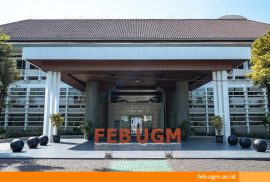

The Faculty of Economics and Business, Universitas Gadjah Mada (FEB UGM), and Hiroshima University of Economics (HUE) have once again strengthened ties between Indonesian and Japanese students through the 2026 Indonesia International Contribution Project (IICP). The program provides students with hands-on learning experiences and fosters collaborative initiatives that benefit local communities.
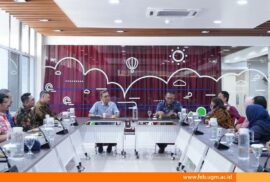
Vice Dean for Academic and Student Affairs of FEB UGM, Bayu Sutikno, S.E., M.S.M., Ph.D., expressed his hope that the established collaboration would provide students with valuable experiences and further strengthen cooperation between the two institutions. He also hoped that students would gain new insights and experiences throughout the program.
Meanwhile, Dr. Takahiro Yamate, a faculty advisor for HUE students, explained that the program was designed to address the need for a younger generation that possesses not only academic abilities but also the capacity to think independently, act responsibly, and understand societal issues. Through the program, HUE students were expected to learn more about Indonesian culture while building collaboration with FEB UGM students.
Held from September 4–15, 2026, IICP 2026 engaged HUE students in a range of activities, with a main focus on the preservation of lurik weaving. The students not only learned about the production process and cultural values behind lurik weaving but also sought to raise awareness among younger generations about the importance of preserving the tradition through educational activities in schools.
The program also involved collaboration with various partners, including LAWE, an organization committed to women’s empowerment and textile product development. Through this collaboration, students learned how local traditions can be developed into economically valuable products while maintaining their cultural identity.
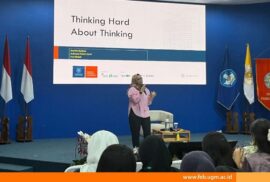
During the IICP opening ceremony, students also participated in various cultural exchange activities. HUE students introduced FEB UGM students to Japanese culture through kendama and origami. In return, they had the opportunity to learn about Indonesian food, including smoked fish, and make onigiri together.
The experience became one of the memorable aspects of the program for HUE students. One of the HUE students, Harry William Winfield Fifth, said that direct interaction between Japanese and Indonesian students was an enjoyable experience and helped them better understand each other’s cultures.
“One of the interesting parts of this experience was observing the cultural differences and different ways of interacting between the two countries. I saw this as an opportunity to become more closely involved in the lives of local communities and understand how we can contribute directly,” he said.
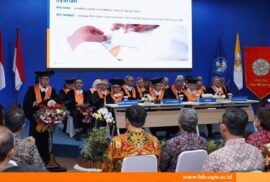
The series of IICP 2026 activities also led to several follow-up initiatives to sustain students’ contributions after the program ended. During the closing presentation, HUE students presented the activities they had carried out, including product development and sales, negotiations with companies, educational activities at elementary schools, and research on village conditions.
William said that being directly involved in the production process made him realize that the fabrics people encounter in everyday life are not merely products but also embody artisans’ skills passed down through generations. He viewed his direct interactions with local communities while learning about lurik weaving as an important lesson on connecting traditions with modern life and younger generations.
“Through my experience as the IICP leader, I learned that it is not only important to learn about lurik weaving but also to communicate its value and appeal to others and think about how the tradition can continue,” he said.
One of the program’s outcomes was reflected in product sales activity. Over two days, the students managed to sell products at up to 3.5 times the initial target. The achievement was part of the students’ efforts to connect traditional handicraft products with a broader market.
In addition to the sales activity, the students also developed a product catalog containing information such as product descriptions, sizes, prices, and other details. The catalog is expected to help companies better understand the products while providing a basis for developing potential collaborations and future orders.
At the community level, the students agreed that distributing woven products to students could continue as part of a village initiative. Starting next year, the activity is planned to be conducted regularly at eight elementary schools in Sumberarum Village.
The continuation of the initiative represents an important outcome in efforts to introduce lurik weaving to younger generations. With follow-up support from the local community, the activities initiated through IICP are expected to continue after the HUE students complete their program in Indonesia.
William also expressed his appreciation to UGM students and faculty members, as well as to various parties who supported the program’s implementation. He said that his experience in Yogyakarta had strengthened the relationship between Japanese and Indonesian students. He hoped that HUE and UGM students could continue discussing ways to promote and preserve lurik weaving.
Through these activities, IICP 2026 served not only as a cultural exchange program but also as a collaborative learning platform that connected students with real-world issues in the community. Working directly with local communities is expected to broaden students’ perspectives while further strengthening the relationship between UGM and HUE.
Reporters: Shofi Hawa Anjani and Dwi Zhafirah Meiliani
Editor: Kurnia Ekaptiningrum
Sustainable Development Goals