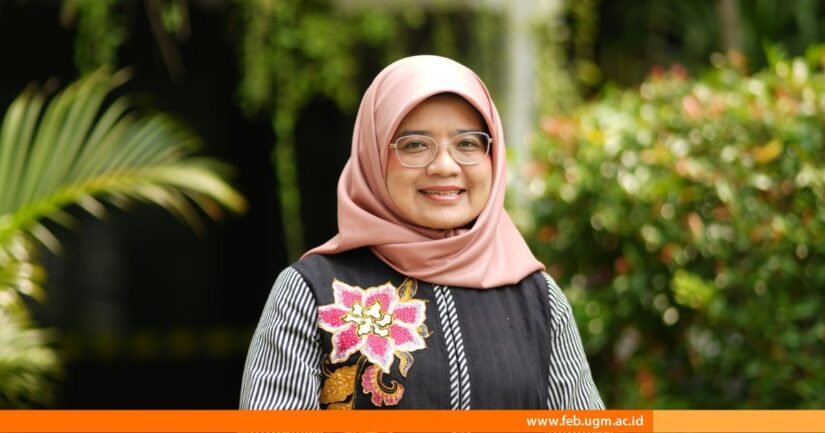
Professor Dr. Nurul Indarti, Sivilokonom., M.Si., Ph.D., a faculty member of the Faculty of Economics and Business, Universitas Gadjah Mada (FEB UGM), has been appointed as an Associate Editor of the Journal of Entrepreneurship in Emerging Economies (JEEE), an international journal published by Emerald. The journal is indexed in Scopus and Web of Science and is ranked Q1 in Scopus. She has served in the role since April 2025.
Her appointment as an Associate Editor of JEEE reflects her extensive academic track record, particularly in entrepreneurship. For more than two decades, Nurul has focused on various areas, including entrepreneurial intention, SMEs, innovation, ethnic entrepreneurship, women entrepreneurship, social entrepreneurship, and sustainability. In addition to conducting research and publishing academic works, she has extensive experience as a reviewer and has been involved with JEEE since 2020. To date, six of her articles covering various topics in entrepreneurship have been published in the journal.
For Nurul, serving as an Associate Editor is a responsibility to help maintain the quality of published knowledge. In this role, she is involved in the manuscript evaluation process, paying close attention to the importance of research questions, methodological rigor, clarity of contribution, and the quality of the peer review process.
“Being an Associate Editor is not merely about holding a position at a journal. We also have a responsibility for the quality of the knowledge that will eventually be published,” said Nurul.
In carrying out her role, Nurul aims to encourage research from emerging economies to go beyond merely highlighting the uniqueness of a particular context or dataset. In her view, research should be able to bring findings from local contexts into broader academic conversations.
She identifies one of the challenges facing research from emerging economies as the lack of a clear ability to demonstrate the contribution of interesting phenomena to theoretical development. Therefore, the editorial process should help authors strengthen their research questions, arguments, methods, and scholarly contributions.
“In my view, emerging economies are interesting not simply because their contexts are different or unique. If the only argument is that ‘Indonesia is different,’ that alone is not sufficient to constitute an academic contribution,” she explained.
Nurul said that what is more interesting is when phenomena in emerging economies demonstrate that theories commonly used to explain them are not sufficiently capable of capturing what is actually happening. She refers to this as an insufficiency of explanation. Many entrepreneurship theories have been developed in environments with relatively established institutions and markets. Meanwhile, entrepreneurs in emerging economies often operate under very different conditions, including limited resources, less-developed formal institutions, high levels of informality, rapid change, and the significant roles played by families and communities.
“Emerging economies are not merely research settings. They can serve as spaces to test, challenge, and develop theories,” said the Professor of Entrepreneurship and Innovation.
She hopes that her involvement as an Associate Editor will bring broader benefits to FEB UGM. According to her, serving on the editorial board of an international journal allows academics to be directly involved in how knowledge is evaluated, debated, and developed within the global academic community.
Nurul noted that this experience also provides valuable insights into international journal standards, the assessment of research novelty and contribution, the positioning of manuscripts within the existing literature, and the peer-review process. These lessons can also be shared with colleagues, early-career researchers, and doctoral students at FEB UGM.
“I also hope this can create more opportunities for international collaboration and networking. The benefit is not only visibility, but also institutional learning. I hope this involvement will contribute to strengthening the presence of FEB UGM and Indonesia in international academic conversations,” she said.
For young Indonesian researchers, including researchers at FEB UGM, Nurul advised that publication should not be the starting point when designing research. Researchers should first identify important scientific questions to be addressed, and then develop their research based on a strong understanding of the literature and the contribution they seek to make.
She also emphasized that the publication process requires perseverance. Revisions and rejections are part of the academic journey and can provide opportunities to learn and improve research quality. Ultimately, according to Nurul, an academic track record is determined not solely by the number of publications but also by curiosity, rigor in data handling, openness to criticism, and perseverance in continuously improving one’s work.
“A good researcher is not simply someone who produces many publications, but someone who has curiosity, is disciplined with data, is open to criticism, and has the perseverance to improve their work continuously. Ultimately, that is the academic legacy we leave behind,” she concluded.
Reportage: Kurnia Ekaptiningrum
Sustainable Development Goals