
The application of Artificial Intelligence (AI) to support environmental sustainability is increasingly becoming a reality on university campuses. Universitas Gadjah Mada (UGM) is among the pioneers in integrating AI into campus management systems to reduce carbon emissions and improve resource efficiency.
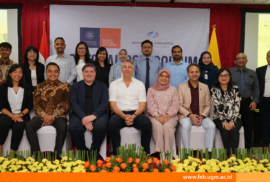
This was highlighted by Prof. Dr. Ir. Ridi Ferdiana, S.T., M.T., IPM, during the FEB UGM Podcast titled Implementing AI on Campus: Smart Solutions for a Greener Future. He explained that UGM is currently transforming from a smart campus into an Intelligent University through its UGM IoT initiative, which has led to the development of various data-driven systems, including UGM Gate.
“UGM Gate has a highly visionary sustainability mission to reduce carbon emissions by regulating the flow of vehicles. This does not mean vehicles are prohibited from entering the campus; rather, alternative transportation options are provided to facilitate movement from one point to another,” said Ridi.
Registered members of the university community can access the campus automatically, while external vehicles are subject to a carbon tax as part of the university’s sustainability strategy. The system also supports ride-sharing algorithms and is currently being piloted at the UGM Central Office Building before being gradually expanded across the campus.
The data collected through the system serves as a foundation for designing more efficient parking policies while encouraging the university community to shift toward environmentally friendly transportation options, such as Trans Gadjah Mada (the university’s electric bus service) and Pit UGM (the campus bicycle-sharing program). Nevertheless, Ridi emphasized that technology alone is only one component of a much broader solution.
“AI for sustainability—AI is only part of the solution. Out of the entire solution, AI contributes only about 20%, while the remaining 80% lies in procedures and the problem-solving process itself,” he emphasized.
Beyond its implementation on campus, Ridi also discussed AI’s broader potential in addressing global sustainability challenges, particularly climate change. According to him, AI enables scientists and policymakers to simulate the impacts of various environmental factors more quickly and accurately than conventional methods.

“Science has long established that forests retain water. When forest cover declines drastically, there are inevitable consequences. AI allows us to analyze these impacts much faster and even simulate them based on the Earth’s current conditions,” he explained.
Climate phenomena such as El Niño and La Niña, which have made rainfall patterns increasingly unpredictable, can also be modeled more comprehensively. AI enables simulating the impacts of deforestation on rainfall distribution and assessing potential flood risks.
Despite its promising potential, Ridi stressed that implementing AI for sustainability is not without challenges. Public resistance remains a primary obstacle, as policies such as carbon taxes may face opposition from various stakeholders.
Another challenge lies in data management. At UGM Gate, the system generates between 30 and 60 gigabytes of data every month, creating a dilemma between long-term data storage needs and infrastructure limitations.
Infrastructure readiness is another critical concern. Deploying AI at a production scale requires substantial computing capacity, reliable electricity, and adequate cooling systems to support continuous operations.
Ridi emphasized that the success of AI implementation depends on real-world usage and continuous improvement. Stakeholder support is equally essential, as resistance from users or policymakers can significantly hinder adoption.
More importantly, he underscored the need to maintain human involvement at every stage of AI implementation.
“We must keep humans in the loop. We need to validate that the AI processes are functioning correctly and continuously. That is why the concept of explainable AI is so important,” he stressed.
This human-centered AI approach ensures that technology operates in ways that align with users’ contexts and values. For Ridi, this represents the true essence of AI for sustainability, not merely developing advanced technology, but creating technology that delivers meaningful and lasting impact.
Reporter: Dwi Zhafirah Meiliani
Editor: Kurnia Ekaptiningrum
Sustainable Development Goals