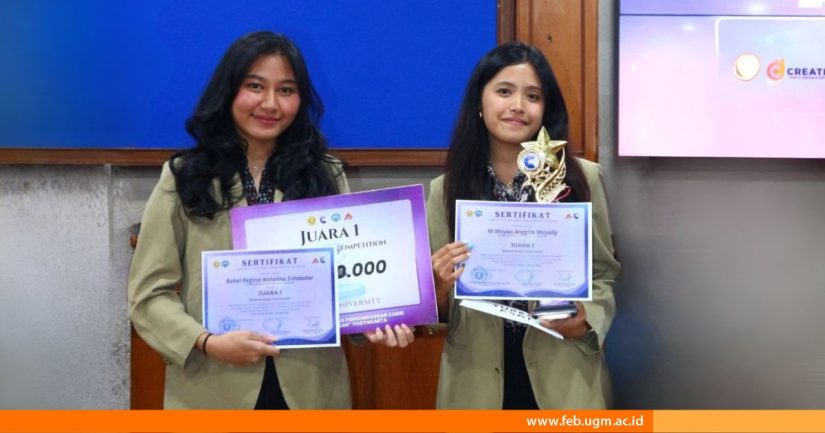
Students from the Faculty of Economics and Business, Universitas Gadjah Mada (FEB UGM), have once again achieved national recognition. Ni Wayan Anggita Mayolly (Accounting 2024) and Rahel Regina Nataline Sidabutar (Accounting 2024) won First Place in the 2026 National Essay Competition.
The competition was part of Clash of University 2026, organized by the Student Executive Board (BEM) of the Faculty of Economics and Business, UPN “Veteran” Yogyakarta, on 28 June 2026. Carrying the theme “Empowering Youth for Indonesia’s Sustainable Future,” the event highlighted the importance of empowering young people to develop critical, creative, and solution-oriented ideas in addressing the nation’s challenges.
In the competition, May and Rahel explored disparities in the implementation of Environmental, Social, and Governance (ESG) practices between large corporations and micro, small, and medium enterprises (MSMEs) in Indonesia. They emphasized that while many MSMEs have already adopted sustainable practices, they often struggle to demonstrate these efforts to investors and business partners.
“We were inspired by the paradox within Indonesia’s ESG ecosystem. While hundreds of corporations publish sustainability reports, around 56.14 million MSMEs which contribute nearly 60% of the country’s GDP remain largely excluded from the ESG ecosystem,” said May.
To address this issue, the team proposed ESGenpact, a student-driven digital ESG assistance ecosystem supported through the e-ESGenpact platform. The platform integrates several key features, including ESG Assessment and Scoring, a Benchmarking Dashboard, Progress Reports, and a Sustainable MSME Directory.
The idea was developed through extensive secondary research using data from Indonesia’s Financial Services Authority (OJK), the Ministry of MSMEs, KPMG, PwC, and Deloitte. The concept was then refined through continuous discussions and strengthened with flow diagrams, platform mock-ups, SWOT-TOWS analysis, risk mitigation strategies, and key performance indicators to ensure its practical applicability.
Within the platform, university students serve as ESG companions, analysts, and reviewers, participating in a structured process that includes talent sourcing, ESG bootcamps, field projects, and ESG certification to assist MSMEs directly.
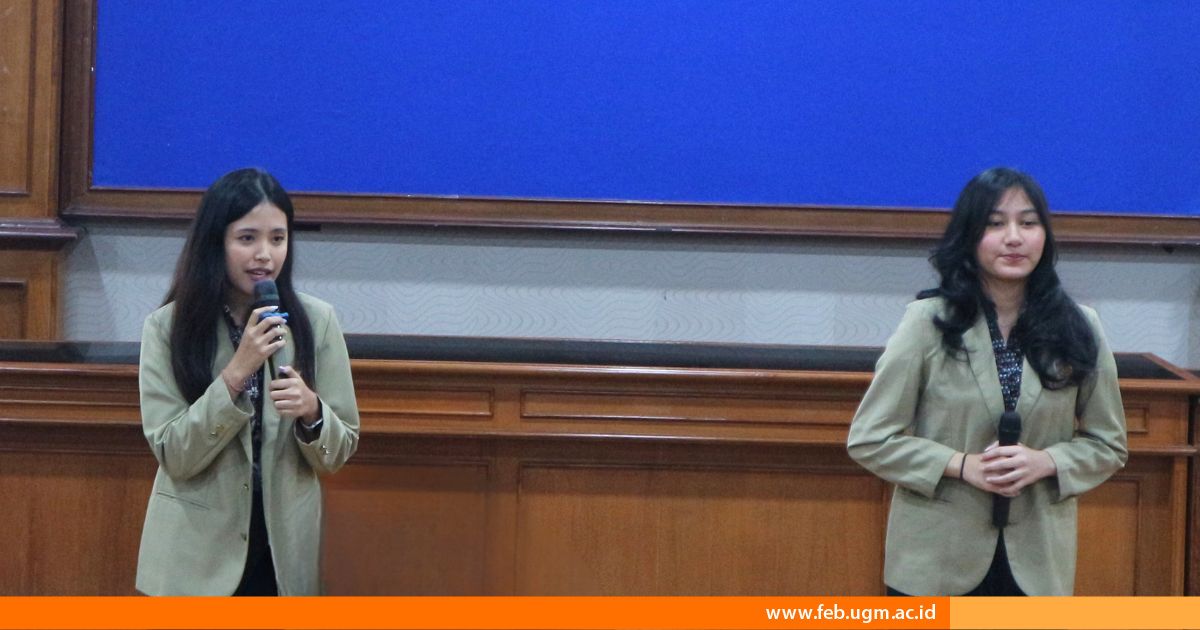
“University students hold a strategic position as agents of change who can bridge global sustainability demands with the limited capacities of MSMEs,” May explained.
Rahel added that one of the biggest challenges during the competition was integrating data from numerous sources into a coherent and convincing narrative. Nevertheless, they successfully overcame this challenge through continuous discussions and multiple rounds of revision until the proposal was fully refined.
“We also had to ensure that ESGenpact was genuinely practical and not merely another digital platform similar to existing solutions,” Rahel said.
The competition provided valuable learning experiences for both students, particularly in strengthening teamwork, developing solution-oriented thinking toward real socio-economic issues, and enhancing their ability to formulate structured ideas and conduct risk management analysis.
They hope to further develop ESGenpact through community service programs (KKN), pilot projects with MSMEs, and collaborative academic research involving the university and ESG communities.
“Start with real problems that you truly understand and care about, then strengthen your ideas with credible data,” Rahel encouraged.
Reporter: Dwi Zhafirah Meilian
Editor: Kurnia Ekaptiningrum
Sustainable Development Goals