Innovation doesn’t end with the birth of an idea; it requires a process to transform that idea into a solution that addresses real-world problems. In addition to creating economic value, a solution must also consider social and environmental aspects, as well as the sustainability of its impact.
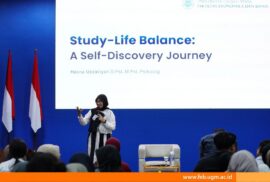
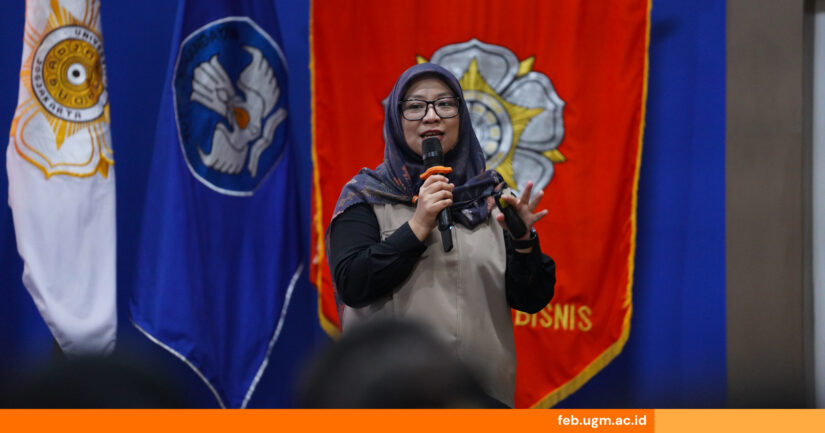
Megawati Syahril, Founder and Chief Executive Officer of PT Segala Sukses Bersama, encouraged FEB UGM students to view social issues in their communities as opportunities to create value and develop solutions that can make a difference. She shared her experience in developing Sagata, a business that supports the economic independence of artisans with disabilities in Yogyakarta through handmade products, such as bags and wallets.
During the “Future Leaders for Impact” event titled “Create Innovation and Sustainable Solutions”, organized by the Career and Student Development Unit (CSDU) of FEB UGM for the class of 2026 on September 15, 2026, Megawati explained that the development of Sagata stemmed from issues such as limited employment opportunities, stigma and discrimination against people with disabilities, and skills that were not yet fully aligned with market demands. For Megawati, the solutions developed must go beyond mere products; they must also address the systems that ensure these impacts can be sustained over time.
In developing solutions, he introduced five criteria to consider: desirable, feasible, viable, inclusive, and sustainable. These five criteria are used to determine whether the beneficiaries truly need an idea and have the potential to be accepted by the market.
According to him, products in the social business sector must still be of high quality so that consumers do not purchase them solely out of pity. Products that offer value to consumers will encourage repeat purchases and enable the business to operate sustainably.
Sustainability must also be built across various dimensions: social, economic, environmental, and organizational. In practice, Sagata implements a zero-waste approach by repurposing fabric scraps into other products, while simultaneously establishing standard operating procedures and quality control measures.
From an economic perspective, business sustainability must be supported by margin management, repeat orders, and cash flow. Meanwhile, from a social perspective, the business is geared toward building capacity, creating job opportunities, and supporting artisans’ economic independence.
Megawati also shared examples of other businesses developed in partnership with orphans, such as a vegetable stand and a toasted-bread shop. According to her, solving social problems doesn’t always have to start on a large scale.
“Don’t just focus on formal channels. The world isn’t as straightforward as a textbook. If possible, start now, while you’re still students, to be productive,” said Megawati.
She encouraged students to observe issues in their surrounding communities and connect them to their existing knowledge. In her view, making an impact can begin with simple steps, as long as value can be provided to others.
“Every community inevitably faces social problems. See what we can do to create value and deliver value, then apply the economic knowledge you have. If you can do more, start right now,” she concluded.
Reported by: Dwi Zhafirah Meiliani
Editor: Kurnia Ekaptiningrum
Sustainable Development Goals