Indonesia has significant opportunities to benefit from the development of frontier artificial intelligence (AI) technologies, according to Indonesia’s Vice Minister of Communication and Digital Affairs, Nezar Patria. These opportunities are reflected in AI’s substantial potential contribution to the Indonesian economy.
Nezar stated that Indonesia’s digital economy was projected to approach USD 100 billion in 2025. Meanwhile, various studies estimate that AI adoption could contribute up to USD 366 billion to Indonesia’s gross domestic product (GDP) by 2030. Across Southeast Asia, AI’s economic potential is estimated at USD 1 trillion, with Indonesia potentially accounting for approximately 40 percent of that figure.
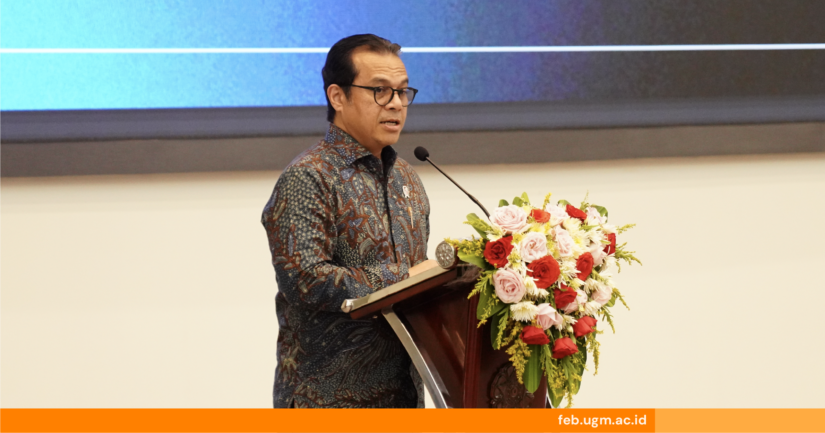
Nezar made these remarks during his presentation titled “Artificial Intelligence for Local Governments: Accelerating Digital Transformation and Improving Performance Amid Opportunities and Challenges” at the National Seminar, Award Ceremony, and Launch of the GM-DTGI 2026 Dashboard, held at the Faculty of Economics and Business, Universitas Gadjah Mada (FEB UGM), on Thursday (November 5, 2026).
Nezar expressed his appreciation to UGM, particularly FEB UGM and the GM-DTGI research team, for developing an index to measure digital transformation governance in local governments. According to him, the index provides a more detailed picture of digital technology adoption at the regency and municipal levels, complementing existing digital transformation assessments that have largely focused on the national and provincial levels.
“What UGM has done enriches the measurement of Indonesia’s digital transformation index. Its assessment is far more detailed and substantive in its examination of how digital technologies are adopted by local governments. It is at the local level that public services are truly on the front lines,” he remarked.
Nezar explained that over the past two years, GM-DTGI coverage has expanded from 429 to 508 regencies and municipalities. This expansion is considered essential to gaining a more comprehensive understanding of digital transformation among Indonesia’s local governments.
However, he emphasized that the index’s primary purpose is not merely to identify the highest- or lowest-performing regions. More importantly, GM-DTGI is expected to help local governments address three fundamental questions: where they currently stand in digital transformation, which areas require improvement, and which regions can serve as references for adopting best practices.
“This index is not intended to determine who is ahead and who is falling behind. Its purpose is to answer three important questions: Where do we stand in this digital transformation landscape? What needs to be improved? And which regions can we learn from? Which best practices can serve as shared benchmarks so that we can progress together?” he explained.
AI’s Economic Potential and Opportunities for Indonesia
Nezar highlighted that AI development presents substantial economic opportunities for Indonesia. He noted that Indonesia’s digital economy was projected to approach USD 100 billion in 2025. Meanwhile, various studies estimate that AI adoption could contribute up to USD 366 billion to Indonesia’s gross domestic product (GDP) by 2030.
At the Southeast Asian level, AI’s potential contribution to the regional economy is estimated to reach USD 1 trillion, with Indonesia potentially accounting for approximately 40 percent of that value. However, some studies have revised the projected timeline for realizing this potential to 2035, taking into account geopolitical dynamics and global developments.
“We can see that the growth potential is considerable,” Nezar stated.
In response to the development of frontier AI, Nezar argued that Indonesia does not necessarily need to compete to develop the largest AI models against countries that currently dominate the technology, such as the United States and China. Instead, Indonesia’s opportunities lie in its ability to adapt and adopt frontier AI technologies to generate tangible benefits for public administration and the national economy.
He identified five key strengths that Indonesia can leverage within the global AI value chain. First, Indonesia has a large market and user base, enabling the government to be an early adopter and encouraging the adoption of technological standards. Second, the country possesses extensive data resources and valuable local contexts, provided that these are managed accurately, systematically, and securely.
Third, Indonesia can focus on developing sector-specific AI solutions designed to address particular challenges. Rather than relying on a single large-scale AI model for every application, the country can develop or adopt more specialized models tailored to the needs of individual sectors.
Fourth, Indonesia can strengthen its position within the AI ecosystem by developing data infrastructure, diversifying technology suppliers, and enhancing domestic expertise. Fifth, the country can help shape regional AI standards and governance frameworks by drawing on local governments’ experience implementing AI technologies.
Five Strategies for AI Adoption in Local Governments
To encourage AI adoption across government institutions, Nezar outlined five national priorities established by the Ministry of Communication and Digital Affairs (Komdigi) that could serve as a foundation for local governments in implementing AI technologies. These priorities cover healthcare, bureaucratic reform, education, smart cities, and food security.
Implementation efforts are supported by the development of an AI Center of Excellence to promote AI research and applications across government and industry; the formulation of an AI roadmap and ethical guidelines; capacity-building programs for civil servants through applied AI and AI agent training; and ecosystem development through collaboration between universities and industry.
Nezar emphasized that local governments should begin adopting AI by addressing the most pressing public service challenges. Each region could identify two or three priority issues, taking into account their potential impact on service delivery times, costs, and public satisfaction as indicators of success.
Furthermore, local governments need to improve data quality and digital architecture to ensure that data is standardized and can be exchanged securely. Human resource readiness is another critical consideration. Civil servants must be equipped with the skills to evaluate AI-generated outputs, identify potential hallucinations and biases, and maintain accountability in decision-making.
GM-DTGI as a Platform for Collaboration in AI Development
Nezar encouraged GM-DTGI to evolve beyond an annual ranking instrument into a comprehensive map of local governments’ readiness to enter the AI era, while also serving as a platform for knowledge sharing and interregional collaboration.
He proposed establishing pilot regions for responsible AI implementation, tailored to each region’s priority challenges. In addition, an AI Public Service Lab could be developed as a collaborative platform for identifying problems, designing solutions, conducting limited-scale trials, measuring impacts, and scaling up technologies that demonstrate tangible benefits. Capacity-building efforts should also be strengthened through AI governance curricula and certification programs covering technical competencies, ethics, and change leadership.
Within this collaborative framework, universities such as UGM could contribute through research and independent evaluation. The central government would provide policy frameworks and digital architecture, while local governments would take ownership of the challenges being addressed and provide the necessary data and business processes. Alum networks, including KAGAMA (Universitas Gadjah Mada Alumni Association), could also help connect various stakeholders.
Reporter: Kurnia Ekaptiningrum
Sustainable Development Goals