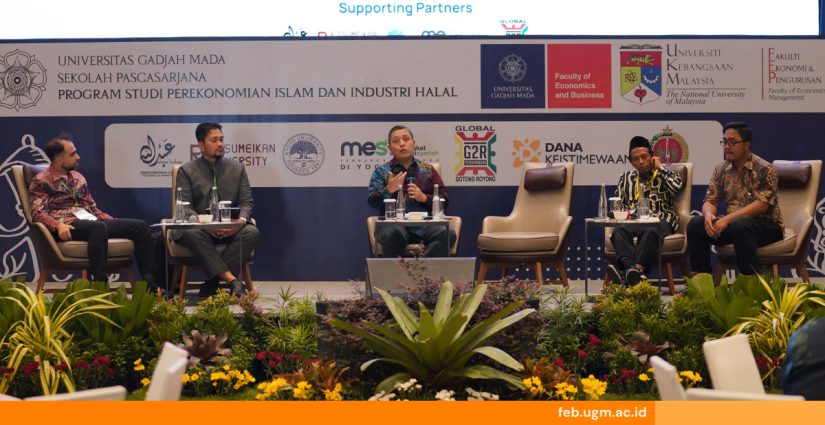
The halal economy is emerging as a potential new driver of the global economy. This insight surfaced during an academic forum discussing the future direction of the halal industry based on research, technology, and global literacy, which brought together experts in halal economic studies at the panel discussion of The International Conference on Islamic & Halal Economic Studies (ICIHES) on Monday (3/11/2025).
Associate Prof. Dr. Mohd Fauzi bin Abu Hussin from Universiti Teknologi Malaysia stated that in the past 50 years, the Islamic economy has grown rapidly but still holds a relatively small market share compared to the potential of the global Muslim population.
“Although many Islamic economic instruments are now in place, public understanding still needs to improve. The main challenge is whether Muslims are truly utilizing the available Sharia-compliant financial instruments,” he said.
He revealed that his institution has developed various programs related to halal studies, including the establishment of a Master of Science in Halal program. The program integrates halal perspectives with contemporary issues and the latest technologies, with a focus on halal research, particularly in the areas of authenticity and halal food safety.
“The global challenge today is that countries such as China, Japan, and Korea have significant potential as producers of halal products. However, if they aim to enter the Muslim market, they need halal certifications from Southeast Asian countries,” he added.
He emphasized that halal is not merely an opportunity for profit but a standard of ethics, transparency, and responsibility.
“In the future, the halal economy will also serve to educate global producers by spreading understanding of ethical standards and transparency in halal products, as well as promoting quality standards,” he said.
Prof. Ir. Yuny Erwanto, S.Pt., M.P., Ph.D., IPM, from the Faculty of Animal Science UGM, discussed halal food authentication among MSMEs. He noted that Indonesia’s food industry is unique because it is MSME-based mainly. However, significant challenges remain, including cross-contamination and inaccurate ingredient composition, which can be caused by shared grinding machines and complexities within the local meat supply chain.
He presented the efforts his team conducted in developing halal detection methods for food products in Indonesia. These methods employ analytical techniques that can reliably, sensitively, and robustly identify the origins of food components, even in complex food matrices, by utilizing specific biomarkers derived from oils or fats, proteins, and DNA.
Meanwhile, Assoc. Prof. Dr. Ammar Khasan from Ritsumeikan University, Japan, stated that Japan plays a role not only as a consumer but also as an academic environment for halal studies.
“The challenge in Japan is that society tends to view halal as something intended only for Muslim tourists and equates halal with Muslim-specific products,” he explained.
He added that halal values actually align with Japanese culture, particularly in terms of cleanliness, food safety, and ethical production. According to him, halal is not only for Muslims but also represents universal human values.
Akhmad Akbar Susamto, S.E., M.Phil., Ph.D., an Islamic economics expert from FEB UGM, elaborated that the halal industry ecosystem encompasses various interconnected sectors, including Sharia-compliant financial services, halal tourism and hospitality, and halal fashion and lifestyle industries, all driven by innovation. Halal can become a new source of economic growth by providing added value, increasing consumer demand, stimulating competition and market diversification, and driving product and process innovation.
He emphasized that the development of the halal industry has become a new momentum within Indonesia’s industrialization agenda. With its large Muslim population, Indonesia possesses a natural advantage in advancing halal-based industries across multiple sectors.
“The implementation of halal certification not only provides religious assurance but also serves as a strategic tool to strengthen domestic industries,” he continued.
Meanwhile, Prof. Dr. Abdul Rohman, S.F., M.Si., Apt., from the Faculty of Pharmacy UGM, highlighted a rising trend in halal products. Scopus data recorded 2,248 publications related to halal products, showing an exponential growth trend. However, harmonizing halal standards remains a challenge due to variations in jurisprudence and fiqh methodologies.
“Therefore, halal research requires international collaboration to develop scientific standards and methods capable of maintaining halal integrity,” he concluded.
Reporter: Shofi Hawa Anjani
Editor: Kurnia Ekaptiningrum
Sustainable Development Goals