
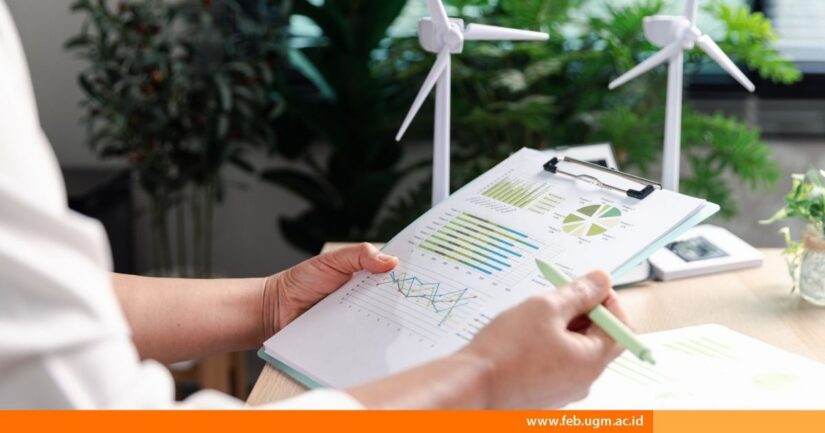
Artificial intelligence (AI) opens new opportunities for companies to manage data and prepare sustainability reports. However, its use cannot rely solely on technological capabilities. Data quality, verification processes, ethics, and human involvement remain essential to ensuring that sustainability information is reliable.
This was conveyed by Dewi Wulansari, S.E., M.Sc., a lecturer at the Department of Accounting, Faculty of Economics and Business, Universitas Gadjah Mada (FEB UGM), in the AI for Future Leader Podcast series titled “AI & The Future of Sustainability Reporting.” She explained that AI can help companies process and analyze data, measure sustainability performance, and manage sustainability-related risks. However, its use still requires human oversight and involvement.
The Development of Sustainability Reporting
Sustainability reporting is not a new concept that emerged alongside technological developments. It dates back to the 1980s through the concept of social reporting, which emphasized social aspects. From the 1990s to the early 2000s, the concept evolved into social and environmental reporting and corporate social responsibility reporting. In the 2010s, its scope expanded further through the concept of sustainability reporting. In the 2020s, the term ESG (Environmental, Social, and Governance) became increasingly common in sustainability reporting.
“The concept of sustainability reporting did not emerge suddenly. We now know the term ESG, but it focuses more on investors, while sustainability has a broader scope,” Dewi explained.
According to Dewi, these developments were also driven by the need to improve the comparability of information across companies. Initially, sustainability reporting was voluntary and lacked uniform standards. This condition subsequently encouraged the development of sustainability disclosure standards, including the IFRS Sustainability Disclosure Standards.
These standards include IFRS S1, which addresses sustainability-related financial disclosures, and IFRS S2, which addresses climate-related financial disclosures. In Indonesia, these standards will be effectively implemented on January 1, 2027, taking into account the sector and the company’s size.
AI as a Supporting Tool
Technologies such as big data, AI, and machine learning have the potential to help companies prepare sustainability reports. AI can be used to process large volumes of data, conduct analysis, support measurement, and identify and manage risks.
Dewi explained that AI, for example, can help estimate emissions through scenario analysis based on transportation usage and travel distance. The data can then be processed into information that supports the measurement of a company’s sustainability performance.

“However, using AI directly to prepare reports needs to be approached with caution. Research on sustainability reports in the financial sector from 2020–2021 found that some companies had highly similar reports because they used the same templates, creating a risk of uniform reporting,” Dewi said.
She also emphasized that AI should be positioned as a supporting tool in data processing and analysis. At the same time, humans remain responsible for reviewing, understanding, and ensuring the accuracy of the information used in reports.
What Does the Future Hold for Accountants?
Technological developments are also transforming the accounting profession. Accountants are no longer expected only to understand financial recording and reporting processes, but also how sustainability data is collected, measured, analyzed, and linked to a company’s financial performance.
The ability to utilize technology is becoming increasingly relevant. Amid increasingly complex reporting requirements, accountants can play a more strategic role in ensuring that technology is used to produce relevant and accountable sustainability information.
“The future of sustainability reporting requires collaboration between technology and human expertise. AI can accelerate data processing, while humans remain essential for verifying the information. Therefore, AI can be understood as a technology used to produce high-quality sustainability information,” Dewi concluded.
The full video of the FEB UGM Podcast, AI for Future Leader Podcast, titled “AI & The Future of Sustainability Reporting,” is available at: http://ugm.id/AIMasaDepanPelaporanKeberlanjutan
Report: Najwa Anggi Namira
Editor: Kurnia Ekaptiningrum
Sustainable Developmnet Goals