Economic issues do not exist in isolation. They are closely intertwined with the quality of democracy, civil liberties, and law enforcement, all of which shape a country’s policy direction. One year after the Seven Urgent Economic Demands (7DDE) were put forward, the question is no longer simply what has been achieved, but where Indonesia’s economy and democracy are heading.
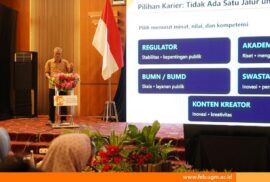
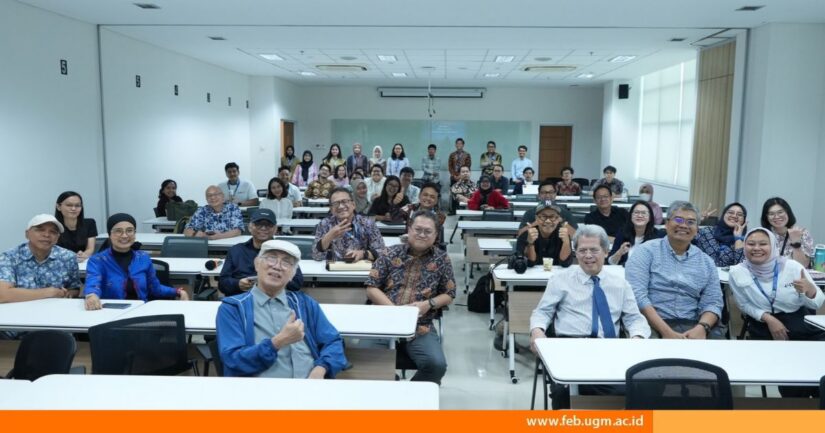
This question was at the heart of a discussion forum marking the first anniversary of the Seven Urgent Economic Demands (7DDE), initiated by the Indonesian Economists Alliance (AEI). The forum featured public figures including Okky Madasari, Father Franz Magnis-Suseno, Todung Mulya Lubis, and Bivitri Susanti as discussion speakers. The forum was held on Friday (25/9/2026) at the FEB UGM Learning Center.
Okky opened the discussion by emphasizing that economic analysis cannot be separated from the state of democracy and civil liberties in Indonesia. She highlighted the connection among control over economic resources, militarization in the economy, and repression of freedom of expression.
She cited the acquisition of an MNC by a defense-related business group with close ties to the military as an example. According to her, such control over the media industry could influence the range of news accessible to the public and potentially lead to greater uniformity in media voices.
As a cultural activist, Okky proposed culture as a means of resistance. She argued that economists’ demands need to be translated into messages that can reach those who need to hear them, as well as the wider public.
“If certain groups indeed control the media, then we need to provide more alternative media and more alternative information,” Okky emphasized.
Father Magnis also stressed that Indonesia’s economy can only be considered to be functioning properly when it supports social justice. He stated that around 60 percent of the population remains insufficiently prosperous, while access to basic education and healthcare has yet to be fully guaranteed. According to him, the government has been less receptive to criticism, citing economic growth of around 5 percent per year.
He also pointed out that the House of Representatives (DPR) does not yet fully represent the people and that the reform agenda to eradicate corruption, collusion, and nepotism has not been fully achieved. Nevertheless, he noted that space for public expression remains open to students, civil society organizations, and religious groups.
Bivitri Susanti examined these issues from two perspectives: the Constitution and the formulation of laws and policies. Regarding the Constitution, she highlighted claims about Indonesian socialism that are often used to justify programs criticized by civil society. She also discussed funding for the Free Nutritious Meals (MBG) program, which, in her view, should not be included in the education budget allocation, as stipulated by a Constitutional Court ruling.
She acknowledged the public’s skepticism toward the legislative process. One reason, she said, is that seven of the eight factions in the DPR are part of the government coalition, making it more likely that legislation will reflect the interests of those in power. She also referred to the ongoing revision of the Financial Sector Development and Strengthening Law (P2SK Law).
Regarding policymaking, Bivitri stated that cost-benefit analysis should serve as the basis for policy decisions. However, she argued that data are often overlooked and that political negotiations may influence some statistics. According to her, businesses need legal certainty, which can only be achieved when law enforcement agencies exercise their authority independently.
“Without legal certainty, business and economic activity will stagnate, and investment will not enter a country that lacks legal certainty. But the rule of law also means ensuring institutionally that law enforcement agencies do not become instruments [of power],” Bivitri said.
In closing, Bivitri encouraged participants to continue speaking out even when results are not immediate. She emphasized that criticism should be delivered in a structured and data-driven manner.
“Do not simply speak out, but continue to speak up with a more systematic structure,” Bivitri said.
The discussion continued with input from students. A representative of the FEB UGM Student Executive Board (BEM FEB UGM) highlighted three key points: the importance of preserving spaces for public expression, ensuring that economic growth is genuinely felt by lower-income communities, and expanding regional autonomy in the economic sector so that regions can develop their own potential.
Responding to the speakers, economist Prof. Dr. Mohamad Ikhsan stated that trust is currently Indonesia’s most valuable asset. Amid high debt burdens, he emphasized that the government should not overlook market confidence. According to him, reform needs to begin with the political market.
The forum underscored the importance of ensuring that economists’ ideas do not remain confined to discussion rooms, but continue to be communicated to the wider public, including through classrooms.
Report: Dwi Zhafirah Meiliani
Editor: Kurnia Ekaptiningrum
Sustainable Development Goals