
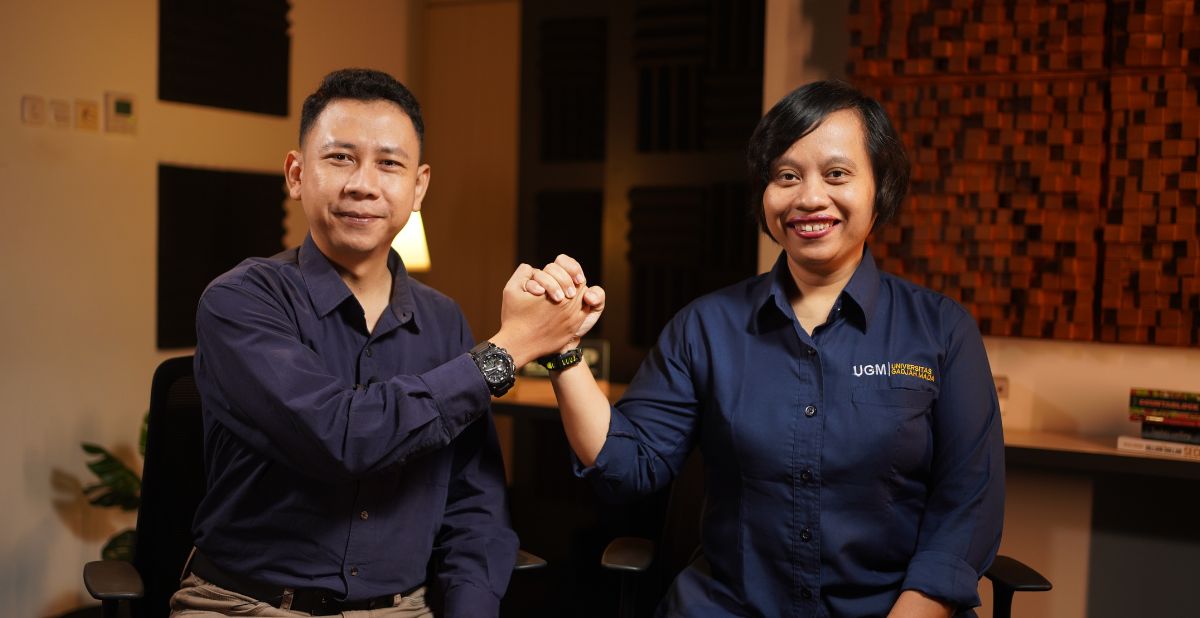
Not all brilliant ideas stem solely from intelligence. In many cases, innovation is determined not only by individual ability but also by the strength of psychological capital and the support of social capital. These findings were revealed in research conducted by lecturers from the Department of Management at the Faculty of Economics and Business, Universitas Gadjah Mada (FEB UGM), RR. Tur Nastiti, M.Si., Ph.D., and Agi Syarif Hidayat, S.E., M.M., a lecturer at the Faculty of Economics and Business, Gunung Jati University.
Tur Nastiti explained that the research was conducted with participants in the Independent Study program, Merdeka Belajar Kampus Merdeka (MBKM), using Partial Least Squares Structural Equation Modeling (PLS-SEM). This method was chosen because it can analyze complex data that is not always normally distributed and provides strong predictive performance. Out of the thousands of questionnaires distributed, 6,409 respondents met the criteria for analysis.
“We investigated how psychological capital plays a role in driving innovative behavior, and how social capital acts as a link that strengthens its effects,” she explained during the Research Series 2.0: How Connections Build Innovation program.
The research findings revealed that individuals with high psychological capital tend to be more innovative. This psychological capital comprises four main elements: self-efficacy, resilience, optimism, and hope. The combination of these four aspects encourages individuals to be more confident, willing to take risks, and open to new experiences.
Agi Syarif Hidayat explained that these traits not only foster self-confidence but also help individuals to build and maintain closer social relationships. This environment, characterized by mutual trust and support, he argued, provides fertile ground for innovation to flourish.
He explained that the courage to step out of one’s comfort zone and openness in interacting with various parties enable individuals to expand their social networks. Through strong networks, they gain access to information, support, and feedback that further enrich innovative ideas.
Furthermore, social relationships grounded in trust also foster collaboration, knowledge exchange, and effective coordination in bringing ideas to fruition.
“When individuals are in an environment with aligned visions and goals, the process of mutual motivation and inspiration occurs naturally, enabling innovation to develop sustainably,” he explained.
Furthermore, this study found that social capital is not merely a connecting factor but also a key driver of the innovation process. Individuals with supportive social networks are more motivated to develop new ideas and turn them into tangible innovations.
“These findings have significant implications for the world of work and education. In an organizational context, leaders play a vital role in building social capital within teams. Close collaboration not only fosters the emergence of new ideas but also enhances the success of implementing them into tangible innovations,” explained Agi.
On the other hand, the use of technologies such as Artificial Intelligence (AI) must be balanced with the strengthening of social interaction. Whilst technology can enhance efficiency, if not applied wisely, it may reduce the social interaction that is crucial for innovation.
In the world of education, particularly the MBKM program, Agi stated that educational programs should not only focus on technical skills but also cultivate the psychological aspects that support innovation and collaboration. Furthermore, fostering an innovative mindset and a spirit of cooperation will help students navigate the increasingly complex challenges of the workplace.
Tur Nastiti added that the best innovations arise from a combination of individual strengths and environmental support. This is because, in an ever-changing world, innovation is not solely about individual intelligence. Other factors play a significant role, namely psychological capital and social capital.
“When someone possesses high self-confidence, optimism, and mental resilience, they are more willing to explore new ideas. However, without social support, without an environment that encourages, provides feedback, and opens up opportunities, those ideas may vanish into thin air,” she emphasized.
Tur Nastiti stated that these findings demonstrate that collaboration and social support are not merely supplementary but the primary catalysts in the innovation process. The stronger the social bonds formed, the greater the likelihood that an idea will develop into a tangible innovation.
More than just academic insight, these findings highlight practical implications applicable across various contexts. From creating a workplace environment that supports team collaboration and encourages knowledge exchange to strengthening relationships between individuals within an organization, all play a role in building a more inclusive ecosystem for creativity and innovation.
“So, if we want to make a breakthrough, it’s not just about our level of intelligence, but also about how strong the social networks we build are,” he concluded.
The full video of the Research Series program entitled ‘How Connections Build Innovation’ can be accessed via: http://ugm.id/CaraKoneksiMembangunInovasi
Reportage by: Kurnia Ekaptiningrum
Sustainable Development Goals