Environmental awareness can begin with simple actions that encourage community creativity. With this spirit, students from the Faculty of Economics and Business, Universitas Gadjah Mada (FEB UGM), have promoted circular economy practices by transforming discarded glass bottles into valuable products in Nusa Lembongan, Bali.
As part of the 2026 UGM Community Service Program (KKN-PPM) Team Nirwana Nusa Penida, Khania Amanda Avendri, a Management student at FEB UGM, together with Muhammad Azka Khairur Rahman, a Computer Science student, initiated the Bottle Painting Upcycling Art Workshop as a community empowerment program. Held on Sunday, August 2, 2026, the workshop encouraged residents to transform used glass bottles into artistic creations while raising awareness of sustainable waste management.
The workshop was inspired by the challenges the Nusa Lembongan community faces in managing glass bottle waste. As a small island, we find it difficult to transport discarded glass bottles to the mainland due to high transportation costs and the significant risk of breakage during shipment. As a result, glass bottle waste continues to accumulate due to ineffective management.
According to Khania, the upcycling initiative offers more than just a solution to waste management. It also serves as an entry point to raise public awareness of the economic potential of materials often considered worthless, while providing a creative space for the community.
“We hope this activity not only helps reduce waste but also creates an enjoyable opportunity for the community, especially children and mothers, to experience something new,” said Khania.
Building on this idea, the team also expanded participation by inviting tourists visiting Nusa Lembongan to join the workshop. Promotion was carried out through social media and direct outreach to visitors in several tourist areas.
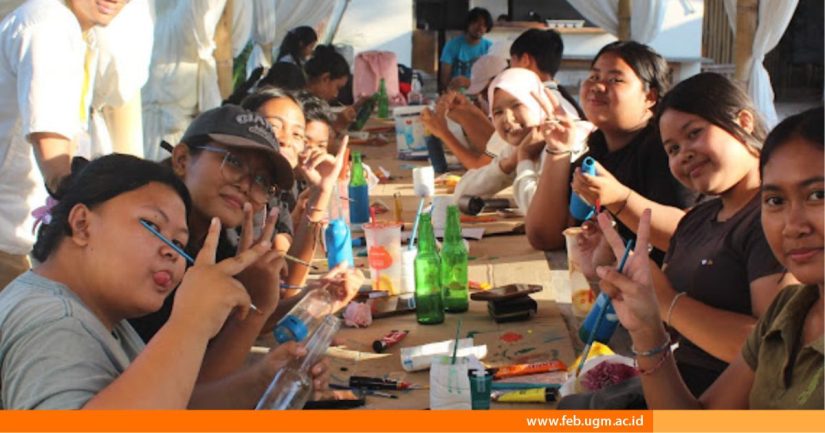
Throughout the event, participants enthusiastically expressed their creativity by painting on used glass bottles. The wide variety of colors and designs demonstrated that discarded bottles can be transformed into aesthetically pleasing and valuable works of art.
“This was my first time painting on a bottle. I usually paint on canvas or fabric. It turned out to be a lot of fun, especially because I could do it together with the children,” said one of the participants from the local Family Welfare Movement (PKK), who attended the workshop until the end.
Through this initiative, the UGM KKN-PPM Team hopes to encourage the community to recognize that waste does not always have to become garbage. Instead, it can be transformed into products with both aesthetic and practical value. Simple creative activities, such as painting on used glass bottles, are expected to be small but meaningful steps toward fostering a more sustainable waste-management culture in Nusa Lembongan.
Source: Khania Amanda Avendri
Editor: Kurnia Ekaptiningrum
Sustainable Development Goals