
Indonesia’s Golden Vision 2045 places workforce productivity improvement as one of the key strategies to escape the middle-income trap. However, behind this ambitious goal, the country’s education system continues to face unresolved fundamental challenges.
Education economist from the Faculty of Economics and Business, Universitas Gadjah Mada (FEB UGM), Gumilang Aryo Sahadewo, S.E., M.A., Ph.D., stated that while Indonesia has successfully expanded access to basic education, the learning crisis persists. Moreover, learning outcomes have not kept pace with rising education spending, creating a major paradox within the sector.
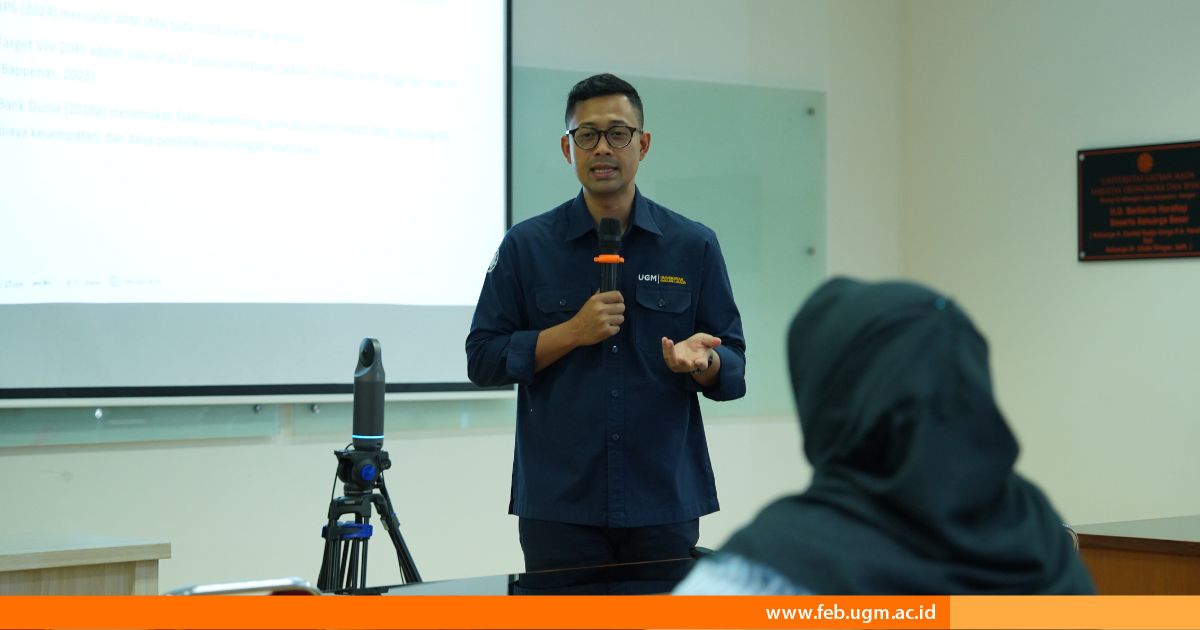
He emphasized that human capital is a critical component in achieving the nation’s long-term development goals. He shared these insights during the Economic and Business Journalism Academy titled “Challenges in Human Capital Development in Indonesia,” held on Wednesday (May 20, 2026) at Pertamina Tower, FEB UGM.
He based his presentation on a chapter from Achieving the Golden Indonesia Vision 2045, a book published by the Asian Development Bank (ADB) in 2026. As one of the contributors, Gumilang, together with Prof. Tri Mulyaningsih from Sebelas Maret University, presented a concerning picture of Indonesia’s human capital development.
Indonesia’s Human Capital Index (HCI) stood at only 0.54 in 2020. It suggests that a child born today is only likely to achieve 54 percent of their potential productivity by the age of 18.
“Indonesia still lags behind neighboring countries such as Vietnam and Thailand. Achieving an HCI of 0.73 by 2045 will require tremendous effort,” he explained.
The Paradox of Education Spending and Learning Outcomes
Gumilang noted that real education spending increased fourfold between 2001 and 2016 following the constitutional mandate allocating 20 percent of the national budget to education. However, this substantial increase in funding has not been fully accompanied by improvements in learning quality.
Data from PISA 2022 show that more than 75 percent of 15-year-old students failed to reach minimum proficiency levels in mathematics and reading. Gumilang described this condition as a phenomenon in which children are in school but not learning.
“Children are attending school, but the learning process has not enabled them to develop optimally,” he said.
He also emphasized the importance of Early Childhood Education (ECE) as the starting point for human capital investment. Theoretically, educational investments made at an early age yield higher returns because compounding works over a longer period.
Nevertheless, Indonesia’s ECE participation rate reached only 36 percent in 2024, well below Malaysia’s and Vietnam’s, which have exceeded 85 percent. This low participation rate reflects unequal access across socioeconomic groups.
“Children from affluent families gain a head start compared to those from less privileged backgrounds. Both theory and empirical evidence suggest that starting earlier yields greater returns,” he explained.
The situation is further exacerbated by the fact that 97 percent of ECE institutions are privately managed, making access heavily dependent on families’ ability to pay. Meanwhile, government spending on ECE accounts for only around 4 percent of the total education budget.
Fundamental Challenges
According to Gumilang, Indonesia’s education challenges extend beyond learning quality and involve governance issues as well. One major challenge is the overly centralized approach to education policy, which often fails to reflect classroom realities.
“Imagine the classroom realities in Yogyakarta compared to those in remote and underdeveloped regions. The facilities are different, and the quality of teachers varies. Implementation will inevitably be suboptimal if the curriculum undergoes standardization through top-down policies. Students in Yogyakarta may perform well, while those in disadvantaged areas will fall even further behind,” he said.
At the same time, uneven capacities among local governments contribute to disparities in education quality across regions. Most education budgets managed by local governments are still absorbed by salary expenditures, leaving only a small portion available for teacher training and improving learning quality.
Another issue lies in the design of teacher incentives, which have not effectively encouraged better teaching performance. Teacher certification programs that lead to higher salaries have not been shown to make much difference in classroom teaching.
In addition, weak data-driven accountability systems hinder effective evaluation of learning. Without transparent mechanisms to monitor learning outcomes, teachers and schools lack clear benchmarks for improvement.
Gumilang argued that education reform should focus on strengthening learning assessment systems and shifting policies toward learning outcomes rather than merely increasing budget allocations.
Education Policy Priorities
Gumilang outlined several policy priorities for the future. One key priority is expanding the supply of and access to quality ECE by increasing funding, utilizing village funds for rural ECE programs, establishing ECE centers, providing teacher training, standardizing curricula, and offering subsidies or vouchers for poor, vulnerable, and aspiring middle-class families.
Another priority is developing performance metrics and data systems to support evidence-based policymaking. Efforts include establishing reliable performance indicators for students and teachers, as well as creating open databases that enable policy evaluation by both central and local governments.
A further priority is redesigning education financing incentives by strengthening performance-based School Operational Assistance (BOS) programs and improving supporting databases. The educational performance of districts and municipalities could also serve as a criterion for allocating regional incentive funds.
Additionally, teacher contracts and compensation systems should reward performance. It could include providing additional compensation for teachers in remote areas or high-need schools, funding high-quality continuous professional development programs, and removing teachers who consistently demonstrate poor performance from the profession.
“Reform requires changing the way we do things, not merely adding more money,” he concluded.
Reporter: Dwi Zhafirah Meiliani
Editor: Kurnia Ekaptiningrum
Sustainable Development Goals