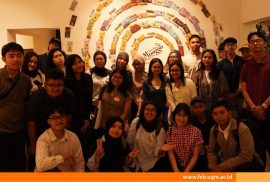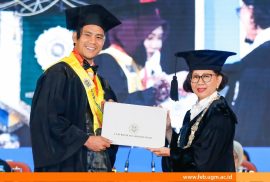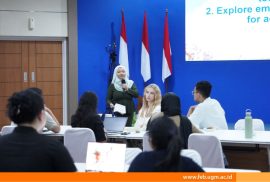
The Center for Good Corporate Governance FEB UGM, in cooperation with the Department of Accounting and the Master of Accounting Program FEB UGM, successfully organized a Book Review on “REFORMASI AKUNTANSI: Membongkar Bounded Rationality Pengembangan Akuntansi” and a Workshop on “Metoda Inovatif Pembelajaran Akuntansi Keuangan Pengantar” from July 22 to July 23, 2010.
In his book, Sony Warsono, MAFIS, Akt., Ph.D., critically examines the current accounting education system, which heavily emphasizes debit and credit mechanisms. This approach often makes it difficult for students—especially beginners—to grasp the fundamental concepts of accounting. Many perceive accounting as overly mechanical and procedural, with a strong reliance on memorization. As a result, researchers have proposed eliminating traditional debit and credit teaching methods from lectures.
To address this issue, the author introduces an alternative accounting learning system based on a mathematical perspective. He aims to challenge the common academic view that debit and credit mechanisms exist merely as conventions or rules of thumb. Through the book review, participants observed how a mathematics-based approach can effectively improve both students’ and academics’ understanding of accounting concepts.
The Senior Vice Chancellor for Administration and Human Resources of Universitas Gadjah Mada, Prof. Ainun Na’im, M.B.A., Ph.D., opened the event. Rimawan Pradiptya, M.Sc., Ph.D., and Ertambang Nahartyo, M.Sc., Ph.D., then presented key ideas on Rational Choice Theory versus Bounded Rationality Theory.
The organizers also invited distinguished speakers, including Prof. Zaki Baridwan, M.Sc., Ph.D.; Prof. Dr. Slamet, M.B.A.; Prof. Jogiyanto M. Hartono, MBA, Ph.D.; and Setiyono Miharjo, MBA, Ph.D. Supriyadi, M.Sc., Ph.D., Mahfud Sholihin, M.Acc., Ph.D., and Lindrianasari, S.E., M.Sc., moderated the sessions.
The event featured two main activities. On the first day, participants discussed and reviewed the book “REFORMASI AKUNTANSI Membongkar Bounded Rationality Pengembangan Akuntansi.” On the second day, they explored mathematics-based learning methods for Financial Accounting courses, particularly Introduction to Accounting I.
Participants—mainly academics and students—actively engaged in the sessions and showed strong enthusiasm and curiosity, especially during the Q&A discussions. The novelty of the mathematics-based approach in Indonesian accounting education drew significant interest. Sony explained that this method uses simple algebraic equations similar to those taught in basic education. This approach helps students, particularly beginners who may feel intimidated by accounting, better understand core concepts and find the subject more engaging.
Source: CGCG_Aya