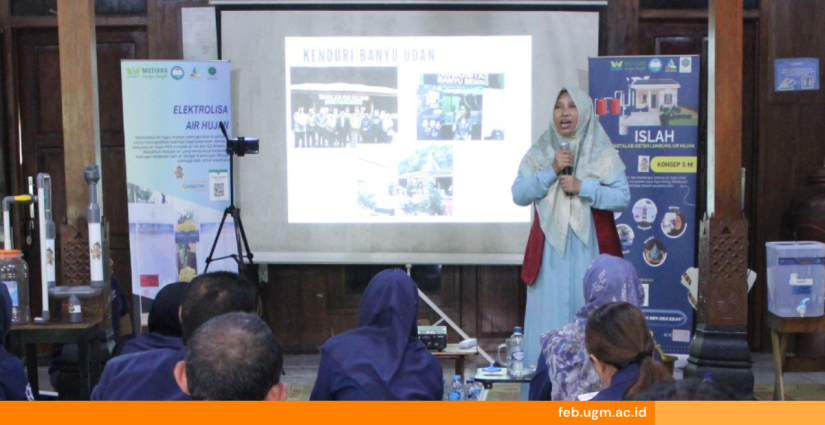
The Faculty of Economics and Business, Universitas Gadjah Mada (FEB UGM), continues to demonstrate its commitment to supporting environmental sustainability. One such effort involves water conservation initiatives. To strengthen its water conservation program, FEB UGM sent 25 of its professional staff to participate in the Rainwater Management and Utilization Training at the Banyu Bening Rainwater School, Tempursari, Ngaglik, Sleman, on Wednesday (21 January 2025).
Nur Bakti Susilo, S.E., Ak., CA., ASEAN CPA, Head of the Administrative Office of FEB UGM, stated that this training activity should have a positive impact on environmental sustainability. FEB UGM has implemented various rainwater management initiatives, including a rainwater saving program and the construction of infiltration wells to reduce waterlogging and flooding.
“This effort is in line with the Ministry of Higher Education, Science, and Technology’s tagline’ Kampus Berdampak’ (Impactful Campus), which emphasizes that higher education institutions must provide tangible benefits for stakeholders and the wider community. Hopefully, we can learn together and apply these practices both within the faculty and in our respective environments,” he explained.
The Founder of the Banyu Bening Rainwater School, Sri Wahyuningsih, emphasized that water management should not stop at institutional policy alone. She encouraged every individual to become an agent of change and to adapt in facing various environmental challenges.
“What each individual needs to realize is the awareness to utilize rainwater wisely and return it to nature, so that humans can play a role as guardians of environmental balance. Campuses should not become pioneers of groundwater exploitation without efforts to return water to nature,” she asserted.
Considering that water issues are becoming increasingly complex and require serious attention, Sri explained that water self-sufficiency is essential because water is a basic human need.
“The question is whether society is truly prosperous in fulfilling its water needs. The reality is that water needs today are still largely paid for due to limited water sources and low public trust in the quality of available water,” Sri revealed.
She invited participants to use rainwater for daily needs through the concept of a water granary, known as the 5M principle: Collecting (Menampung), Treating (Mengolah), Drinking (Minum), Saving (Menabung), and Becoming Independent (Mandiri).
Sri explained that the process begins by collecting rainwater after the first 5–10 minutes of rainfall to avoid dust and debris from rooftops. The collected rainwater is then settled and filtered using simple filtration tools such as clean buckets or containers, funnels, cloth or strainers, and water storage containers.
She also highlighted the importance of proper water storage, such as placing containers away from direct sunlight and ensuring they are tightly covered. These measures are necessary to prevent algae growth and the potential release of microplastics.
Processed rainwater, she continued, can be stored in large tanks as a reserve for the dry season. Meanwhile, excess water should be returned to the ground through infiltration wells as a form of ecological responsibility.
“By applying the 5M principle, communities can achieve water independence and actively contribute to maintaining environmental balance,” she concluded.
In this training, FEB UGM’s professional staff not only discussed rainwater management but also had the opportunity to conduct simple, practical water-quality tests using a TDS tester.
Reporter: Shofi Hawa Anjani
Editor: Kurnia Ekaptiningrum
Sustainable Development Goals