The transportation sector is one of the key drivers of the modern economy, supporting human mobility, logistics, and interregional connectivity elements essential to economic growth. However, this sector is also often a major contributor to carbon emissions and environmental degradation. It raises an important question: how can we balance the need for mobility and economic growth with the urgency of ecological sustainability?
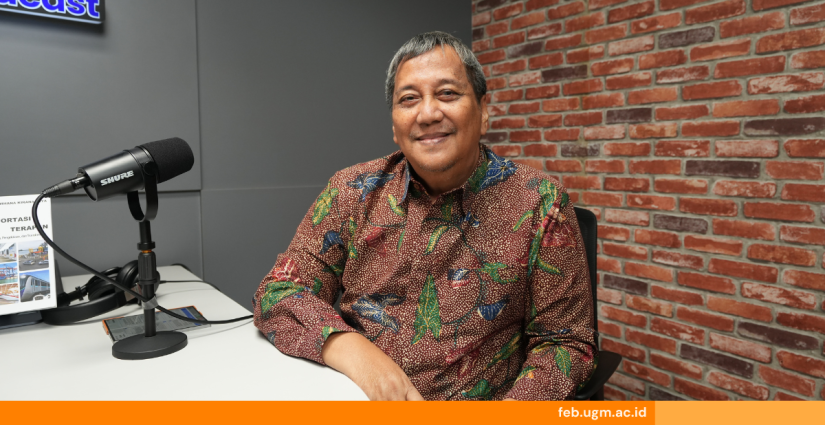
Therefore, discussions of overall economic development cannot ignore transportation. In the podcast, a lecturer from the Department of Economics, Faculty of Economics and Business Universitas Gadjah Mada (FEB UGM), Prof. Wihana Kirana Jaya, M.Soc.Sc., Ph.D., explained that the transportation sector plays a crucial role as a derived demand of economic activity. As the economy grows, the demand for transportation automatically increases. Therefore, discussions of overall economic development cannot ignore transportation.
At the macro level, the transportation sector contributes significantly to Indonesia’s economy. Prof. Wihana noted that this sector contributes approximately six percent to the Gross Domestic Product (GDP).
“If we talk about economic growth sectors, transportation contributes around six percent. Transportation itself accounts for about four to five percent, while warehousing contributes around one percent,” he explained.
According to Prof. Wihana, the paradigm of transportation development has shifted. Transportation is no longer viewed solely in terms of increasing capacity and mobility; it must now be directed toward sustainable transportation that takes environmental, social, and economic factors into account.
He emphasized that transportation transformation must begin with a change in perspective. Sustainability is not only about the application of technology but also involves institutions, regulations, and the behavior of the actors involved.
“When we look at transportation, we must start the change from mindset, then modify regulations toward sustainability,” Prof. Wihana stated.
Although the idea of sustainable transportation is gaining momentum, its implementation in Indonesia remains a significant challenge. Prof. Wihana argued that the main challenge lies not solely in technology but in changing mindsets, which require time and consistency.
“Mindsets take a long time to change, but they will change if there are clear and consistent regulations,” he stressed, adding that regulation serves as a crucial instrument to guide market and societal behavior in line with sustainability goals.
In practice, Prof. Wihana explained that Indonesia has already initiated several sustainable transportation practices. These include the use of renewable energy at Teluk Lamong Port, the adoption of electric vehicles in tourism areas such as Borobudur and Bali, and the development of green transportation concepts and transit-oriented development in the new capital city, Nusantara.
However, he emphasized that these initiatives still require policy consistency and cross-sectoral integration to achieve broader, more sustainable impacts.
Prof. Wihana also highlighted the importance of cross-sector policy orchestration. Without strong coordination between planning, regulation, and implementation, sustainable transportation policies risk operating in silos.
“If policies fail to be well orchestrated, each sector may act independently. Even though the ultimate goal is the same — sustainable, low-emission economic growth — this can lead to problems,” Wihana said.
Furthermore, Prof. Wihana emphasized that businesses and society are essential in driving the transition toward sustainable transportation. At the global level, sustainability standards have become market demands from both investors and consumers. Without adapting to sustainability principles, the national transportation sector risks losing competitiveness, particularly in international logistics and tourism.
The full episode of the FEB UGM Podcast program Sustainable and Democratic Economy can be accessed via: ugm.id/FEBPodcastEkonomiBerkelanjutandanDemokratis
Author: Dwi Zhafirah Meiliani
Editor: Kurnia Ekaptiningrum
Sustainable Development Goals