Managing university life involves more than simply dividing time between academic responsibilities and other activities. Students also need to understand themselves, set priorities, and maintain their capacity to manage various responsibilities effectively.
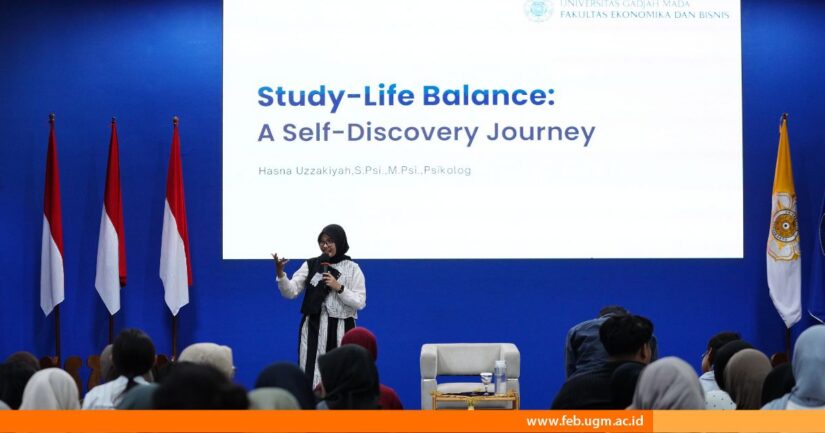
Addressing this need, the Career and Student Development Unit (CSDU) of FEB UGM held a “Study-Life Balance” training session as part of the STAR LEAD (Soft Skills Training and Recharging Leadership Exploration and Development) program for the 2026 undergraduate cohort. The session was held on Friday (September 11, 2026) at the FEB UGM Learning Center Auditorium and featured Hasna Uzzakiyah, M.Psi., Psychologist, as the speaker.
During the session, Hasna encouraged students to first understand themselves before determining how they want to navigate university life. One of the concepts introduced was ikigai, a framework that helps individuals understand what they enjoy, the abilities they possess, the contributions they want to make, and the skills needed in the workplace. This understanding can help students determine which experiences to pursue during their university years while staying aligned with their interests and abilities.
In addition to self-awareness, students also face changes in their daily routines when entering university. While school life tends to involve more structured activities, university provides students with greater freedom to set their own schedules, make decisions, and take responsibility for the consequences.
“At university, we are given more freedom to make our own choices. Therefore, the decisions and risks also become our responsibility,” Hasna explained.
To help students navigate these demands, Hasna introduced the concepts of the Circle of Influence and Circle of Concern. The Circle of Influence includes things that individuals can control, such as their study habits and how they respond to situations. Meanwhile, the Circle of Concern encompasses things beyond personal control, such as other people’s personalities and certain policies.
According to Hasna, students should focus on what they can still influence rather than spending their energy on matters beyond their control.

She explained that balance does not mean allocating equal time to every activity. She used the analogy of production and production capability. The results students seek to achieve represent production, while their ability to continue producing those results represents production capability.
“If we focus only on the production, over time our production capability may decline,” Hasna explained.
Therefore, maintaining adequate sleep, a healthy diet, mental well-being, and sufficient recovery time are essential to preserving personal capacity. Students need to consider not only the tasks they have to complete but also the conditions that enable them to continue fulfilling their responsibilities.
Hasna also discussed energy drainers and energy chargers in everyday life. Unhealthy relationships and the habit of comparing oneself with others can drain energy, while activities such as exercising and pursuing hobbies can help restore it.
Understanding oneself and managing personal capacity are important aspects of navigating university life. Hasna reminded students that balance is not about doing as many things as possible, but about choosing what to pursue according to one’s capacity and individual goals.
Report: Dwi Zhafirah Meiliani
Editor: Kurnia Ekaptiningrum
Sustainable Development Goals