

The accountability of non-governmental organizations (NGOs) extends beyond reporting to donors on the use of funds and the implementation of programs.
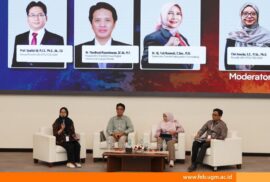
The use of artificial intelligence (AI) presents opportunities for local governments to accelerate digital transformation and improve the quality of public services.

Rising geopolitical tensions are posing new challenges to Indonesia’s economic resilience.

Economist Wisnu Setiadi Nugroho, Ph.D., from the Faculty of Economics and Business, Universitas Gadjah Mada (FEB UGM), highlighted positive developments in Indonesia’s labor market, particularly in employment growth and declining unemployment rates.
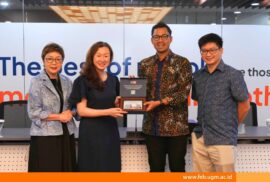
The Faculty of Economics and Business, Universitas Gadjah Mada (FEB UGM), is exploring potential collaboration with Nanyang Technological University (NTU), Singapore, to develop a social project-based learning program for students.

Indonesia’s Gross Domestic Product (GDP) grew by 5.47 percent year-on-year (YoY) in the third quarter of 2026.

The shrinking middle class, persistent poverty, and increasing economic vulnerability have become major challenges in Indonesia’s development agenda in recent years.

University life is not only about pursuing academic activities but also about learning to adapt, understanding oneself, and building healthy social relationships.

The Faculty of Economics and Business, Universitas Gadjah Mada (FEB UGM), has expanded its academic collaboration with the Faculty of Business and Economics (FBE) at the University of Melbourne, Australia, by developing an Accelerated Master’s Program under a 3+1+1 scheme.
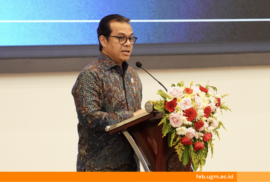
Indonesia has significant opportunities to benefit from the development of frontier artificial intelligence (AI) technologies, according to Indonesia’s Vice Minister of Communication and Digital Affairs, Nezar Patria.
Can we help you?