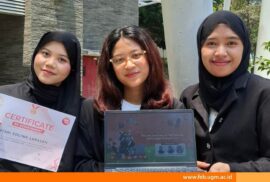
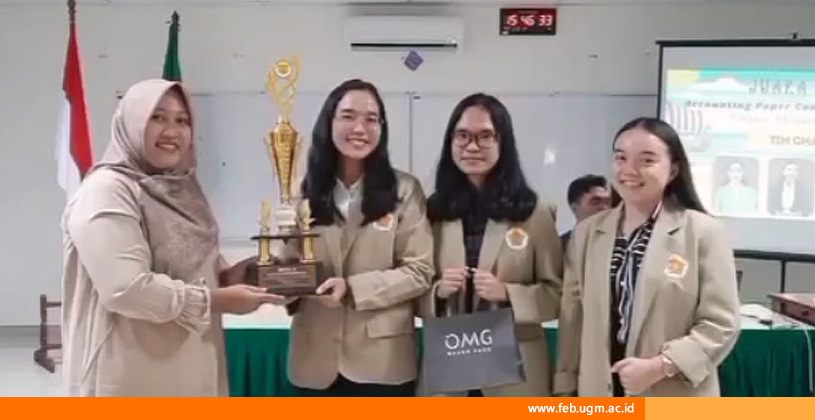
Three undergraduate students from the Accounting Study Program, Faculty of Economics and Business, Universitas Gadjah Mada (FEB UGM), achieved brilliant results in the 2024 Accounting Paper Competition held by the Accounting Study Program Student Association, Universitas Hayam Wuruk Perbanas Surabaya, on March 23, 2024. The three students who joined The CMA team are Alberta Sakanti Sitakara (Accounting 2021), Clara Alverina Laurensia (Accounting 2021), and Monica Krisna (Accounting 2021).
The CMA team placed second under the guidance of Ahmad Zaki, S.E., M.Acc., and Muhammad Akbar Fadzkurrahman Annahl, S.E., M.Sc. This success was achieved after the team went through a series of competition stages that lasted for one month, starting with abstract submission, re-submission of complete written works, and presentation of research results to the judges.
The competition with the theme “Implementation of Green Accounting in Supporting the Achievement of Sustainable Development Goals (SDGs)” was attended by teams of accounting students from various universities in Indonesia. In this competition, each team was asked to create written work on one of three sub-themes: the Application of Green Accounting in Mitigating Climate Change, Green Accounting as a Company Performance Booster, or the Impact of Implementing Green Accounting in the Work Environment.
“We prepared a paper entitled ‘Green Accounting in Tissue Budgeting at the Faculty of Economics and Business, Universitas Gadjah Mada’. In this paper, we discuss how the field of accounting can play a role in achieving SDGs goals, especially in areas related to the environment, social, and economic,” explained Alberta Sakanti.
Alberta explained that in their submitted paper, they discussed in more depth climate change mitigation strategies carried out through simple efforts, one of which was reducing tissue consumption and budgeting.
The team recommended that FEB UGM implement a tissue budgeting process focused on environmental sustainability. Apart from that, recommendations are also provided regarding future environmental costs. This will strengthen the faculty’s commitment to sustainability issues and demonstrate that green accounting is relevant not only for large companies but also for educational institutions.
“We are very happy to be chosen as second place, because to be honest, the time to work on the paper was only two weeks, and it was in between our busy schedules at college,” added Clara.
They hope that the submitted ideas can serve as input for FEB UGM and other educational institutions to implement green accounting, especially regarding tissue budgeting, to achieve environmental sustainability.
Reportage: Hilda Bhakti Fahrezi
Sustainable Development Goals