Despite the growing number of economics graduates produced by universities, the quality of economic reasoning in Indonesia’s public discourse has yet to show significant improvement. Policies in strategic sectors such as food, electricity, and fiscal affairs are often introduced without adequate evaluation and are frequently based on inaccurate diagnoses of underlying problems. This situation underscores the importance of developing adaptive and relevant economics education to strengthen Indonesia’s technocracy.
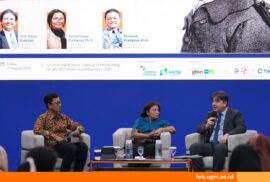
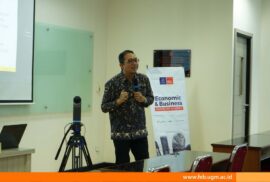
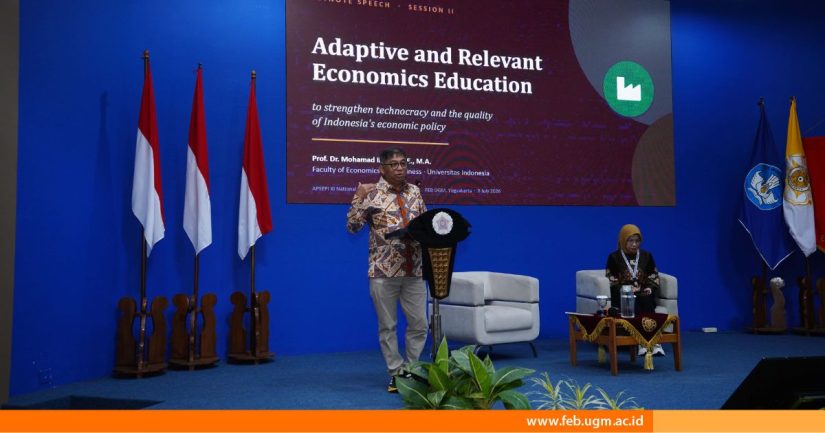
This was highlighted by Prof. Dr. Mohamad Ikhsan, M.A., during his keynote speech at the APSEPI XI 2026 National Seminar and Annual Meeting in a session titled “Adaptive and Relevant Economics Education to Strengthen Technocracy and the Quality of Indonesia’s Economic Policy” held on Thursday (9/7/2026). He opened his presentation with a thought-provoking question:
“Why does an abundance of credentials coexist with a scarcity of analysis that is sharp, courageous, and evidence-based?”
According to Prof. Ikhsan, the gap between the increasing number of economics graduates and the quality of economic reasoning has become a critical challenge. This disparity affects not only the quality of public economic discourse but also the policymaking process that directly impacts society.
“Good policy does not fall from the sky. It is not born from speeches, regulations, or merely the good intentions of leaders,” he said.
Prof. Ikhsan emphasized that building adaptive and relevant economics education goes far beyond curriculum reform, adding new courses or revising syllabi. Rather, economics education serves as the soft infrastructure of national technocracy, making it just as strategic as roads, ports, and power grids.
“The difference is that the impact of economics education as infrastructure may only become visible 10 or 20 years later,” he explained.
He further stressed that the technocracy Indonesia needs is not defined by academic degrees or official positions. Instead, it is about institutionalizing disciplined thinking and intellectual honesty in public decision-making.
Prof. Ikhsan also invited participants to reflect on several recent policy issues, including rolling electricity blackouts, the paradox of rice self-sufficiency, and the Free Nutritious Meals program, arguing that these challenges ultimately stem from weaknesses in economic reasoning.
“These are delayed report cards on what we have taught—and failed to teach—in our classrooms over the years. If we truly want to improve public policy, we must improve the reasoning that produces it. And that reasoning is shaped in the classroom,” he stated.
He further emphasized that strengthening Indonesia’s technocracy is not solely the responsibility of universities at the national level but also of economics study programs across the regions. Discussions on technocracy, he noted, have long centered on Jakarta, even though under decentralization, many decisions that directly affect people’s lives are made at the regional level.
He encouraged economics programs outside the capital to make decentralization a central theme in both research and teaching. Regional economics departments, he argued, should become centers of knowledge for addressing the economic challenges of their respective regions.
“Do not simply send your graduates to Jakarta. Build the capacity to improve policies in the districts, municipalities, and provinces where your institutions are located,” he urged.
In closing, Prof. Ikhsan reminded participants that the future quality of Indonesia’s economic policies depends largely on the quality of economic education today. According to him, today’s classrooms are where tomorrow’s policymakers are being shaped.
“The quality of Indonesia’s economic policy a decade from now is not being determined at the Presidential Palace, the Ministry of Finance, or Bank Indonesia. It is being determined today in the classrooms that you lead,” he concluded.
Reporter: Shofi Hawa Anjani
Editor: Kurnia Ekaptiningrum
Sustainable Development Goals