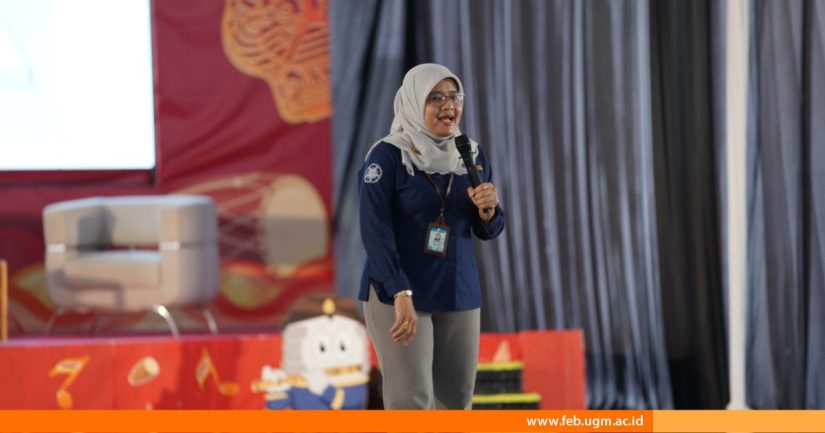
A strong green business goes beyond the intention to reduce waste. It must be carefully designed by identifying the beneficiaries, defining the value proposition, and ensuring both financial sustainability and social impact. This was the key message delivered during the Developing Business Mindset (DBM) session titled “Business Model Canvas for Green Business & Social Impact” for new students of Pionir Simfoni FEB UGM 2026 on Wednesday (August 5, 2026).
Professor of the Department of Management at FEB UGM, Nurul Indarti, introduced the Business Model Canvas (BMC) as a practical framework for transforming green business ideas into testable business models. She explained that waste contains hidden resources that can be converted into valuable business inputs when supported by appropriate design, processes, and partnerships.
Prof. Nurul explained that waste-related problems stem from three main factors. First, the volume of waste is growing faster than the capacity to manage it. Second, waste creates negative externalities, including air, soil, and water pollution. Third, the economic value embedded in waste remains largely untapped. She related these issues to the principles of the 3Rs: reduce, reuse, and recycle.
She further emphasized that a green business must address three essential dimensions: people, planet, and profit. The people dimension focuses on benefiting communities and fostering fair relationships; the planet dimension emphasizes waste reduction and material recovery; while profit ensures sufficient revenue to cover costs and sustain long-term impact.
“Before initiating a green business, it is important to consider whether the business model addresses the three key dimensions—people, planet, and profit. These elements must reinforce one another to create a truly sustainable impact,” said Prof. Nurul.
As part of the hands-on exercise, the new students analyzed three waste-related case studies involving plastic straws, second-hand clothing, and coconut shells. They identified the stakeholders most affected by each issue and designed the nine building blocks of the Business Model Canvas to develop appropriate solutions.
“The Business Model Canvas helps us view an idea holistically. A strong green business is not only about reducing waste, but also about building relationships, generating revenue, and empowering communities,” she concluded.
Reporter: Dwi Zhafirah Meiliani
Editor: Kurnia Ekaptiningrum
Sustainable Development Goals