Industrial waste is often perceived as a problem. However, for Andre Suryaman, waste materials that would typically end up in landfills became the starting point of a business capable of reaching the global market. Through Natural House Homedeco, he transforms industrial waste into valuable decorative products.
For Andre, the decision to use waste materials as raw materials began with a simple need and the courage to recognize an opportunity. Since establishing Natural House Homedeco in 1997 as a space to channel his creativity as an artist and painter, he has experimented with a range of accessible, affordable materials. Waste eventually became one of his choices.
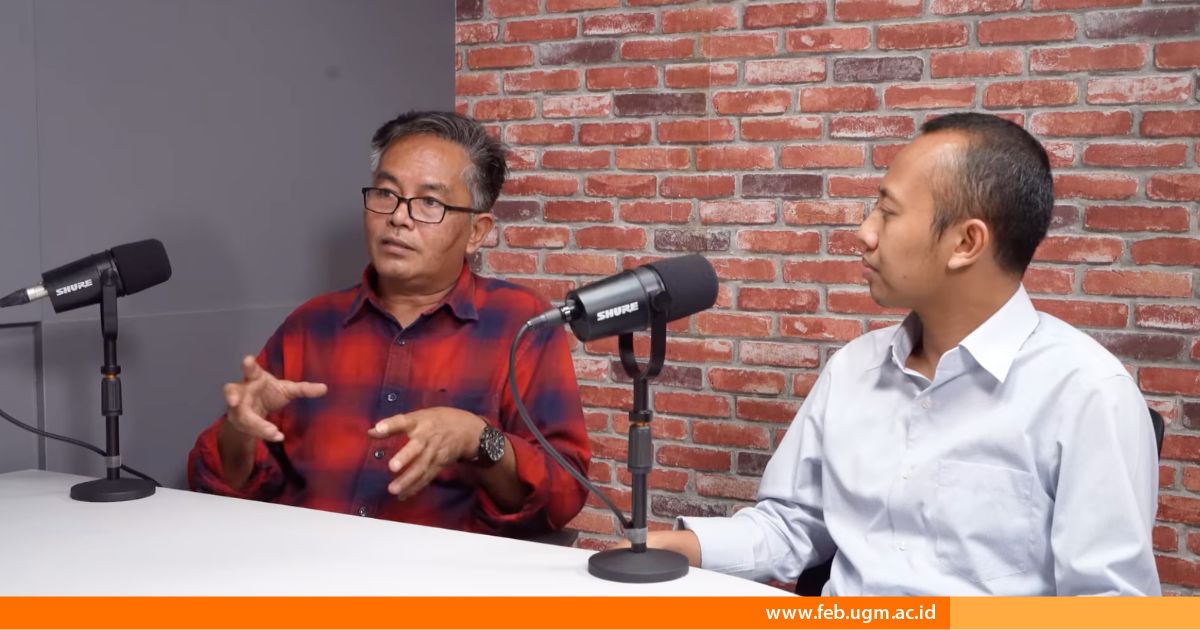
“I chose waste materials because they are inexpensive. With a touch of imagination and creativity, these materials can be transformed into something valuable,” he explained during an episode of FEB Podcast entitled “Sustainability Innovation: Turning Waste into Global Business Opportunities.”
Initially, Andre did not limit the types of waste materials used as the basis for his work. He explored and utilized both organic and non-organic materials, transforming them into new, more valuable creations. Over the course of his business journey, his interest in the automotive industry and welding as an art form led him to focus more on metal materials.
“Actually, because I was also interested in the automotive industry and welding as an art form, I eventually began focusing on metal materials and utilizing industrial waste in 2013,” he said.
Turning Waste into Valuable Products
The strength of Natural House Homedeco lies not only in its use of leftover materials but also in how it gives waste new value through design. Andre combines art to create beauty with design to address consumers’ functional needs.
According to Andre, combining art to create beauty and design to fulfill needs is an appropriate approach to creating value from products made from waste materials. Through these products, consumers can also experience visual appeal while learning the stories behind the materials used. This approach gives waste-based products a distinctive character and creates opportunities for them to compete in broader markets.
Since 2013, approximately 80 percent of Natural House Homedeco’s products have been marketed for export, while the remaining 20 percent have targeted the domestic market. This demonstrates that waste-based products have the potential not only to serve as an environmental solution but also to become creative products with global competitiveness.
Selling Products Alongside Sustainability Values
Luluk Lusiantoro, Ph.D., a lecturer at the Department of Management, Faculty of Economics and Business, Universitas Gadjah Mada (FEB UGM), and an expert in the circular economy, explained that reusing materials previously considered waste is part of an effort to create new value. However, the success of a sustainable business depends not only on the ability to process waste but also on the ability of business actors to identify consumers who value sustainability.
According to him, consumers do not always purchase products solely because of their function or appearance. In sustainable products, additional value is embedded in the production process, materials, and environmental impact.
“The products being offered are not merely goods, but also the values embedded within them,” he explained.
These values are one of the reasons why products that adopt sustainable principles tend to have higher prices. One of the challenges is that production processes have not yet reached a large enough scale to achieve economies of scale, resulting in relatively high per-unit production costs. According to Luluk, business actors need to develop their business models further so that sustainable products can reach a broader market without compromising their sustainability values.
The journey of Natural House Homedeco demonstrates that there is room to create value from something previously considered worthless. Through a combination of creativity, design, the reuse of leftover materials, and an understanding of the market, waste can be transformed into products that carry both economic value and a story. However, building a sustainable ecosystem cannot be achieved by business actors alone. Change also increasingly requires consumers to consider sustainability when making purchasing decisions.
“The transition toward a more sustainable economy requires the involvement of various stakeholders because businesses respond to consumer demand, and changes in consumption behavior can ultimately encourage producers to change as well,” Luluk concluded.
The full video of the FEB Podcast episode “Inovasi Keberlanjutan: Mengubah Sampah Menjadi Peluang Bisnis Global” is available at http://ugm.id/InovasiKeberlanjutanMengubahSampahMenjadiPeluangBisnisGlobal.
Report: Najwa Anggi Namira
Editor: Kurnia Ekaptiningrum
Sustainable Development Goals