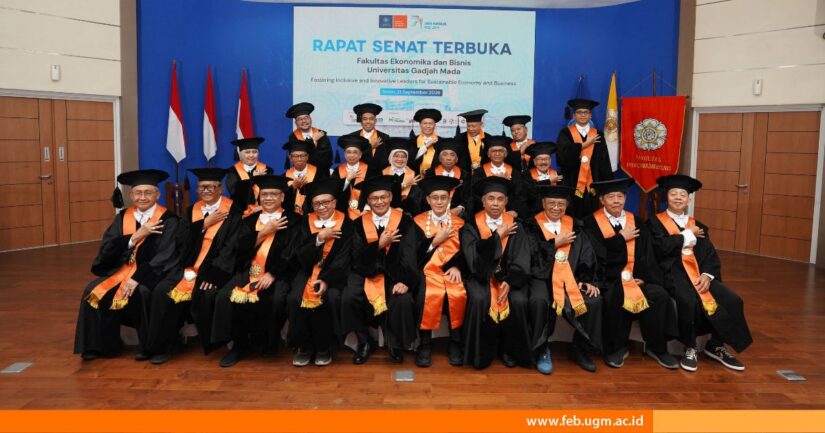
The Faculty of Economics and Business, Universitas Gadjah Mada (FEB UGM), commemorated its 71st Anniversary by reaffirming its commitment to nurturing future leaders who are inclusive, innovative, and sustainability-oriented. The commitment reflects the faculty’s 71-year journey while also shaping FEB UGM’s direction in responding to changes in the economy and technology, as well as global challenges.
The 71st Anniversary celebration of FEB UGM carried the theme “Fostering Inclusive and Innovative Leaders for Sustainable Economy and Business.” The theme reflects FEB UGM’s mission, “We Nurture Future-Ready Leaders in Economics and Business to Foster Sustainability.”
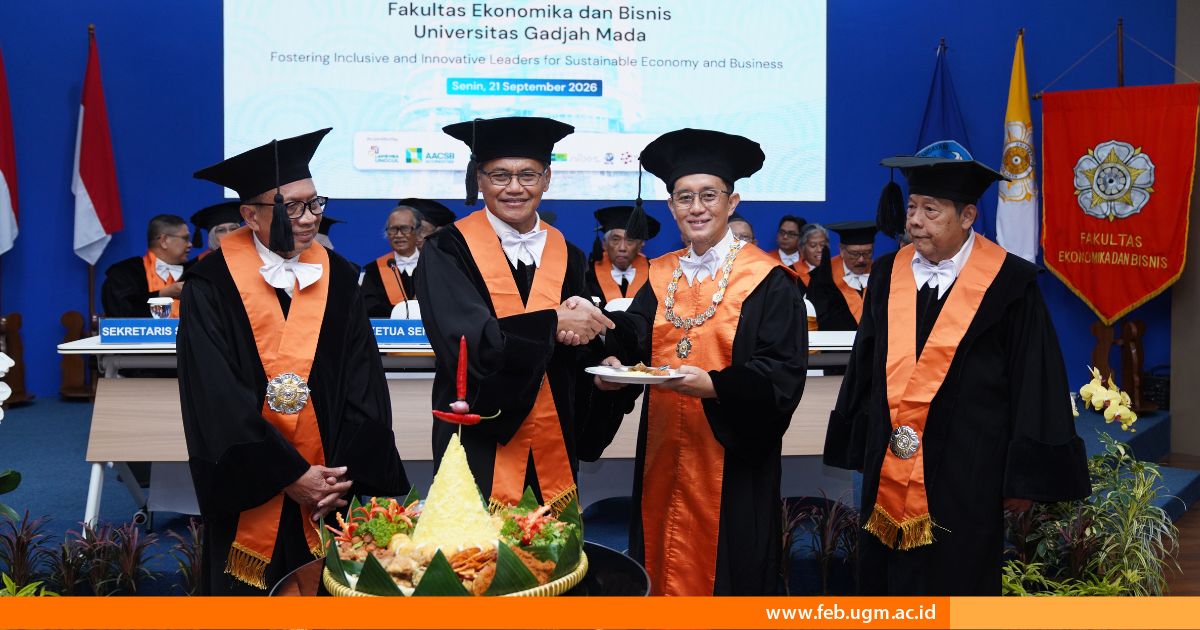
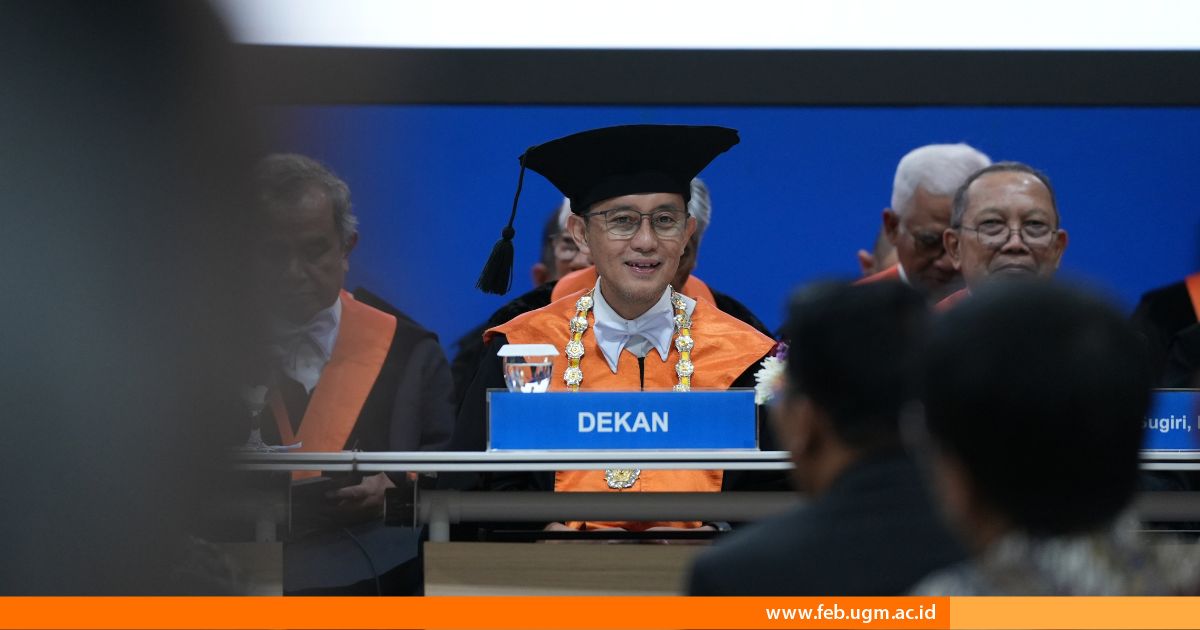
“The theme reflects FEB UGM’s commitment not only to producing academically and professionally excellent leaders. More importantly, we aim to develop leaders who can embrace diversity, foster innovation, and make decisions while considering economic, social, and environmental sustainability,” said Didi on Monday (21/9) while delivering the Dean’s Annual Report at the Open Senate Meeting commemorating the 71st Anniversary at the Auditorium of the FEB UGM Learning Center Building.
Dr. Didi Achjari, M.Com., Ak., CA., explained that the faculty’s development over the past five years has been guided by six main objectives outlined in the FEB UGM Strategic Plan 2023–2027. These objectives include developing graduates as outstanding and sustainability-minded leaders, strengthening FEB UGM’s position as a thought leader in sustainability, creating societal impact, improving the quality of human resources, developing a strategic ecosystem to support the university’s three pillars of higher education, and creating a sustainable, healthy, and socially responsible campus environment.
Student Affairs
In terms of education, FEB UGM admitted 613 new undergraduate students for the 2026/2027 academic year, out of 17,090 applicants. These included 432 students in the Regular Undergraduate Program and 181 in the International Undergraduate Program (IUP). At the postgraduate level, FEB UGM admitted 429 new master’s students, 41 doctoral students, and 43 new students in the Professional Accounting Program.
Overall, the number of active FEB UGM students has reached 4,480 across 14 study programs, including matriculation programs. The active student population consists of 2,278 undergraduate students, 87 professional program students, and 2,115 postgraduate students.
Student Demographics
Didi explained that, demographically, FEB UGM students represent diverse backgrounds and regions of origin. Over the past five years, FEB UGM undergraduate students have consistently come from more than 25 provinces across Indonesia. The number reached 27 provinces in 2022, increased to 32 provinces in 2025, and stood at 28 provinces in 2026.
“This diversity reflects FEB UGM’s appeal as a higher education institution with a national reach, as well as its commitment to providing access to quality education for Indonesia’s best young people from diverse regions and backgrounds,” he explained.
 The commitment to inclusive education is also reflected in student financial support. In 2026, 49.6 percent of new Regular Undergraduate students received tuition fee (UKT) subsidies, with 14.02 percent receiving full subsidies or zero tuition fees. In addition, 142 students received the Indonesia Smart College Card (KIP-K) scholarship.
“This support demonstrates that nearly half of FEB UGM’s new students receive financial assistance for their education, while reaffirming the faculty’s continued commitment to expanding inclusive and equitable access to higher education,” he emphasized.
Internationalization
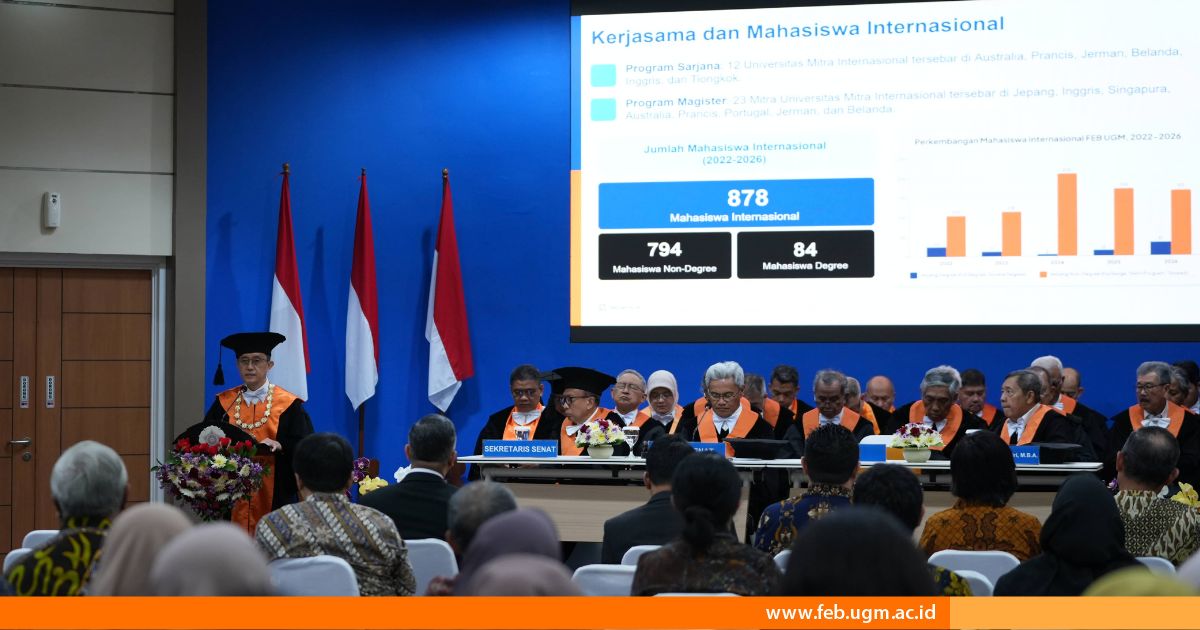
On the global stage, FEB UGM continues to expand its partnership network, including through double-degree programs with 12 universities at the undergraduate level and 23 at the master’s level across various countries. Between 2022 and 2026, a total of 878 international students studied at FEB UGM, comprising 794 in non-degree programs and 84 in degree programs.
Innovative Curriculum and Learning
Didi said that FEB UGM continues to strengthen its curriculum to respond to students’ needs, workplace demands, and sustainability challenges. Among these efforts, Fast-Track programs have been developed between the Undergraduate Accounting Program and the Master of Science in Accounting Program, and between the Master of Science in Accounting Program and the Doctoral Program in Accounting. The Recognition of Prior Learning (RPL) program in the Master of Accounting Program also provides opportunities for professionals to collaborate with the Professional Accounting Program, the Indonesian Tax Consultants Association, and central and local government officials.
Meanwhile, the integration of sustainability perspectives is reflected in new courses and concentrations across various study programs. These include redesigning undergraduate programs by adding the Sustainable Leadership Orientation course across three programs and integrating UGM’s interdisciplinary curriculum.
The Master of Development Economics Program has developed a concentration in Infrastructure and Economic Development in collaboration with PLN, as well as a course on Digital Innovation for Sustainable Development. The Master of Management Program has introduced a Railway Management concentration in collaboration with PT KAI, as well as courses in Sustainability Leadership, Environmental Impact Assessment, and Business Ethics for Sustainability. Meanwhile, the Master of Science in Accounting Program has strengthened courses in Sustainable Finance and Investment, as well as Management Accounting and Control for Sustainability.
At the doctoral level, FEB UGM has also introduced the International Doctorate in Business (IDB), designed for experienced business leaders to transform their practical experience into academic contributions.
Learning innovation has also been strengthened through case- and project-based learning methods. A total of 74 courses across three undergraduate programs have implemented these methods, while 46 courses directly involve practitioners. FEB UGM has also hosted 19 international guest lecturers and developed 186 Massive Open Online Course (MOOC) videos as open learning resources.
Enhancing Student Quality
FEB UGM continues to strengthen student quality not only through academic competency development but also through various skills that support students’ readiness for the professional world. This commitment is reflected in the Soft Skills Training and Recharging Leader Exploration and Development (STAR LEAD) Program, a mandatory soft-skills development program designed to equip students with the skills needed in professional environments. Other soft-skills development programs are also implemented at the postgraduate level, tailored to the needs of each study program.
These development programs are also reflected in FEB UGM students’ achievements. Between 2022 and 2026, FEB UGM students achieved awards in 297 national competitions involving 680 students, and 40 international competitions involving 111 students,” said Didi.
Research and Publications
To strengthen its thought leadership, Didi continued, FEB UGM supports research productivity and scholarly publications through various grant schemes. The number of funded grant proposals has increased over the past five years. In 2026, approved research funding consisted of 105 research grant proposals, 10 book chapter grant proposals, and 8 book grant proposals.
FEB UGM also continues to strengthen support for academic productivity. As of August 2026, FEB UGM had produced 96 Scopus-indexed publications, with 68.8 percent published in Q1 journals. The quality of FEB UGM’s scholarly publications is also reflected in the distribution of publications across journals listed in the ABS/ABDC Journal Quality List. During the 2022–2026 period, the number of publications in ABS/ABDC-ranked journals fluctuated but generally increased. As of mid-2026, there were 19 publications in Category C journals, 16 in Category B, and 5 in Category A*/A.
FEB UGM also continues to improve the quality and reputation of its academic journals. The Gadjah Mada International Journal of Business (GAMAIJB) rose from SCImago Journal Rank Q3 in 2025 to Q2 in 2026. Meanwhile, the Journal of Indonesian Economy and Business (JIEB) remained at Q3. At the national level, the Journal of Leadership in Organizations (JLO) remained in the Sinta 2 category. At the same time, the Accounting and Business Information Systems Journal (ABIS) rose from Sinta 5 in 2025 to Sinta 4 in 2026.
Community Engagement and Partnerships
FEB UGM continues to strengthen its societal impact through strategic partnerships, applied research, and community engagement activities, facilitated by the Center for Economic and Business Research and Training (P2EB), which was subsequently renamed Research and Development for Societal Impact (RDSI).
Over the past five years, RDSI has managed a total of IDR 102.36 billion in funding through various research, training, assessment, and consulting activities. P2EB and RDSI have also established 257 partnerships with various stakeholders from government institutions, state-owned enterprises, private companies, universities, and international organizations.
Beyond education and research, FEB UGM continues to strengthen its role in creating tangible societal impact. The faculty focuses its community engagement activities on three areas: Governance and Information Systems, Entrepreneurship and MSMEs, and Sustainable Development.
In Governance and Information Systems, one of the faculty’s flagship programs is the Gadjah Mada Digital Transformation and Governance Index (GM DTGI), which measures the readiness and implementation of digital transformation governance in local governments across regencies and cities. This focus has also been expanded into education and accounting practices through the development of SIDEK-Edu, an information system designed to support training for vocational teachers and students.
In the field of Entrepreneurship and MSMEs, FEB UGM has developed SIDEK-ERP (Enterprise Resource Planning Debit-Credit System), a platform designed to support training and capacity building for MSME owners. Meanwhile, in sustainable development, FEB UGM continues to strengthen its contributions through green entrepreneurship, technological innovation, and community empowerment, including through the ASEAN Network for Green Entrepreneurship and Leadership (ANGEL) UGM, established in collaboration with 11 universities across Southeast Asia.
These efforts have been strengthened through the development of Westa, an artificial intelligence (AI)-based application developed by a FEB UGM research team to support more efficient waste identification and management. At the local level, FEB UGM also implements the BISSA program in Grojogan Hamlet, Bantul, which promotes community-based waste management through biopores for organic waste and waste banks for inorganic waste.
Faculty and Professional Staff
In 2026, FEB UGM continued to strengthen the quality and competencies of its faculty members, supported by 143 permanent lecturers, including 28 professors. Seventy-five percent of the lecturers hold doctoral degrees, while the proportion of lecturers classified as Scholarly Academics under AACSB standards increased from 51 percent in 2022 to 66 percent in 2026. The proportion of lecturers meeting at least one of the four AACSB qualification categories also increased from 86 percent to 91 percent.
Faculty development is supported by funding of up to IDR 40 million per lecturer per year for training, conferences, network building, and international research collaboration.
The implementation of the university’s three pillars of higher education is also supported by competent and dedicated professional staff. FEB UGM currently has 214 professional staff members. The faculty demonstrates a strong commitment to ensuring that professional staff receive at least 20 hours of competency development each year through various training programs, ranging from data management and official correspondence to Psychological First Aid, as well as professional certifications in various fields.
Accreditation and Reputation
Didi also emphasized that FEB UGM continues to strengthen its strategic ecosystem, supporting the university’s three pillars through quality assurance and academic reputation. This commitment is reflected in FEB UGM’s successful renewal of international AACSB accreditation in 2024 for 13 study programs, and in all 14 study programs receiving the “Excellent” accreditation rating from LAMEMBA in 2025.
FEB UGM’s global reputation also continues to grow. In the QS World University Rankings by Subject 2026, FEB UGM was ranked in the 201–250 range for Accounting and Finance, Business and Management, and Economics and Econometrics. Meanwhile, the QS Global MBA Rankings 2027 placed the FEB UGM MBA Program in the 191–200 range globally, rising from 30th to 27th in Asia.
In conclusion, Didi connected the theme of Sustainable Economy and Business to the Javanese philosophy of memayu hayuning bawana, which embodies the idea of preserving and enhancing the world by caring for what already exists, avoiding harm, and creating benefits for future generations. For FEB UGM, sustainability is an integral part of the faculty’s journey in advancing education, research, community engagement, and institutional development.
Meanwhile, UGM Rector Prof. Dr. Ova Emilia, M.Med., Ed., Sp.OG(K), Ph.D., said that FEB UGM’s various achievements and innovations form an important part of the faculty’s contribution to supporting development in the fields of economics and business. She specifically highlighted SIDEK-EDU, the Gadjah Mada Digital Transformation Governance Index (GM DTGI), and WESTA as examples of technological innovations supporting learning, government governance, and environmental management.
The Rector also highlighted FEB UGM’s academic reputation in the QS Global MBA Rankings 2027 and QS World University Rankings by Subject 2026. According to her, these achievements have been made amid challenges including geopolitical uncertainty, climate change, market fluctuations, disruption caused by artificial intelligence, economic inequality, and gaps between industry needs and the workforce. In this context, adaptation, resilience, and innovation are considered important pillars for higher education institutions to continue developing.
“Rankings are not everything, but rankings are indicators of our collective performance and certainly reflect the inclusive leadership within this faculty. Hopefully, through the spirit of this year’s FEB Anniversary, every innovative work produced will inspire the growth of future leaders in economics and business who embrace inclusivity, innovation, and sustainability,” said the Rector.
The full 2026 FEB UGM Dean’s Annual Report is available at ugm.id/DiesFEBUGM71.
Reportage by: Kurnia Ekaptiningrum
Sustainable Development Goals