The Job Loss Insurance (Jaminan Kehilangan Pekerjaan/JKP) program is designed to protect workers who experience Termination of Employment (PHK). However, the extent to which the program can help workers cope with job loss and support their return to the labor market remains a challenge.
Muhammad Adiyaksa Maulana Tsaqif, an Accounting student at the Faculty of Economics and Business, Universitas Gadjah Mada (FEB UGM), together with the UGM Social Humanities Research Student Creativity Program (PKM-RSH) Kembali Kerja team, researched the implementation of the Job Loss Insurance (JKP) program to improve the re-employment of workers following Termination of Employment (PHK). Conducted from May to September 2026, the research focused on Central Java, selected for its high number of workers affected by layoffs and its diverse labor market.
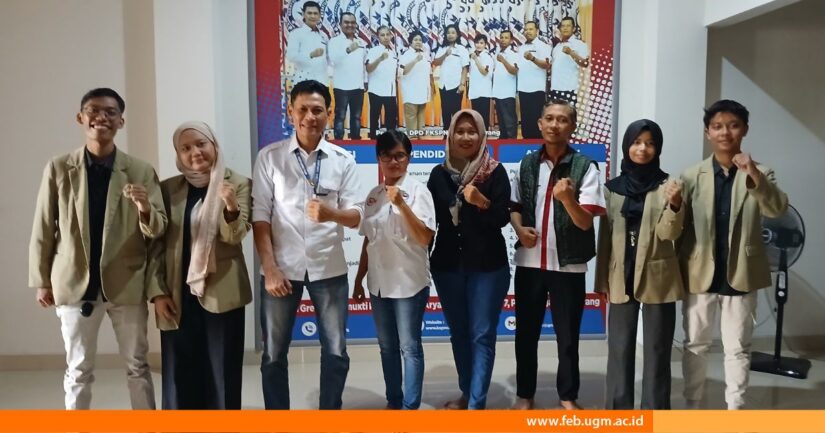
The PKM-RSH Kembali Kerja team consists of Wahyu Fajar Nur Rohim (Law 2023), Ghefira Mustika Putri (Law 2023), Sahda Huwaidah Estiningtyas (Statistics 2024), Umi Khusnul Khotimah (Public Policy Management 2024), and Muhammad Adiyaksa Maulana Tsaqif (Accounting 2024). Their research, entitled “Socioeconomic Analysis of the Job Loss Insurance Program to Improve the Re-employment of Workers Following Termination of Employment,” was conducted under the supervision of Dr. Dian Agung Wicaksono, S.H., LL.M.
Wahyu Fajar Nur Rohim explained that the research aimed to examine the extent to which JKP fulfills workers’ rights to social security and supports their return to work following the termination of employment.
“Through this research, we aim to understand the extent to which JKP, as one form of fulfilling the right to social security, supports workers who experience termination of employment,” he said.
The study employed a qualitative approach to examine the implementation of JKP and explore the perceptions of labor unions and beneficiaries regarding the program. Data were collected from both primary and secondary sources.
Primary data were collected through in-depth interviews with various parties involved in the implementation of JKP, including the Ministry of Manpower, BPJS Ketenagakerjaan Regional Office for Central Java and the Special Region of Yogyakarta, and the Central Java Provincial Office of Manpower and Transmigration.
The team also explored the perspectives of labor unions through interviews with the Federation of Indonesian Metal Workers Unions (FSPMI) Central Java, Confederation of All-Indonesian Workers’ Unions (KSPSI) Central Java, and Confederation of National Workers’ Unions (KSPN) Central Java. In addition, interviews were conducted with JKP beneficiaries. Meanwhile, secondary data on the provision of JKP benefits were obtained from relevant laws and regulations and a literature review of the JKP program.
Muhammad Adiyaksa Maulana Tsaqif stated that the research findings indicate that the implementation of JKP still faces several challenges across its three main benefits: cash benefits, access to labor market information, and vocational training.
Cash benefits were considered helpful in enabling beneficiaries to meet their living needs after experiencing termination of employment. However, the support has not yet been sufficient to sustain beneficiaries’ economic conditions in the long term. In terms of labor market information, available job vacancy information was not always considered relevant to beneficiaries’ needs or locations.
“Meanwhile, vocational training still needs to be aligned with the competencies required by the labor market and the individual circumstances of beneficiaries,” he explained.
These findings are also consistent with labor unions’ perceptions, which acknowledged that JKP has provided support to workers following termination of employment. Nevertheless, its implementation needs strengthening to be more responsive to beneficiaries’ needs.
Tsaqif noted that job vacancy information could be made more relevant and accessible. Training programs should also take into account workers’ experience and interests, as well as available employment opportunities in the labor market.
Based on these findings, the Kembali Kerja team developed a mechanism to improve workers’ re-employment by integrating labor market information with vocational training. The mechanism covers preparation, implementation, and post-implementation stages and involves collaboration among the government, companies, and beneficiaries to match workers’ characteristics with labor market needs.
As one of the research outputs, the Kembali Kerja team also developed a policy brief summarizing the research findings and recommendations for strengthening the implementation of JKP. The policy brief was prepared as a concise and accessible means of communicating the research findings to policymakers. Through the policy brief, the team hopes that the recommendations can serve as a basis for developing JKP policies that are more responsive to the needs of workers affected by the termination of employment and can more effectively support their return to employment.
Source: UGM PKM-RSH Kembali Kerja Team
Editor: Kurnia Ekaptiningrum
Sustainable Development Goals