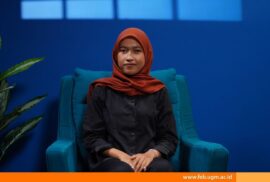
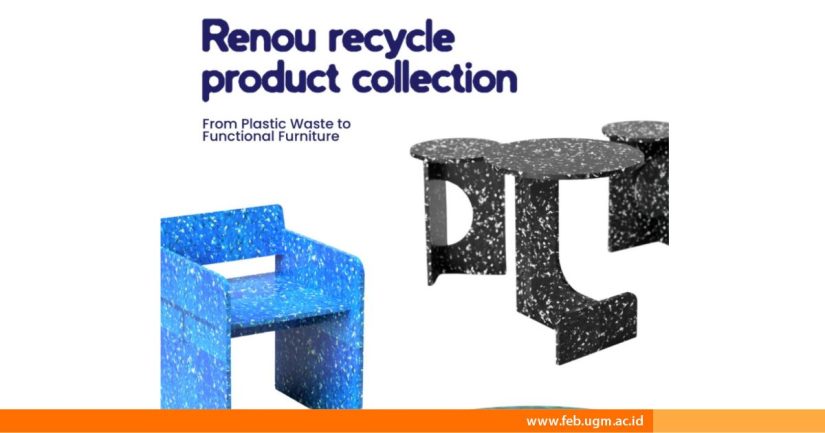
Waste remains a serious problem in Indonesia, including in the Yogyakarta region. Driven by concerns over the waste crisis in Yogyakarta, Alan Putra Wijaya, a student in the Management Program at UGM’s Faculty of Economics and Business (FEB), along with fellow UGM students, took the bold step of addressing the waste problem through a business idea: transforming waste into furniture or home furnishings.
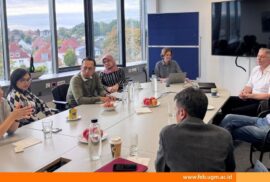
Alan and Muhammad Fikri Iedfi Darmawan, a student in the Environmental Infrastructure Engineering program at the Faculty of Engineering, UGM, brought this idea to life through a startup named Renou, located in Kalasan, Sleman, Yogyakarta. They also collaborated with the Waste Management Facility—Reuse, Reduce, Recycle (TPS3R).
“We’re partnering with the local TPS3R to impact and educate the surrounding community directly. We’re turning plastic waste into functional furniture and accessories,” explained Alan.
Alan explained that this idea originated from a fourth-semester course assignment to develop a business concept. Since Yogyakarta was facing a waste crisis at the time, the idea emerged as a way to address it.
“For us, the existing waste problem is enormous, both upstream and downstream. Any single party cannot easily solve the waste problem, and it won’t be resolved in 5–10 years—it may even take decades to address. As young people, we still have 40–50 years to contribute to society and the nation,” he explained.
Alan further revealed that Renou processes High-Density Polyethylene (HDPE) plastic waste as raw material for furniture and home goods. The reason is that this type of plastic waste is widely found in the community. This waste, which pollutes the environment and is considered unsightly, is transformed into functional and aesthetically pleasing products..
Renou’s business began operations in mid-2025. Along the way, Alan admitted that running this business while balancing it with his studies was not easy. Additionally, at the time, he was pursuing a dual degree program at Toulouse Business School in France, there were many adjustments to be made, such as work hours and meeting times, due to a 6-hour time difference.
“Previously, when I was still in Indonesia, managing my time was relatively easy. But now, with the significant time difference and the considerable academic workload in France, many tasks have ultimately been handled by my colleagues,” he said.
Moving forward, Alan hopes that Renou can continue to make the greatest possible impact in the waste management industry. In the long term, he hopes that Renou will be able to be involved in the waste management process from start to finish. Despite his young age, Alan is confident that this vision will certainly become a reality.
Alan also has a message for students. He encourages young people always to be productive and contribute to society, starting with small things first. From there, it can be a step for young people to contribute to the nation.
“We still have plenty of time, bet on yourself, do what you can do, and dream big!” he emphasized.
Author: Najwa Anggi Namira
Editor: Kurnia Ekaptiningrum
Sustainable Development Goals