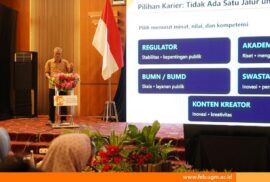
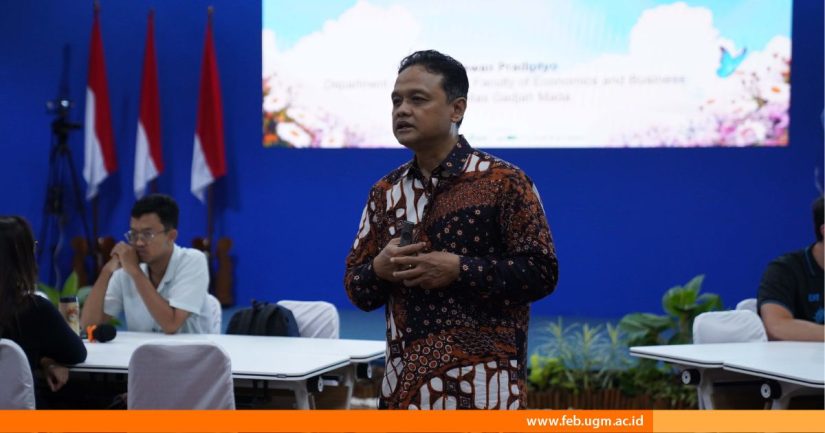
Rimawan Pradiptyo, S.E., M.Sc., Ph.D., a lecturer at the Department of Economics, Faculty of Economics and Business, Universitas Gadjah Mada (FEB UGM), shared his experience in initiating Sambatan Jogja (SONJO) to foster solidarity and support vulnerable communities affected by the COVID-19 pandemic in Yogyakarta during the Global Summer Week (GSW) 2026. He explained how game theory and experimental economics can be applied to build social capital during times of crisis.
Rimawan recalled that, at the beginning of the pandemic, the government’s response was relatively slow, including its decision to invite public figures to promote tourism despite the growing public health emergency. This situation prompted a fundamental question that became the foundation of SONJO.
“The choice was whether we wanted to take action and help ourselves, or simply wait for government assistance,” he said during GSW 2026 on Monday (20/7/2026).
SONJO was officially established on 24 March 2020 and operated entirely through 30 WhatsApp groups with around 2,300 members. Its first in-person meeting was not held until two years later. Rimawan explained that the initiative was built not on his personal network, but on UGM’s position as a trusted academic institution.
From the outset, SONJO deliberately refused to accept financial donations, a decision that surprised many philanthropists who wished to contribute. Rimawan explained that the decision was made to avoid legal risks, as SONJO is an informal organization without the authority to manage third-party funds.
“We certainly need resources, but resources do not always mean money. Time, WhatsApp, and an internet connection are all valuable resources,” he said.
Despite operating without financial support, SONJO successfully coordinated the administration of approximately 178,000 vaccine doses, a program that Rimawan said was recognized by Indonesia’s Ministry of Health as one of the country’s most efficient vaccination initiatives. The movement also established community shelters that provided free accommodation for up to 10 days to asymptomatic COVID-19 patients.
One of the greatest challenges, according to Rimawan, was maintaining compliance and cooperation among members without formal contracts, a situation that contradicts the basic principles of mechanism design in economics.
“SONJO is not a formal institution. The question is: how can you encourage people to comply with cooperative rules without any contracts? All we had was a shared agreement among ourselves,” he explained.
To address this challenge, Rimawan relied on a self-selection bias mechanism. He believed that only individuals who were genuinely committed to contributing would remain involved, naturally reducing opportunistic behavior within the community.
During the first three weeks of SONJO’s establishment, Rimawan implemented a structured grievance management system. Complaints and concerns submitted throughout the day were compiled into daily summaries and shared with members every midnight.
He also incorporated local cultural values to minimize conflicts among members, many of whom had never met in person. For example, discussions conducted in Indonesian would often conclude with respectful Javanese (krama) expressions whenever disagreements arose. This culturally grounded approach is one of the reasons why he declined requests to replicate SONJO in other cities, including Jakarta.
“SONJO in Jakarta or any social capital initiative elsewhere will only be effective if we truly understand the local culture. Without understanding the community’s cultural context, it is very difficult to maximize the role of social capital,” he said.
Rimawan led SONJO without any formal organizational structure or official title. He described his approach as servant leadership, in which a leader’s credibility is built by demonstrating a willingness to work first and harder for the benefit of others, rather than relying on past achievements.
“What matters most is not our past performance or credibility. When building social capital, people need to see whether we genuinely work for the well-being of others or simply for ourselves,” he said.
Rimawan concluded by citing two sources of inspiration behind SONJO: Sun Tzu’s principle of knowing oneself and one’s opponent, and Jalaluddin Rumi’s famous saying that the path appears once you begin walking. For him, both philosophies ultimately highlight one essential principle: intention matters more than resources or money.
Reporter: Dwi Zhafirah Meiliani
Editor: Kurnia Ekaptiningrum
Sustainable Development Goals