How companies report environmental, social, and governance issues is evolving with the introduction of new sustainability disclosure standards. Sustainability reports are no longer limited to explaining a company’s operational impacts on the environment and society. They also need to explain how sustainability issues affect financial performance, cash flows, access to financing, and the company’s prospects.
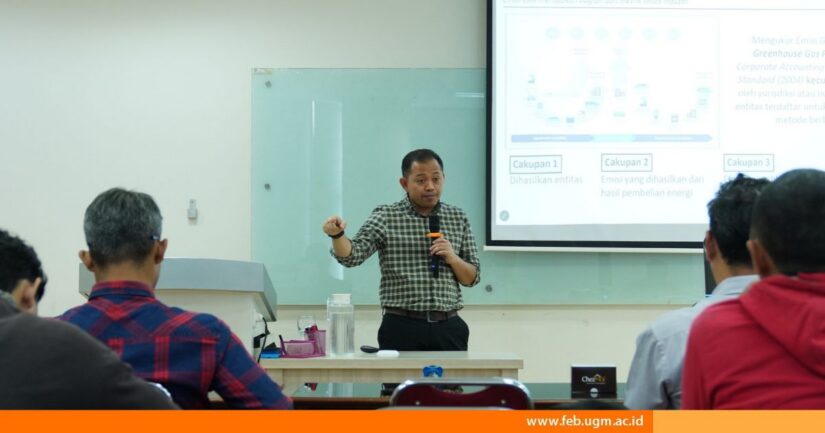
This was highlighted by Ahmad Zaki, S.E., M.Acc., Ph.D., a lecturer at the Department of Accounting, Faculty of Economics and Business, Universitas Gadjah Mada (FEB UGM), during an Economic and Business Journalism session titled “Understanding PSPK 1 and PSPK 2: New Sustainability Disclosure Standards,” recently held at FEB UGM. He discussed the development of Sustainability Disclosure Standards (SPK) in Indonesia and explained the differences in focus between the two standards.
According to Zaki, sustainability disclosure can be viewed from two perspectives: inside-out and outside-in. The inside-out perspective focuses on the impacts of a company’s activities on the economy, environment, and society. Meanwhile, the outside-in perspective looks at how sustainability challenges, such as climate change, can affect a company’s cash flows and access to capital.
These two perspectives come together in the concept of double materiality. This concept assesses sustainability from two sides: the company’s impacts on the environment and society, and the impacts of sustainability issues on the company’s financial condition. Information is considered material when its omission could reasonably be expected to influence the decisions of primary users of general-purpose financial reports.
Based on this framework, PSPK 1 is designed to provide information on sustainability-related risks and opportunities that is useful to primary users of financial reports. The standard is built around four pillars: governance, strategy, risk management, and metrics and targets.
Under the governance pillar, entities are required to disclose the processes used to monitor, manage, and oversee sustainability-related risks and opportunities. The strategy pillar covers how entities manage these risks and opportunities, including their effects on business models and value chains, strategy and decision-making, and financial position and performance.
Zaki emphasized that sustainability disclosures should demonstrate the relationship between sustainability-related risks and opportunities and a company’s financial performance. This includes the connections among the disclosure pillars, as well as the relationships between different sustainability-related risks and opportunities.
Unlike PSPK 1, which covers sustainability-related risks and opportunities more broadly, PSPK 2 specifically addresses disclosures related to climate-related risks and opportunities that could reasonably be expected to affect an entity’s prospects. The risks covered by PSPK 2 include physical risks and transition risks. Physical risks may arise from climate-related events as well as long-term changes in climate patterns. Meanwhile, transition risks arise from efforts to shift toward a low-carbon economy.
Zaki further explained that one important aspect of PSPK 2 is the disclosure of greenhouse gas (GHG) emissions across three scopes. Scope 1 covers emissions generated directly by an entity, Scope 2 covers emissions from purchased energy, and Scope 3 covers emissions generated by other parties as a result of the use of the entity’s assets. Measurement is based on the Greenhouse Gas Protocol: A Corporate Accounting and Reporting Standard.
Additional disclosure requirements apply to entities engaged in financial activities such as asset management, commercial banking, and insurance. These requirements relate to potential credit risks arising from financing clients vulnerable to climate-related risks.
Zaki also noted that sustainability principles are increasingly being applied in higher education. The Faculty of Economics and Business, Universitas Gadjah Mada (FEB UGM), is committed to becoming a sustainable campus by integrating these principles into its operations, research, and academic programs.
Through the Sustainability and Strategic Initiative Unit (SSIU), FEB UGM develops a sustainability framework using a value chain approach and three main pillars of higher education. SSIU also plays a role in reporting the faculty’s sustainability performance through an annual sustainability report.
The report covers various indicators, ranging from student wellness, student lifecycle, and the academic environment to sustainability-focused research and community engagement, as well as waste management, energy consumption, and transportation.
Report: Dwi Zhafirah Meiliani
Editor: Kurnia Ekaptiningrum
Sustainable Development Goals