One year after presenting seven economic emergency demands, the Indonesian Economists Alliance (AEI) has once again evaluated developments in national economic policy. The evaluation highlights several issues that still require attention, ranging from budget allocation, institutional independence, and state dominance in the economy to social protection and the management of natural resources.
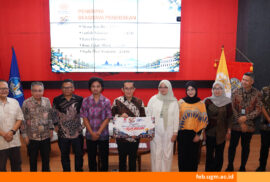
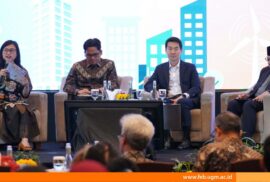
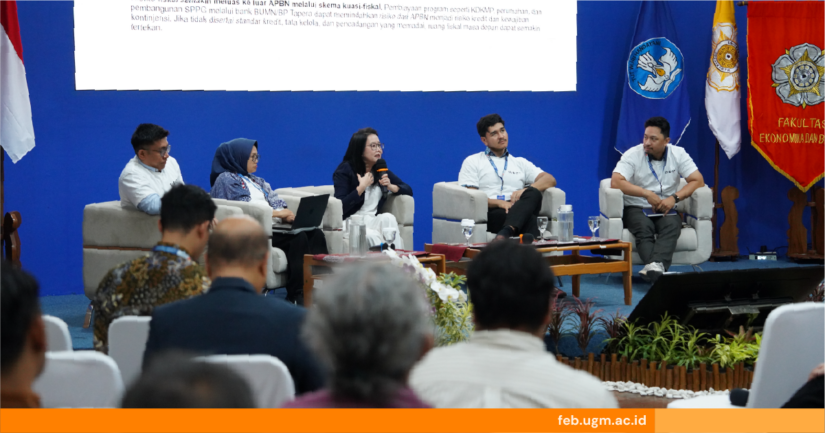
The evaluation was presented during the ” 1-Year Public Discussion on the 7 Urgent Economic Demands (7DDE),” organized by the AEI in collaboration with the Faculty of Economics and Business at Gadjah Mada University (FEB UGM) on Friday, September 25. The discussion served as a forum to review the progress of the seven demands previously presented by the AEI to government officials and to address future economic policy challenges.
Jahen F. Rezki, an economist from FEB UI, noted that policy developments over the past year indicate a trend toward ” Omni-Dominance” or a ” Command Economy. This is characterized by the consolidation of the government’s role and the expanding involvement of state and quasi-fiscal entities in economic activities
“The consolidation of executive power and the involvement of state and quasi-fiscal entities in the market, ranging from Danantara and state-owned export enterprises (DSI) to the centralized operations of KDKMP—have distorted resource allocation and triggered a crowding-out effect on the private sector and MSMEs,” he said.
Jahen stated that the direction of economic policy is deteriorating and trending in a regressive direction relative to the 2025 baseline. There has been a systemic dismantling of checks and balances, a weakening of the independence of key institutions, an erosion of fiscal discipline due to massive populist programs, and a re-centralization that is eroding local fiscal capacity and public services.
An evaluation of economic policy developments following AEI’s presentation of seven urgent economic demands in September 2025 was discussed across four clusters: fiscal aspects, institutions, the business climate, and social protection, as well as ecological impacts and legal justice.
Teuku Riefky from LPEM FEB UI presented an evaluation regarding fiscal policy and technocracy. AEI urges the government to correct budget misallocations. This is because no substantive fiscal rebalancing has yet taken place. Large-scale priority programs, particularly the MBG, continue to absorb a significant portion of fiscal space, while education, health, regional capacity, and risk mitigation needs face increasingly higher opportunity costs. The success of the MBG program is still largely measured by the number of kitchens and beneficiaries, while evaluations of cost-effectiveness, nutritional quality, actual impact, and relative benefits compared to alternative budget uses remain limited.
“The Constitutional Court’s ruling separating the MBG from mandatory education spending starting in 2028 is an important correction,” he explained.
In addition, Teuku Riefky explained that TKD has not yet recovered, and the trend toward fiscal centralization is strengthening. TKD is projected to decline from Rp919.9 trillion in the 2025 State Budget to Rp693 trillion in 2026; the proposed Rp735 trillion for 2027 represents only a partial recovery. Meanwhile, the fiscal buffer for disasters and shocks remains inadequate. Disaster reserves of around Rp5 trillion per year fall far short of the estimated recovery needs of approximately Rp22 trillion. Fiscal risks are also increasingly spreading beyond the State Budget through quasi-fiscal schemes. The financing of programs such as KDKMP, housing, and SPPG development through state-owned banks and BP Tapera can shift risks from the State Budget to credit risks and contingent liabilities.
Mervin Goklas, an economist from LPEM FEB UI, discussed the second cluster regarding institutions and markets. AEI observes a de facto erosion of institutional independence. Bank Indonesia’s independence has declined from 0.84 (2013–2022) to 0.76 (2023).
Another issue is that BPS data is not aligned with real-world indicators. Investment has shifted toward state-owned enterprises (SOEs) and quasi-fiscal entities. Consequently, government financing has become increasingly centralized.
“The appointment of strategic officials and state-owned enterprise executives is increasingly dominated by cronyism, political dynasties, and the militarization of civilian affairs,” he added.
Titik Anas, an economist from the Faculty of Economics and Business at Padjadjaran University, presented the third cluster on the business climate and social protection. The discussion highlighted TKDN reforms but was overshadowed by DSI’sDSI’sDSI’sDSI’s control of export channels and the threat of predatory behavior by KDKMP/MBG toward local MSMEs. The social protection budget and the integration of the National Single Social and Economic Database (DTSEN) show progress. However, social assistance remains static and is not yet adaptive to shocks such as mass layoffs, hydrometeorological disasters, and El Niño.
“KDKMP and MBG are displacing local businesses. The social protection budget is robust, but social assistance is static and reactive. Meanwhile, the new JKP program functions only as a temporary income replacement and has not yet facilitated reskilling and job matching, nor has it reached the millions of informal workers who are most vulnerable to shocks,” he explained.
Meanwhile, Ega Kurnia Yazid, a GRIPS PhD candidate, presented the fourth cluster’s discussion on systemic impacts, ecological crises, and legal justice. State dominance without technocratic oversight has resulted in a 66% surge in national deforestation, rampant agrarian conflicts, a surge in disasters caused by land-use conversion, and the erosion of legal standards. Excessive extractivism has been shown to erode the country’s real wealth (as reflected in negative Adjusted Net Savings) even as nominal GDP growth figures mask it.
AEI has made several strategic recommendations, namely urging the government to strengthen fiscal discipline by limiting quasi-fiscal interventions through state-owned enterprises and the banking sector, as well as conducting a spending review of mandated programs and projects. AEI also calls on the government to maintain a level playing field for businesses by evaluating state-owned entities’ control over supply chains and their expansion, which could potentially squeeze local businesses and SMEs.
At the regional level, AEI recommends restoring Regional Transfer (TKD) allocations to strengthen fiscal capacity and public services. AEI also advocates protecting the education budget and separating the MBG budget from the 20 percent mandatory education spending, in accordance with the Constitutional Court’s ruling.
Gumilang Arya Sahadewo, Ph.D., Associate Dean for Research, Community Service, Collaboration, and Alumni Affairs at the Faculty of Economics and Business (FEB) UGM, expressed his appreciation for the economists’ concern regarding economic issues and public welfare. According to him, the economists’ calls are not merely a response to the situation from a year ago but part of a long-term effort to drive policy improvements.
“Thank you for the economists’ concern for the nation. These calls are not merely a reaction to events from a year ago, but represent work that needs to be done over the long term,” said Gumilang.
He noted that academics and scientists play a vital role in continuing to contribute to the policy-making process. The research and knowledge produced by universities, he said, can be part of the effort to strengthen the quality of public policy.
Reportage by: Kurnia Ekaptiningrum
Sustainable Development Goals