Digital business management has become an essential requirement for Micro, Small, and Medium Enterprises (MSMEs) amid the rapid growth of the digital economy. Changing consumer behavior and intensifying business competition require MSMEs to adopt technology to remain competitive and achieve sustainable growth.
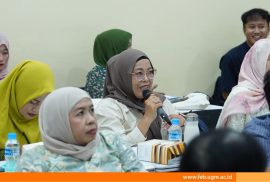
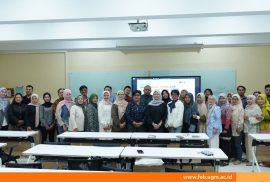
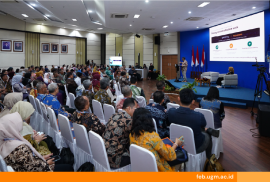
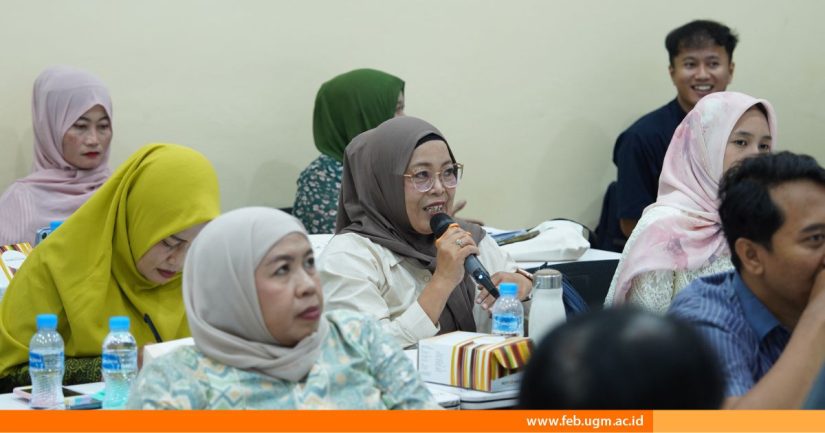
This issue was highlighted during the Implementation Training for SIDEK-ERP, held on Thursday (10/7/2026), to strengthen the Digital Accounting Ecosystem in the TEFA Collaboration with MSMEs. During the event, the Head of the Accounting Research and Development Unit at the Faculty of Economics and Business, Universitas Gadjah Mada (FEB UGM), Haryono, Drs., M.Com., Ak., CA., delivered a presentation titled “Sidek-ERP as a Digital Business Management Solution for MSMEs” to participating MSME owners.
Haryono explained that MSMEs have consistently contributed around 60 percent of Indonesia’s Gross Domestic Product (GDP) in recent years. However, this significant contribution has not yet been matched by well-organized business management practices. To provide a clearer understanding, he introduced three terms that are often used interchangeably: digitization, digitalization, and digital transformation. He described digitization as the simplest stage, involving the conversion of physical information into digital formats, such as transforming paper documents into PDF files.
Digitalization, meanwhile, refers to the use of digital technologies and data to improve business processes, for example, through cloud computing and smarter supply chain management.
Digital transformation goes a step further by fundamentally changing business activities, processes, and models through technologies such as data analytics and artificial intelligence, improving efficiency and creating new business opportunities.
According to Haryono, changing consumer behavior, intensifying market competition, the need for greater operational efficiency, and opportunities for market expansion are among the key reasons MSMEs should embrace digitalization. The benefits include broader market access, lower marketing costs, increased employment opportunities, and greater potential for export and import activities.
Nevertheless, he acknowledged that many MSMEs continue to face challenges in their digital transformation journey, including limited digital literacy, high initial investment costs, inadequate technological infrastructure, and resistance to organizational change.
To address these challenges, Haryono introduced Sidek-ERP (Sistem Debit Kredit Enterprise Resource Planning), a web-based application developed by the Information Systems Research Center (PKSI) of FEB UGM. The platform is designed to help MSMEs manage and plan their business resources through an integrated system.
Sidek-ERP enables users to analyze financial data more effectively, minimize recording errors, simplify bookkeeping processes, and generate accurate, efficient, and reliable financial reports. The application consists of five integrated modules covering accounting, finance, inventory, purchasing, and sales.
He further noted that Sidek-ERP has also been widely adopted as a learning platform across various educational levels. To date, the application has been used by more than 400 university students, 56 vocational high school students, and 264 MSME practitioners.
Haryono expressed his hope that Sidek-ERP will continue to be developed and adopted more widely by MSMEs across Indonesia, contributing to stronger accounting practices and more sustainable business growth.
Reporter: Dwi Zhafirah Meiliani
Editor: Kurnia Ekaptiningrum
Sustainable Development Goals