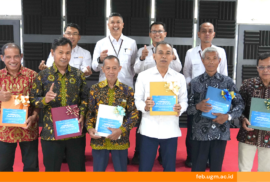

Educating communities about waste management cannot rely solely on classroom-style discussions or meetings. Hands-on learning experiences are often far more effective in encouraging lasting behavioral change. This was evident when residents of Grojogan Hamlet, Tamanan Village, Bantul Regency, learned about community-based waste management practices through jumbo biopore systems and a waste bank in RW 05, Mangkuyudan, Yogyakarta, on Saturday (July 25).
The activity was part of the Bersih, Inovatif, Sehat, Sejahtera, Asri (BISSA) Community Service Program, funded through the Community Service Grant of the Faculty of Economics and Business, Universitas Gadjah Mada (FEB UGM).
The head of the BISSA program, Qisha Quarina, S.E., M.Sc., Ph.D., explained that the focus on waste management stemmed from persistent challenges faced by communities across Yogyakarta.

“Waste management will continue to be an essential and long-term issue. If communities do not manage their waste properly, they will continue to face the same problems,” she said.
After previously carrying out a community service project in Sendowo Village by developing a more appropriate waste disposal facility that eliminated open burning, the team has now shifted its focus to managing organic waste through biopore systems while strengthening inorganic waste management through waste banks. This experience has become the foundation for developing a new partner village in Grojogan Hamlet.
“We focus on empowering communities by engaging them in learning and practical training. We hope that residents will become more independent and take the initiative to improve waste management practices within their own communities,” she added.
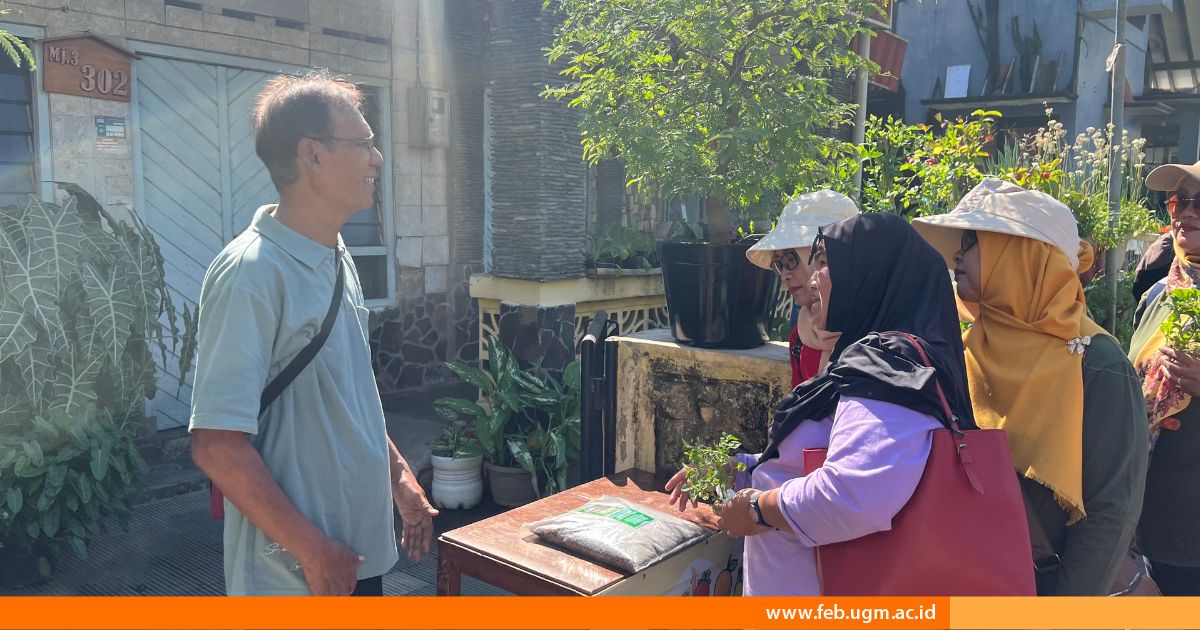
During the program, participants visited RW 05 Mangkuyudan to observe firsthand how residents manage organic waste using biopore holes installed in several households. Residents demonstrated the process by placing organic waste into the biopore holes and applying a solution made of water, agricultural EM4, and molasses. The solution accelerates fermentation and the decomposition of organic materials. The waste is periodically added to the solution and treated until it decomposes into compost that can be used as organic fertilizer.
It is hoped that Grojogan Hamlet can eventually be developed as a sister village to Mangkuyudan, which has successfully implemented community-based waste management.
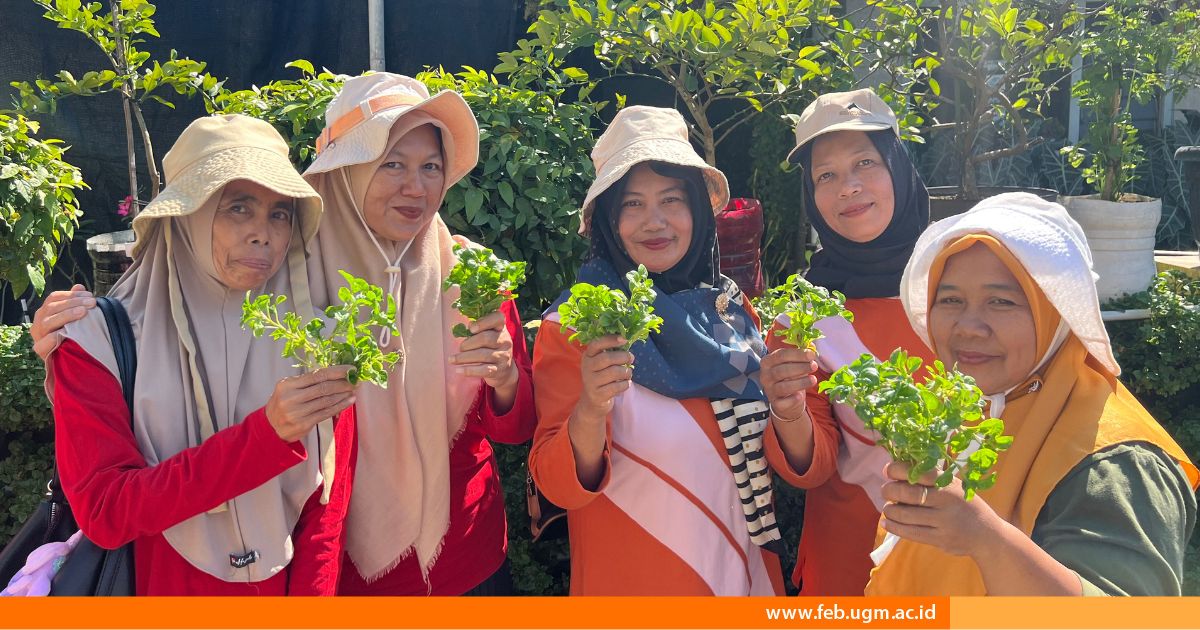
Participants also toured the neighborhood to see how residents maximize the use of front yards, alleys, and narrow pathways for vegetable cultivation using polybags and vertical planting systems attached to walls.
One of the Grojogan residents, Rini, said that she gained valuable insights that could be applied in her own community. According to her, the practice of growing vegetables in alleys and narrow spaces offers inspiration for communities with limited land.
“We usually grow vegetables directly in the ground because we still have a small amount of land. However, after seeing plants grown in polybags and mounted on walls, we were inspired because even the smallest spaces can be utilized and have the potential to increase household income,” she said.
Meanwhile, the Head of Grojogan Hamlet, Roi Hermawan, welcomed the program, saying it provided new perspectives on independent waste management, particularly for organic waste. He noted that the initiative aligns with Hamlet’s tagline, ‘Grojogan Menawan,’ which reflects the community’s aspiration to create a cleaner, greener, and more organized environment through responsible waste management.
“We will apply this knowledge in Grojogan Hamlet, especially in handling household waste. We will encourage residents to become more concerned about waste management so that organic household waste is no longer discarded but instead creates added value,” he said.
Roi Hermawan also expressed his hope that the successful practices implemented in Mangkuyudan would continue and inspire communities in other regions.
“We hope this area will continue to serve as an inspiration, as many groups have already come here to conduct benchmarking visits. Hopefully, these best practices can create a broader impact by supporting the government’s efforts to promote community-based household waste management,” he concluded.
Reporter: Shofi Hawa Anjani
Editor: Kurnia Ekaptiningrum
Sustainable Development Goals